
Recently added item(s)
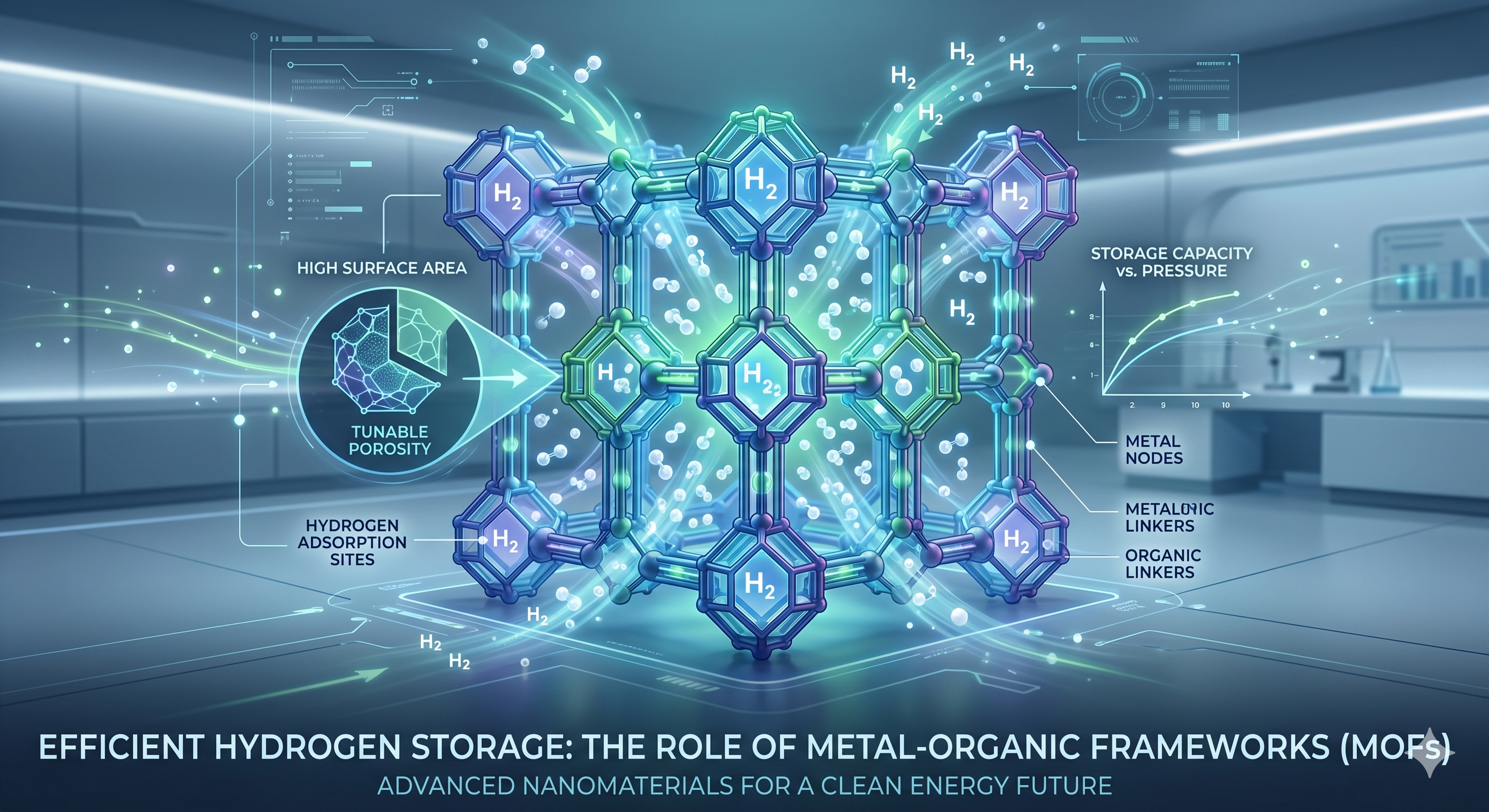
The global energy landscape is undergoing a radical transformation. As the world pushes to decouple economic growth from carbon emissions, hydrogen has emerged as a frontrunner in the race for clean energy. It is the most abundant element in the universe, possesses a high energy density by mass, and its only combustion byproduct is pure water. However, there is a significant “bottleneck” preventing the “Hydrogen Economy” from becoming a daily reality: storage.
Storing enough hydrogen to power a car for 500 kilometers or to stabilize a city’s power grid requires immense pressure or extremely low temperatures—both of which are energy-intensive and potentially hazardous. This is where nanotechnology and materials science step in. Among the most promising solutions are Metal-Organic Frameworks (MOFs). These “molecular sponges” offer a revolutionary way to pack hydrogen molecules tightly without the need for extreme conditions.
Understanding the Hydrogen Storage Dilemma
To appreciate MOFs, one must first understand why hydrogen is so difficult to handle. At room temperature and standard pressure, hydrogen is a gas with very low density. To store a practical amount of energy, you generally have two traditional options:
-
High-Pressure Compression: Compressing hydrogen gas to 700 bar (700 times atmospheric pressure). This requires heavy, expensive tanks and poses safety risks.
-
Cryogenic Liquefaction: Cooling hydrogen to -253°C. The energy required to maintain these temperatures often consumes up to 30% of the energy stored within the hydrogen itself.
Solid-state storage, where hydrogen is “held” by a material, is the third and most promising path. This is the domain of Metal-Organic Frameworks.
What are Metal-Organic Frameworks (MOFs)?
Imagine a set of Lego blocks where the “studs” are metal ions (like Zinc, Copper, or Iron) and the “bricks” are organic molecules (linkers) that connect them. When these are assembled, they form a crystalline, porous structure that looks like a 3D jungle gym on a molecular scale.
MOFs are celebrated for their extraordinary surface area. A single gram of certain MOFs can have a surface area equivalent to several football fields. This vast internal space is filled with billions of tiny pores that can act as “docking stations” for hydrogen molecules.
The Mechanism: How MOFs Store Hydrogen
MOFs primarily store hydrogen through a process called physisorption. Unlike chemical storage (where hydrogen bonds permanently to a material and requires high heat to be released), physisorption involves weak Van der Waals forces.
When hydrogen gas enters the MOF structure, the attraction between the gas molecules and the internal walls of the MOF causes the hydrogen to “stick” to the surface. This allows the molecules to be packed much more closely together than they would be in a standard gas cylinder, effectively increasing the storage density without needing astronomical pressures.
Current Research and Breakthroughs
The field of MOF research is moving at a lightning pace. Scientists are no longer just “discovering” MOFs; they are engineering them for specific performance metrics.
1. Open Metal Sites
Recent research focuses on creating “unsaturated” or “open” metal sites. By removing certain molecules from the metal nodes during synthesis, researchers leave behind “exposed” metal ions. These ions have a much stronger pull on hydrogen molecules, significantly increasing the amount of hydrogen the MOF can hold at higher temperatures (closer to room temperature).
2. Specialized MOF Variants: MOF-5, Ni-MOF, and Nu-1000
-
MOF-5: One of the earliest and most studied frameworks, serving as a benchmark for capacity.
-
Ni-MOF-74: Known for its high density of open nickel sites, showing great promise for capturing hydrogen at lower pressures.
-
NU-1000: Developed at Northwestern University, this zirconium-based MOF is incredibly stable and has shown high efficiency in repeated “charge and discharge” cycles.
3. AI and Machine Learning in MOF Discovery
One of the most exciting current trends is the use of Artificial Intelligence. There are millions of possible combinations of metals and organic linkers. Using AI, researchers can now run “digital simulations” to predict which MOF structures will be the most efficient before ever stepping into a lab. This has accelerated the discovery of materials that can operate at 100 bar instead of 700 bar.
From Lab to Industry: Real-World Testing and “Clinical” Validation
While “clinical trials” is a term usually reserved for medicine, the materials science equivalent involves industrial pilot programs and in-situ performance testing.
-
Automotive Integration: Several automotive manufacturers are testing MOF-lined fuel tanks. These tanks can potentially store the same amount of hydrogen as a standard 700-bar tank but at much lower pressures (around 100-200 bar), making the vehicles lighter, safer, and cheaper to manufacture.
-
Stationary Storage: In energy grids, MOFs are being tested for “peak shaving.” During times of high solar or wind production, excess energy is used to produce hydrogen, which is then stored in large MOF containers and released when demand spikes.
-
Stability Trials: Long-term studies are currently observing how MOFs behave after 1,000+ cycles of filling and emptying. Early results indicate that high-quality zirconium and aluminum-based MOFs maintain their structural integrity remarkably well.
Advantage vs. Risk: A Detailed Evaluation
As with any disruptive technology, MOFs come with a set of trade-offs that must be managed.
Advantages
-
High Gravimetric Capacity: They are incredibly light, which is vital for transport applications (drones, trucks, planes).
-
Tunability: We can change the pore size and chemical affinity of a MOF to suit different types of hydrogen (e.g., green hydrogen vs. blue hydrogen).
-
Low-Pressure Operation: Reducing the storage pressure from 700 bar to 100 bar drastically reduces the energy cost of compression and simplifies the design of storage tanks.
-
Fast Kinetics: MOFs can be “refueled” very quickly compared to other solid-state materials like metal hydrides.
Risks and Challenges
-
Moisture Sensitivity: Many early-generation MOFs are “hydrophobic” or easily destroyed by humidity. If the hydrogen gas isn’t perfectly pure or if there is a leak, the MOF structure can collapse.
-
Thermal Management: When hydrogen “sticks” to the MOF, it releases a small amount of heat (adsorption enthalpy). Managing this heat during rapid refueling is a significant engineering challenge.
-
Cost of Production: Synthesizing high-quality organic linkers can be expensive. For MOFs to be commercially viable, we need large-scale, “green” synthesis methods that don’t rely on toxic solvents.
-
Volumetric Density: While MOFs are great at holding a lot of hydrogen per kilogram, they sometimes take up more physical space than liquid hydrogen.
The Road Ahead: 2026 and Beyond
We are moving away from the “discovery phase” and entering the “optimization phase” of MOF technology. The focus for 2026 is on Hybrid Storage Systems. Researchers are combining MOFs with other materials, such as graphene or carbon nanotubes, to create “scaffolds” that are more durable and have even higher thermal conductivity.
Furthermore, the “Strategic Materials” movement is pushing for MOFs made from abundant, non-toxic metals like Iron and Aluminum, moving away from rarer elements to ensure that the hydrogen revolution is truly sustainable and scalable.
Conclusion
Metal-Organic Frameworks represent one of the most sophisticated examples of “atomic-scale engineering.” By providing a safe, efficient, and tunable way to store hydrogen, they are solving the most difficult puzzle in the transition to clean energy. While challenges regarding moisture stability and production costs remain, the rapid integration of AI in material discovery and the success of early industrial pilots suggest that MOFs will be the “fuel tanks of the future.”
The shift from fossil fuels to hydrogen isn’t just about changing our energy source; it’s about changing how we interact with matter. Through the porous corridors of MOFs, we are finding a clearer path toward a carbon-neutral world.