
Recently added item(s)
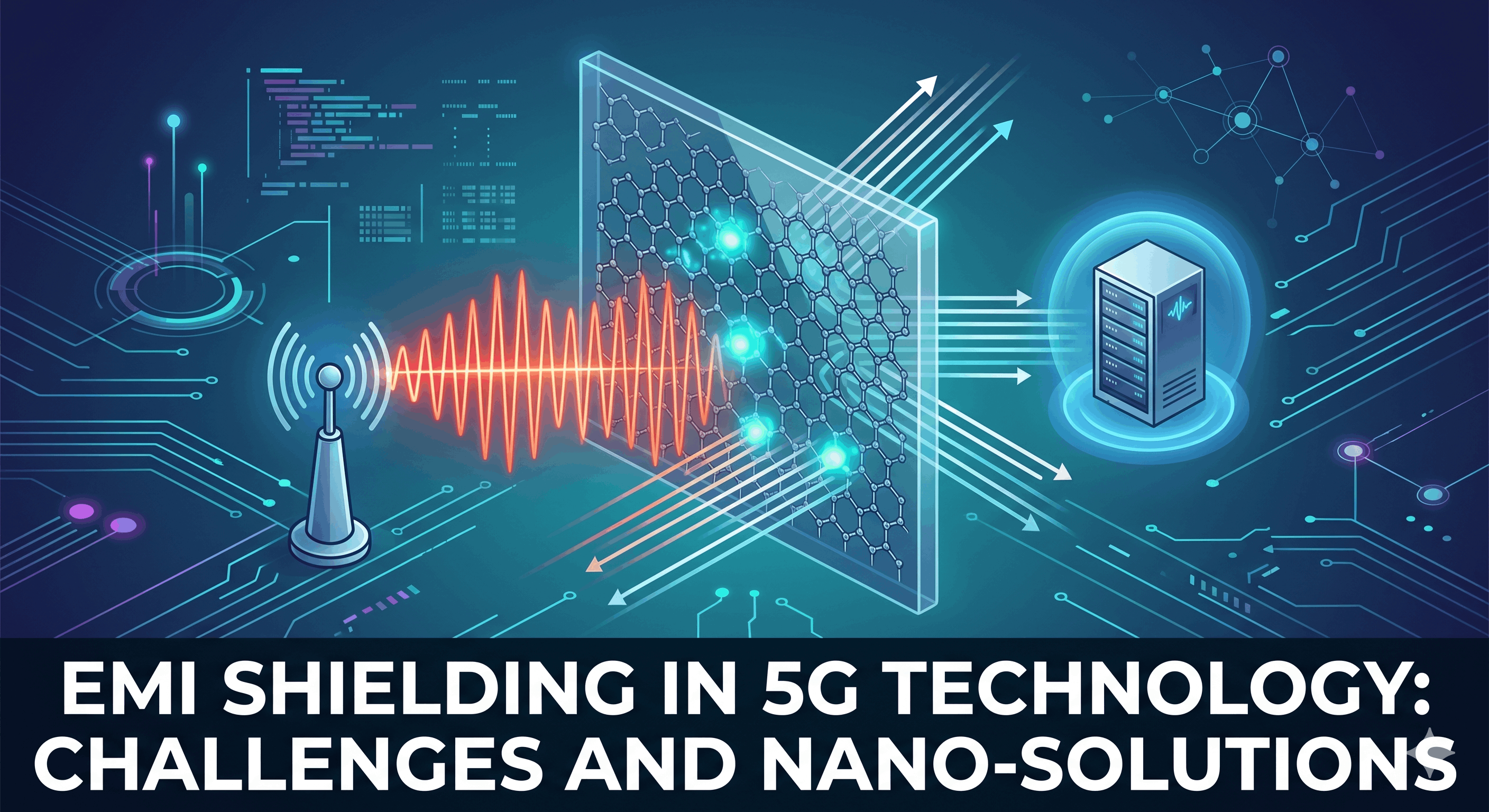
The digital world is currently undergoing a massive transformation. We are moving from a world where “some things” are connected to a reality where “everything” is connected. 5G technology is the central nervous system of this revolution, promising speeds up to 100 times faster than 4G and latencies so low they are almost imperceptible. However, this invisible leap forward comes with a hidden, technical price tag: a chaotic environment of electromagnetic interference (EMI).
As we pack more antennas, processors, and sensors into smaller devices, these components begin to “shout” over one another. This is where EMI shielding comes in—and where traditional materials are failing. To solve the 5G interference crisis, scientists are looking at the smallest structures imaginable: nanomaterials.
1. The Invisible Traffic Jam: What is EMI?
Electromagnetic Interference (EMI) is the disruption of an electronic device’s operation caused by an external electromagnetic field. Think of it like trying to have a private conversation in a crowded, noisy stadium. If everyone is shouting at the same volume, you can’t hear the person next to you. In the world of electronics, this “noise” can cause dropped calls, slow data speeds, or even the total failure of critical systems like medical devices or autonomous vehicle sensors.
5G operates across two main frequency ranges:
-
FR1 (Sub-6 GHz): Similar to existing 4G bands but more crowded.
-
FR2 (mmWave): High-frequency bands between 24 GHz and 100 GHz.
The jump to millimeter-wave (mmWave) frequencies is where the trouble starts. These waves are incredibly short and carry vast amounts of data, but they are also very sensitive. They can be blocked by a hand, a wall, or even rain. More importantly, they generate significant “noise” within the device itself.
2. Why 5G Changes the Rules of Shielding
For decades, the gold standard for shielding was simple: metal. Copper or aluminum foils were wrapped around components to reflect incoming signals away. But 5G has rendered these “old-school” methods obsolete for three main reasons:
The Skin Effect
As frequency increases, electricity tends to flow only on the very outer surface of a conductor. This is known as the skin effect. At 5G mmWave frequencies, the “skin depth” is incredibly thin (often less than a micrometer). Thick metal plates become dead weight because only their surface is doing the work.
Device Miniaturization
We want our phones thinner and our wearables lighter. Heavy metal shields take up precious space that could be used for batteries or better cameras.
Thermal Management
High-frequency 5G components generate intense heat. Traditional metal shields often trap this heat, leading to “thermal throttling”—where your phone slows down because it’s getting too hot. We need materials that can block interference and move heat away simultaneously.
3. The Nano-Revolution: Solutions at the Atomic Scale
To meet the demands of 5G, researchers are turning to nanomaterials. These are materials engineered at the scale of atoms and molecules, offering properties that simply don’t exist in the bulk world.
Graphene and Carbon Nanotubes (CNTs)
Graphene, a single layer of carbon atoms arranged in a honeycomb lattice, is a “super-material.” It is 200 times stronger than steel, lighter than paper, and an incredible conductor of both electricity and heat.
-
The Benefit: Graphene-based shields are ultra-thin and flexible. Unlike metals, which mostly reflect interference (sending the “noise” elsewhere inside the device), graphene can absorb electromagnetic waves, turning them into harmless heat.
MXenes: The Rising Stars
Discovered relatively recently, MXenes (pronounced “max-enes”) are two-dimensional inorganic compounds consisting of thin layers of transition metal carbides.
-
The Performance: In recent scientific trials, MXenes have shown the highest EMI shielding effectiveness of any synthetic material at comparable thicknesses. A coating of MXene just a few micrometers thick can block over 99.99% of interference, making it the “holy grail” for 5G hardware.
Silver and Nickel Nanoparticles
By embedding silver or nickel nanoparticles into polymers or inks, manufacturers can “print” shields directly onto circuit boards. This allows for complex, 3D-shaped shields that fit perfectly around tiny components, saving massive amounts of space.
4. Current Research and Scientific Breakthroughs
The field of nano-shielding is moving at breakneck speed. Here are three areas where current research is breaking new ground:
A. Hybrid Composites
No single nanomaterial is perfect. Researchers are now creating “hybrid cocktails.” For example, combining Carbon Nanotubes (which provide a conductive network) with Graphene (which provides surface area) creates a shield that is far more effective than either material alone. Recent studies in Advanced Functional Materials have demonstrated that these hybrids can achieve high shielding efficiency even at 60 GHz.
B. 3D-Printed Shields
Using specialized “nano-inks,” engineers are now 3D printing EMI shields. This allows for the creation of “lattice” structures. These tiny, cage-like structures are designed to trap electromagnetic waves in a “maze,” forcing them to bounce around until their energy is fully absorbed.
C. Self-Healing Coatings
One major challenge with nanomaterials is durability. If a shield cracks, interference leaks in. New research into “self-healing” nano-polymers allows the shielding layer to repair itself at the molecular level if it is scratched or bent, ensuring the long-term safety of the device.
5. Clinical and Environmental Considerations
When we talk about “5G and Health,” the conversation usually revolves around whether the signals are safe for humans. While international bodies like the ICNIRP maintain that 5G is safe within established limits, EMI shielding is actually a health-positive technology.
Reducing “Electrosmog”
By effectively containing signals within a device, nano-shielding reduces the amount of “stray” radiation emitted into the environment. Clinical research into bio-electromagnetics focuses on how we can minimize human exposure to localized electromagnetic fields. Advanced nano-solutions ensure that the energy stays where it belongs: in the antenna, not in your hand or head.
The Biocompatibility Challenge
A critical part of current clinical research is ensuring that these nanomaterials themselves are safe. If a wearable device uses graphene, we must ensure it doesn’t cause skin irritation or enter the bloodstream. Studies are ongoing to determine the long-term biological impact of carbon-based nanomaterials to ensure they are as “green” and safe as they are effective.
6. Advantage–Risk Assessment
Every technological leap involves a trade-off. Here is how nano-solutions for EMI shielding stack up:
Advantages
-
Weight & Space: Up to 90% lighter than traditional metal shielding.
-
Performance: Exceptional absorption capabilities at high mmWave frequencies.
-
Multi-functionality: Many nanomaterials (like Graphene) act as both an EMI shield and a high-efficiency heat sink.
-
Flexibility: Essential for the next generation of foldable phones and smart clothing.
Risks and Challenges
-
Cost: Synthesizing high-purity MXenes or Graphene is currently much more expensive than stamping out aluminum foil.
-
Oxidation: Some nanomaterials, particularly certain MXenes, can degrade or “rust” when exposed to air and moisture over long periods.
-
Manufacturing Scale: Transitioning from a laboratory “gram-scale” to a factory “ton-scale” remains a significant hurdle for the chemical industry.
7. Conclusion: The Path Forward
The success of 5G—and the 6G technology already on the horizon—depends on our ability to manage the electromagnetic chaos. We can no longer rely on the bulky, heavy materials of the 20th century to solve 21st-century problems.
Nanotechnology offers a path toward devices that are faster, cooler, and safer. While the challenges of cost and mass production remain, the shift toward carbon-based and 2D-material solutions is inevitable. As we move closer to a fully connected world, it is the smallest particles that will be doing the heaviest lifting.