Recently added item(s)
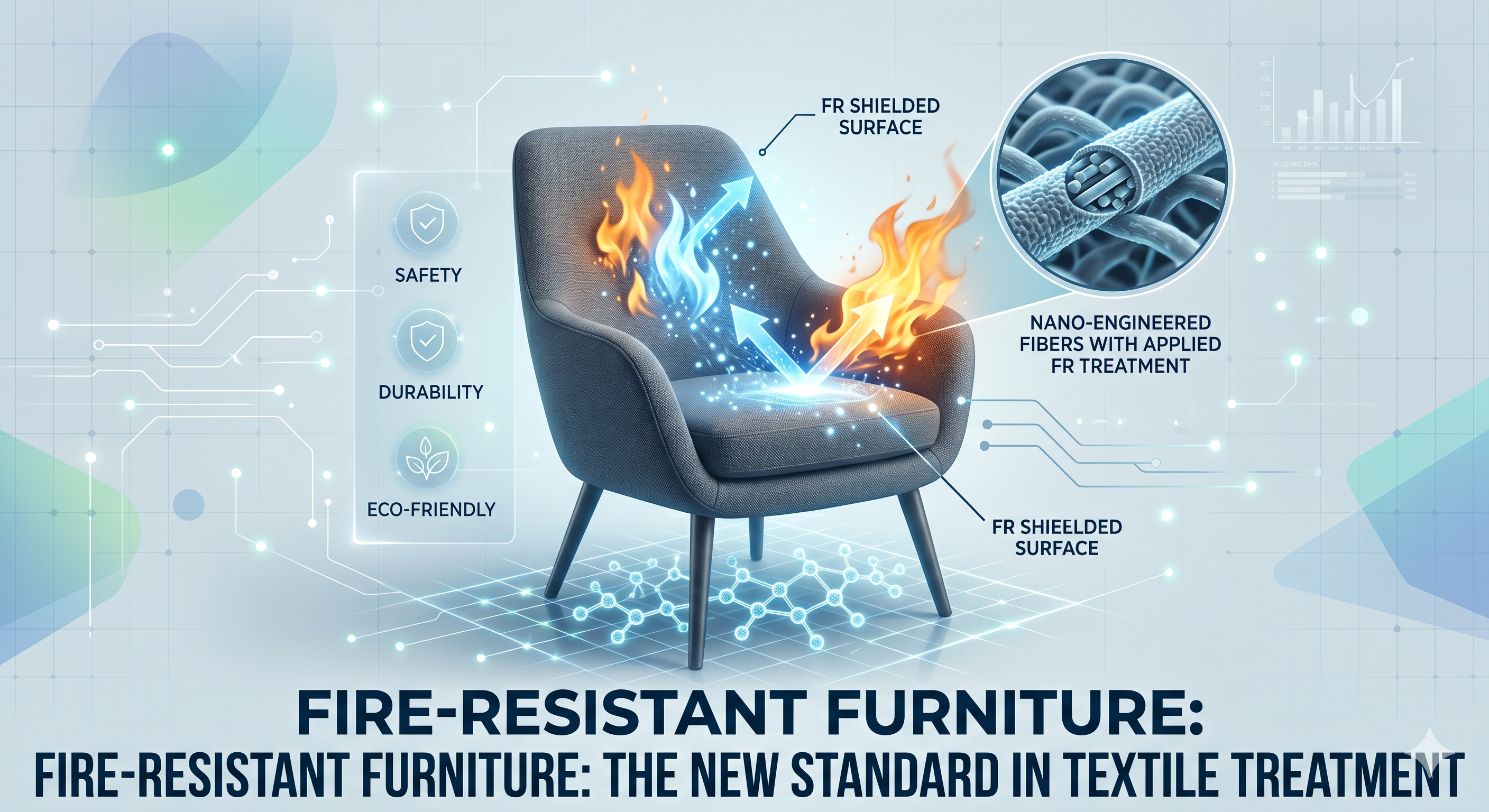
We’ve all been there: scrolling through interior design feeds, admiring that perfect velvet sectional or minimalist linen armchair. In the past, our primary concerns were comfort, color, and whether the cat would shred the upholstery. But as we move through 2026, a new priority has taken center stage in the global furniture market: Safety through Science.
Modern homes are essentially “high-fuel” environments. Between the synthetic foams in our cushions and the sheer density of electronics in our living rooms, the speed at which a fire can consume a room has accelerated significantly over the last few decades. This reality has birthed a new standard in Fire-Retardant (FR) Textile Treatments—a field that has recently pivoted from “toxic necessity” to “green innovation.”
1. The Modern Living Room: A High-Fuel Environment
To understand why textile treatment is the “new standard,” we have to look at how our homes have changed. In the 1970s, a typical living room was filled with natural materials: wood, cotton, and wool. If a fire started, you had roughly 17 to 20 minutes to escape.
Today, the average sofa is a block of polyurethane foam wrapped in synthetic polyester. These materials are essentially “solid gasoline.” In a modern home, the “flashover” point—where everything in the room ignites—can occur in less than 3 minutes. This drastic reduction in escape time is why advanced fire-resistant treatments are no longer optional extras; they are fundamental components of architectural and interior design.
2. The Chemistry of Defense: How Fire Retardants Work
Fire isn’t just one thing; it’s a chemical chain reaction. To stop it, textile treatments use one of four primary “modes of action” at the molecular level:
-
The Gas Phase (The “Fire Snuffer”): When heated, these chemicals release non-flammable gases (like nitrogen or water vapor) that dilute the oxygen around the fabric, effectively starving the flame.
-
The Char Formation (The “Shield”): This is common in modern phosphorus-based treatments. The chemical causes the fabric to form a carbonaceous “char” layer upon contact with heat. This crust acts as a thermal barrier, protecting the flammable foam inside.
-
Endothermic Cooling (The “Heat Sink”): Certain treatments trigger a chemical reaction that absorbs massive amounts of heat, cooling the fabric surface below its ignition point.
-
Dilution: The treatment releases inert substances that separate the fuel (the fabric) from the heat source.
3. The Ghost of Chemistries Past: The Risk Assessment
For years, the “risk” side of the fire-retardant equation was dominated by Halogenated Flame Retardants (HFRs) and PBDEs. While these were effective at stopping fires, they came with a heavy price:
-
Bioaccumulation: They didn’t break down, eventually ending up in house dust, our bloodstreams, and the environment.
-
Endocrine Disruption: Clinical studies from the early 2020s linked legacy FRs to thyroid issues and developmental delays in children.
-
Toxic Smoke: ironically, while they prevented the spread of fire, when they did burn, they released highly toxic halogenated gases that were often more dangerous than the fire itself.
The 2026 Perspective: These “forever chemicals” are rapidly being phased out in favor of “Green Chemistry.”
4. The 2026 Breakthrough: “Layer-by-Layer” (LbL) Nanocoatings
The most exciting research in 2025 and 2026 involves Layer-by-Layer (LbL) Assembly. Instead of soaking a fabric in a vat of harsh chemicals, scientists are now “printing” nanometer-thin layers of benign materials—like clay, chitosan (derived from shrimp shells), or DNA—directly onto the fibers.
These nanocoatings are invisible, don’t change the “hand” (feel) of the fabric, and are incredibly effective. A 2025 study published in Advanced Materials showed that LbL-treated cotton could withstand a direct blowtorch flame for 60 seconds without the fire spreading to the underlying foam. Because these layers are physically bonded to the fiber, they don’t “off-gas” or wash out over time.
5. Advantage–Risk Assessment: The Balanced View
In 2026, the industry uses a rigorous “Safety vs. Sustainability” matrix to evaluate new treatments.
The Advantages
-
Increased Escape Time: The primary goal is saving lives. Modern treatments can provide the extra 5–10 minutes needed for a family to exit a building.
-
Insurance and Compliance: In many regions, high-occupancy residential buildings now require “Class A” fire-rated furniture for insurance eligibility.
-
Durability: New-age phosphorus-based treatments are “wash-fast,” meaning they don’t lose their protective qualities after professional steam cleaning.
-
Smoldering Resistance: Most home fires start from a dropped cigarette or an overheated laptop. Modern FR treatments are specifically designed to prevent these “smolder” events from turning into open flames.
The Risks
-
Skin Sensitization: Even with “green” chemicals, some individuals with extreme chemical sensitivities may experience contact dermatitis from certain topical treatments.
-
The “False Sense of Security”: Fire-resistant does not mean fire-proof. Homeowners may become less vigilant about smoke detectors or fire hazards because they believe their furniture is invincible.
-
End-of-Life Recycling: Fabrics treated with complex chemical cocktails can be harder to recycle back into the circular economy compared to pure, untreated natural fibers.
6. Bio-Based Alternatives: Phosphorus and Lignin
Current research is heavily focused on Lignin—a byproduct of the paper industry. Lignin is naturally char-forming. By combining lignin with Phytic Acid (found in seeds and grains), researchers have created a 100% bio-based fire retardant that rivals synthetic versions in performance.
Clinical observations in 2025 have shown that these bio-based alternatives have zero impact on indoor air quality, making them the preferred choice for hospitals, nurseries, and sustainable “wellness” homes.
7. What Consumers Should Look For in 2026
If you are currently in the market for new furniture, the “New Standard” is usually represented by specific certifications. Look for these instead of just a generic “Fire Resistant” tag:
-
OEKO-TEX® ECO PASSPORT: Ensures the fire retardants used have been tested for harmful substances.
-
Global Recycled Standard (GRS): Often indicates that the flame retardants used are compatible with circular economy recycling.
-
Halogen-Free Labels: Specifically look for “Halogen-Free” to ensure you are avoiding the legacy toxic chemicals of the past.
8. Conclusion: The Future is Smarter, Not Just Safer
The global supply chain of textiles has reached a tipping point. We are moving away from the “soak and coat” era of the 20th century into an era of Molecular Engineering. The fire-resistant furniture of 2026 is a testament to how we can solve a critical safety problem—the flammability of modern synthetics—without sacrificing our health or the planet.
As we continue to integrate more technology into our seating (think built-in wireless chargers and heated cushions), the role of these invisible fire-shields will only become more vital. The “Invisible Janitor” of the previous article cleaned our glass; the “Invisible Shield” in our sofas keeps us breathing easy.