
Recently added item(s)
In the modern world, we are surrounded by polymers. From the upholstery in our cars and the casings of our smartphones to the insulation in our walls and the massive battery packs in our electric vehicles (EVs), synthetic materials are the fabric of 21st-century life. While these materials are versatile and lightweight, they possess a dangerous hidden trait: they are essentially solid fuel. When a fire starts, these polymers ignite rapidly, releasing intense heat and toxic smoke that can turn a survivable incident into a catastrophe in seconds.
For decades, the industry relied on adding massive amounts of flame retardant (FR) chemicals to these plastics. However, these “traditional” solutions often made the materials brittle, heavy, and, in some cases, environmentally toxic.
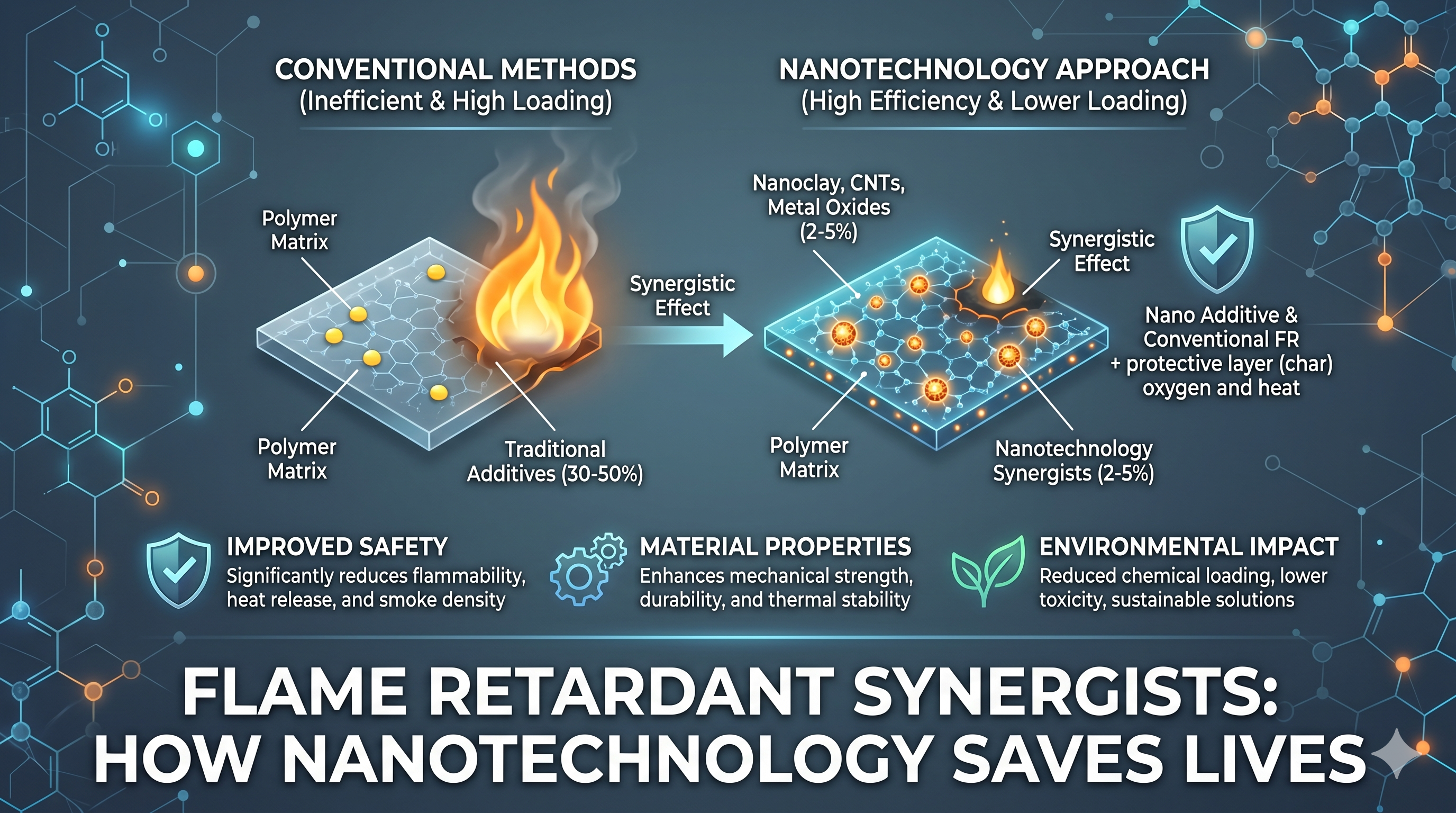
Enter the age of Flame Retardant Synergists powered by Nanotechnology. By leveraging the unique properties of matter at the nanoscale, we have discovered that “1 + 1 = 3.” When a tiny amount of nano-powder is combined with a primary flame retardant, the efficiency doesn’t just increase—it multiplies. This is how nanotechnology is quietly becoming the invisible lifesaver in our homes, factories, and vehicles.
The Power of Synergy: Why “Nano” is the Secret Ingredient
In chemistry, synergy occurs when the combined effect of two substances is greater than the sum of their individual effects. In fire safety, a synergist is a material that might not be a great flame retardant on its own but makes the primary FR much more powerful.
When we move to the nanoscale (particles smaller than 100 nanometers), the rules of engagement change. Nanoparticles have a massive surface-area-to-volume ratio. This means they can interact with the polymer chains at a molecular level, creating a defensive network that traditional “macro” powders simply cannot match. This allows manufacturers to reduce the total amount of additives by up to 50%, maintaining the material’s strength while making it virtually unignorable by flames.
The Three Shields: How Nano-Synergists Stop Fire
To understand the impact of nanotechnology, we must look at the three ways these particles defeat fire.
1. The “Char Shield” (The Condensed Phase)
The most effective way to stop a plastic from burning is to turn its surface into “armor.” When heat hits a polymer infused with nano-synergists like Nano-Zinc Borate or Layered Double Hydroxides (LDHs), it triggers a rapid chemical reaction that creates a thick, carbonaceous “char” layer.
This char acts as a thermal barrier, insulating the unburnt plastic underneath from the heat. Nanoparticles act as a “scaffold” for this char, making it stronger and preventing it from cracking or falling off.
2. The “Tortuous Path” (The Barrier Effect)
Imagine fire trying to “breathe” out toxic gases while “drinking” in oxygen. Nanoparticles like Nano-Clays (Montmorillonite) or Graphene are shaped like tiny plates. When dispersed in a plastic, they create what scientists call a “Tortuous Path.” For the volatile gases to escape the plastic and feed the fire, they must wiggle through millions of these microscopic plates. This dramatically slows down the “Heat Release Rate” (HRR), giving people vital extra minutes to escape a burning building or vehicle.
3. The “Smoke Eater” (Gas Phase Suppression)
More people die from smoke inhalation than from heat. Many nano-synergists, particularly Nano-Antimony Trioxide (ATO) and Nano-Magnesium Hydroxide, work in the gas phase. As the material heats up, they release specific molecules that “quench” the free radicals in the flame, effectively “choking” the fire at a molecular level and reducing the density of the toxic black smoke.
Applications for a Connected World
1. EV Battery Safety (Thermal Runaway)
In 2026, the primary focus of fire safety research is the Electric Vehicle. Lithium-ion batteries can enter “thermal runaway,” a chain reaction of fire that is nearly impossible to extinguish.
Current 2025-2026 research is utilizing Nano-Alumina and Carbon Nanotubes in the battery separators and casings. These nano-synergists don’t just stop the fire; they act as a heat-sink, spreading the thermal energy across the pack to prevent a single cell’s failure from igniting the entire car.
2. Aerospace and High-Speed Rail
In the confined space of an airplane or a high-speed train, fire is an absolute nightmare. Nano-synergized composites are now the standard for interior panels. These materials meet the strictest “Smoke and Toxicity” (FST) standards because nanotechnology allows for flame suppression without releasing the corrosive halogenated gases common in older materials.
3. Smart Textiles
From firefighter uniforms to hotel curtains, nanotechnology is being used to create “Intelligent Textiles.” Instead of soaking a fabric in chemicals that wash out, researchers are using Nano-Silica “sol-gel” coatings that bond to the fibers. These textiles remain soft and breathable but instantly char and self-extinguish when touched by a flame.
Recent Research & Clinical Safety Studies (2025–2026)
As we master the synthesis of these materials, the focus has shifted toward “Green Synergists” and Occupational Health.
-
Bio-Nano Synergy (2025): A landmark study published in late 2025 investigated the use of Nano-Lignin (a waste product from the paper industry) combined with phytic acid. This 100% bio-based nano-synergist achieved a “V-0” rating (the highest fire safety grade) in epoxy resins, proving that we don’t need toxic chemicals to be safe.
-
Toxicity and Leaching Trials: Clinical research is currently monitoring the “migration” of nanoparticles from consumer products. 2026 data suggests that when nanoparticles are properly “anchored” in the polymer matrix, they are significantly safer than traditional liquid flame retardants, which can leach out and enter the human bloodstream or the water supply.
-
The Pulmonary Safety of Nano-ATO: Because Antimony is a heavy metal, its nano-form is under intense clinical scrutiny. 2026 safety protocols have introduced “Masterbatch Encapsulation,” where the nano-powder is pre-mixed into plastic pellets in a closed-loop system, eliminating the risk of inhalation for factory workers.
Advantage vs. Risk Assessment
Evaluating nanotechnology in fire safety requires a balance between performance and long-term environmental impact.
The Advantages
-
Lower Loading Levels: You can achieve superior fire protection with only 2-5% nano-additive, compared to 20-30% of traditional minerals.
-
Improved Mechanical Integrity: Traditional FRs make plastic weak. Nano-synergists can actually act as reinforcements, making the plastic stronger and more heat-resistant.
-
Smoke Suppression: Nano-synergists are the best-known tools for reducing smoke density, which is the leading cause of death in fires.
-
Multifunctionality: One additive can provide fire resistance, UV protection, and even electrical conductivity (in the case of Carbon Nanotubes).
The Risks and Challenges
-
Dispersion Issues: If the nanoparticles “clump” together (agglomeration), they lose their effectiveness. Achieving a perfect “mix” requires high-end equipment like twin-screw extruders.
-
Cost: Nano-powders are more expensive per kilogram than bulk minerals. However, because you use so much less, the “cost-per-part” often breaks even.
-
Recycling Complexity: How do we recycle a plastic that is full of complex nanomaterials? In 2026, this remains a major research hurdle for the “Circular Economy.”
Synergist Comparison: Finding the Right Match
| Synergist Type | Primary Partner | Best For | Mechanism |
| Nano-Antimony (ATO) | Halogenated FR | Electronics / PVC | Gas-phase quenching |
| Nano-Zinc Borate | Phosphorus FR | EV Batteries / Cables | Char formation / Drip prevention |
| Nano-Clay (MMT) | Intumescent FR | Construction Materials | Barrier effect / Tortuous path |
| Nano-Magnesium (MDH) | Polyolefins | Eco-friendly housing | Water release / Smoke suppression |
The Future: “Active” Nanotechnology
As we look toward 2030, the frontier is “Stimuli-Responsive” Flame Retardants. Researchers are developing nanoparticles that remain dormant until they hit exactly 200°C. At that precise temperature, they “burst” open, releasing a concentrated cloud of extinguishing agents exactly where the fire is starting. This “Precision Medicine” approach to fire safety will allow us to build lighter, safer, and more sustainable structures than ever before.
Conclusion
Flame retardant synergists are the ultimate expression of how “small” science solves “big” problems. By rethinking fire safety at the molecular level, nanotechnology is allowing us to keep the conveniences of modern polymers without the deadly risks.
For entrepreneurs and materials scientists like those at Nanokar and Başoğlu Kimya, the mission is clear: to continue refining these “slick and safe” materials so that the next generation of electronics and vehicles aren’t just faster and smarter—they are fundamentally incapable of causing a tragedy. In the battle against fire, nanotechnology isn’t just an option; it is our most powerful shield.