
Recently added item(s)
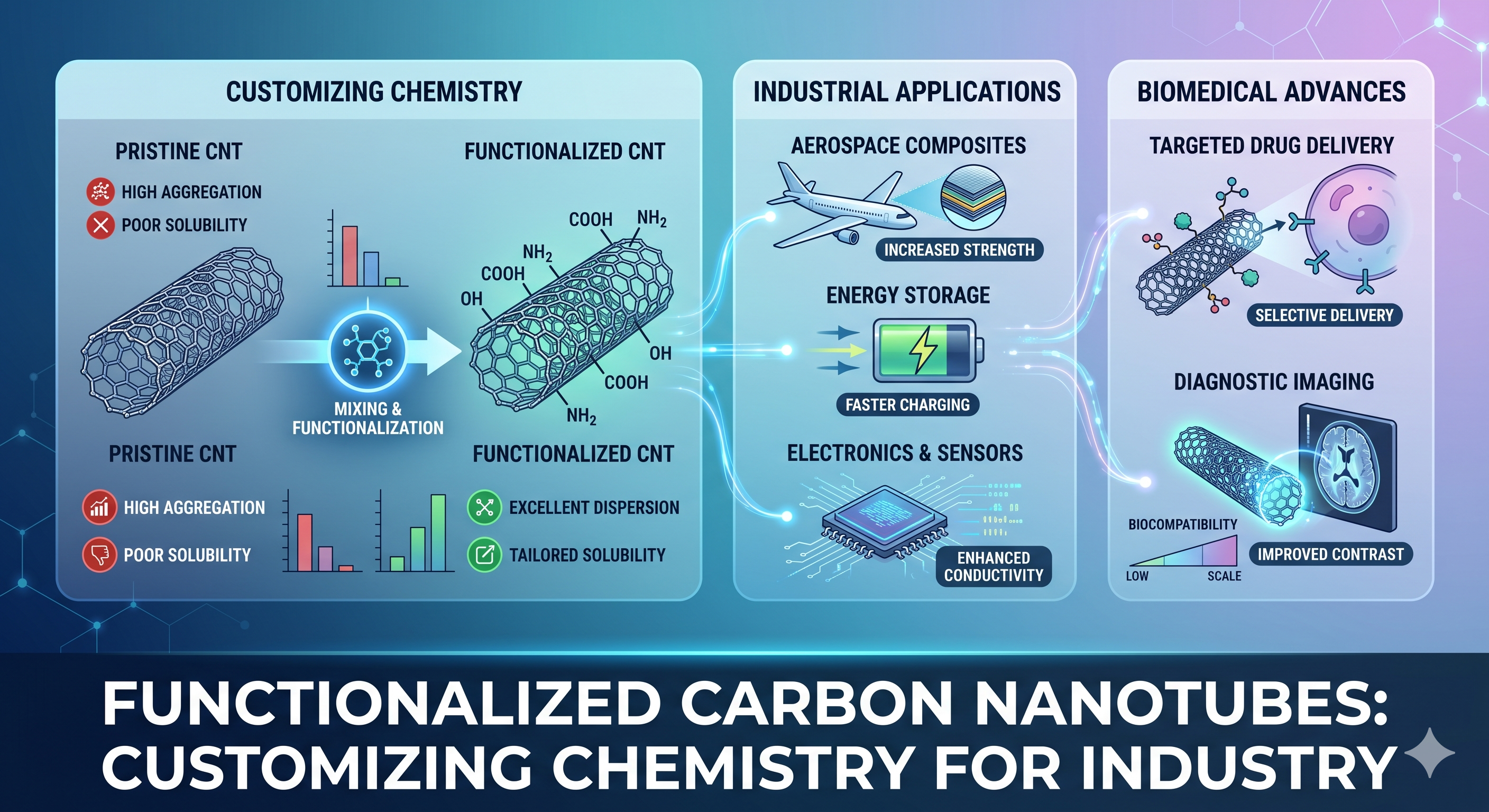
The true potential of nanotechnology often lies not in what a material can do by itself, but in how well it can “play” with others. Carbon Nanotubes (CNTs) are the perfect example. While pristine nanotubes are incredibly strong and conductive, they are also chemically “antisocial”—they tend to clump together and resist mixing with other substances.
Functionalization is the process of chemically “dressing up” these nanotubes with specific molecules to make them compatible with solvents, polymers, and even human cells. As of 2026, this customization of chemistry has become the master key unlocking billion-dollar applications across aerospace, green energy, and oncology.
1. The Chemistry of Customization: Covalent vs. Non-Covalent
To make a nanotube “industrial-ready,” scientists use two primary chemical strategies to modify its surface.
Covalent Functionalization (The Permanent Bond)
This involves creating strong, permanent chemical bonds between the nanotube’s carbon wall and a functional group (like oxygen, nitrogen, or fluorine).
-
The Benefit: It creates an incredibly strong interface, perfect for high-strength composites.
-
The Trade-off: Every bond added to the tube’s wall slightly disrupts its perfect crystal structure, which can marginally lower its electrical conductivity.
Non-Covalent Functionalization (The Molecular Wrap)
In this method, molecules like surfactants, DNA, or polymers “wrap” around the nanotube without breaking any carbon bonds.
-
The Benefit: It preserves 100% of the nanotube’s electrical and thermal properties.
-
The Trade-off: The “wrap” is less stable than a permanent bond and can sometimes slip or detach under extreme industrial conditions.
2. Aerospace and Automotive: The Quest for Perfect Bonding
In 2026, the push for lightweighting in electric vehicles (EVs) and aircraft is the primary driver for functionalized CNTs. A pristine nanotube added to a plastic wing is like a smooth needle in a haystack; it slides out easily. A functionalized nanotube, however, has “chemical hooks” that grab the surrounding plastic.
-
Interfacial Strength: By functionalizing CNTs with amino or epoxy groups, manufacturers have increased the interlaminar shear strength of aerospace composites by over 40%.
-
Smart Coatings: Multi-walled nanotubes (MWCNTs) functionalized with fluorinated groups are being used to create ice-phobic and anti-corrosive coatings for jet engines, reducing maintenance costs significantly.
3. The Medical Frontier: Targeted Oncology and Healing
The most delicate application of functionalized CNTs is in the human body. Pristine nanotubes can be toxic, but functionalization makes them biocompatible.
Clinical Studies and Drug Delivery (2025-2026)
Recent clinical data has highlighted the success of PEGylated CNTs (nanotubes coated with Polyethylene Glycol).
-
pH-Triggered Release: In 2026, pilot clinical trials demonstrated that functionalized SWCNTs could carry the anti-cancer drug 5-FU directly into tumors. Because the tumor environment is more acidic, the chemical bond on the nanotube “unhinges” only at the site of the cancer, sparing healthy tissue.
-
Wound Healing: New studies published in early 2026 show that CNTs functionalized with specific proteins can promote “bioelectrical signaling” in skin cells, accelerating the closure of chronic diabetic wounds by up to 35% compared to traditional dressings.
4. Green Energy: Customizing the Battery Anode
The EV battery market is currently shifting toward silicon anodes to increase range. However, silicon expands and cracks during charging. Functionalized CNTs are the solution.
-
Molecular Cages: Functionalizing the nanotubes with carboxyl groups allows them to bond tightly to silicon particles, creating a conductive, flexible “cage” that prevents the anode from falling apart.
-
Faster Charging: Custom-engineered nanotubes in the cathode are helping batteries reach an 80% charge in under 8 minutes by providing a more efficient “highway” for lithium ions.
5. Advantage vs. Risk Assessment
As the industry scales to produce thousands of tons of functionalized CNTs annually, the safety profile is under intense scrutiny.
Advantages
-
Solubility: They can be “dissolved” in water or oils, allowing for 3D printing and spray-painting of electronics.
-
Specific Targeting: In medicine, they can be “programmed” to find specific cells.
-
Enhanced Stability: They don’t settle or clump over time, ensuring a longer shelf-life for industrial paints and inks.
Risks and Challenges
-
Chemical Purity: Residual catalysts (like iron or nickel) used in production can interfere with the functionalization process.
-
Environmental Fate: There are concerns that functionalized CNTs might reach the environment and eventually accumulate in the food chain. Research projects like DECANO (2026) are currently investigating how bacteria might be used to safely degrade these materials.
-
Complexity of Production: Customizing the chemistry adds an extra step (and cost) compared to using raw nanotubes.
6. The “Smart” Future: Sensing and Self-Repair
The next frontier for functionalized CNTs is stimuli-responsive materials. Imagine a bridge where the nanotubes are functionalized to react to the presence of rust. If the bridge begins to corrode, the chemical groups on the nanotubes trigger a color change or send an electrical signal to a central monitoring station.
In the automotive sector, self-healing coatings are already being tested, where functionalized nanotubes “unzip” to release a healing agent when a scratch is detected on a car’s surface.
7. Conclusion: Engineering the Interface
The “Carbon Revolution” is no longer just about the nanotube itself; it is about the interface. By mastering the art of functionalization, we have turned a simple cylinder of carbon into a versatile, programmable tool. Whether it is helping a drug find a cancer cell, a battery charge in minutes, or a spacecraft withstand the vacuum of space, customized chemistry is what makes the impossible possible.
As we look toward 2030, the ability to “dial in” the exact chemical properties of a material at the molecular level will be the defining characteristic of the high-tech industry.