
Recently added item(s)
If you have ever taken a rapid COVID-19 test or a pregnancy test, you have likely stared intently at a small white plastic device waiting for a red line to appear. That red line is not just a chemical reaction; it is a masterpiece of nanotechnology. The vivid color you see is actually caused by millions of Gold Nanoparticles (AuNPs) clustered together.
Lateral Flow Assays (LFAs) have become the most ubiquitous diagnostic tool in the world, providing decentralized, rapid testing that requires no laboratory equipment. At the heart of this “lab-on-a-strip” technology is gold—not in its shiny, bulk form, but as microscopic spheres so small that they interact with light in extraordinary ways. This article explores how gold nanoparticles power our diagnostics, the latest research in the field, and why they remain the gold standard for rapid testing.
2. The Physics of Color: Surface Plasmon Resonance
Why is the line red if the particles are made of gold? This is due to a phenomenon called Surface Plasmon Resonance (SPR).
At the nanoscale (typically 20 to 40 nanometers for diagnostics), the electrons on the surface of a gold particle oscillate when hit by light. For gold spheres of this size, they absorb green and blue light and reflect a deep, vibrant red. This optical property is incredibly sensitive. If the particles get slightly closer together or if their surface environment changes, the color can shift to purple or blue. This intense coloration allows us to see the presence of a virus with the naked eye, even when the actual amount of viral protein is extremely small.
3. Anatomy of a Lateral Flow Assay
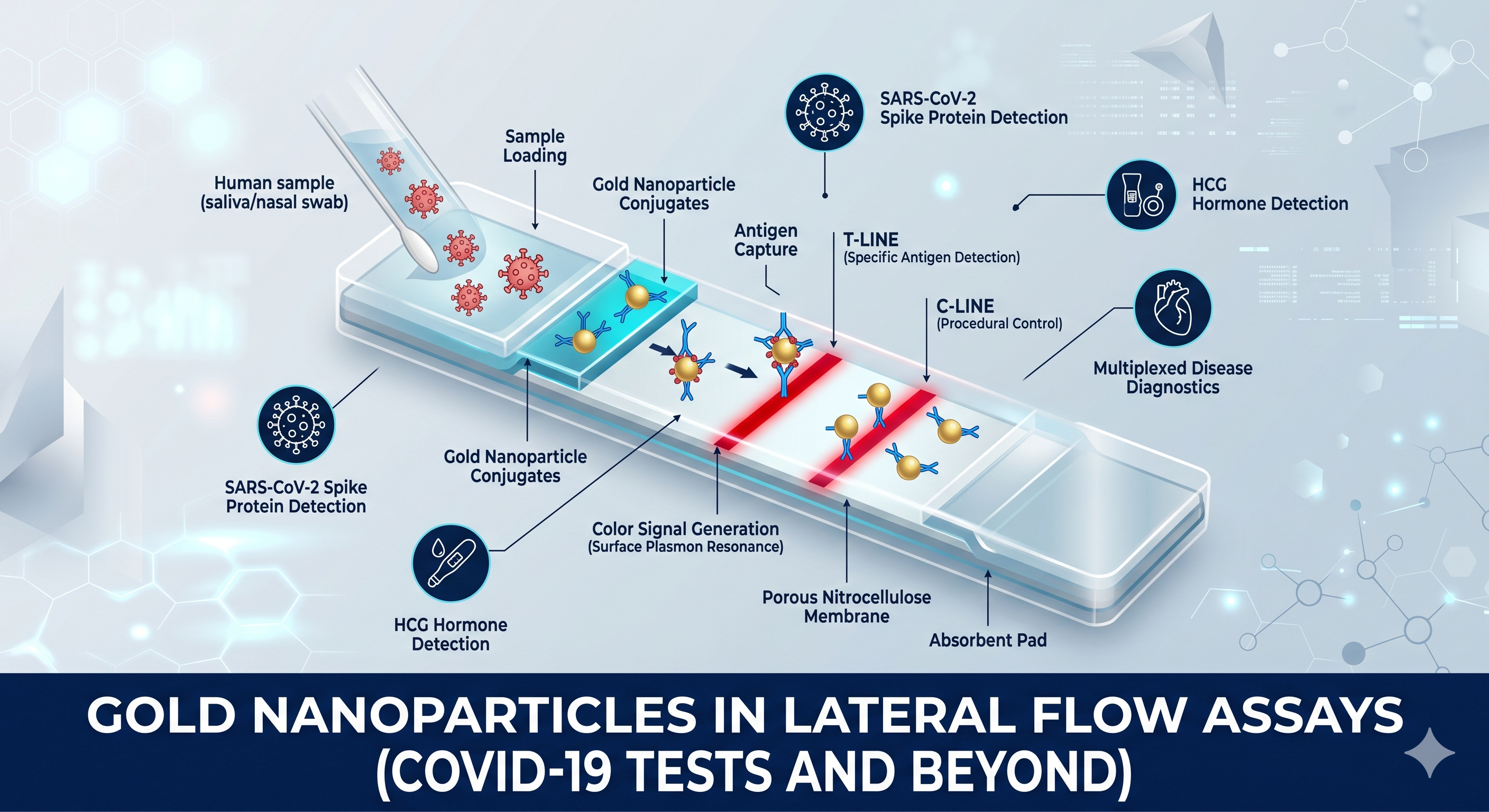
To understand the role of gold, we must look at how an LFA strip is constructed. It consists of four main parts:
-
Sample Pad: Where the fluid (saliva or blood) is applied.
-
Conjugate Pad: This is where the Gold Nanoparticles live. They are “conjugated” (chemically bonded) to antibodies that recognize a specific target, like the SARS-CoV-2 spike protein.
-
Nitrocellulose Membrane: The “track” where the reaction happens. It contains the Test Line (anchored antibodies) and the Control Line.
-
Wick/Absorbent Pad: Pulls the liquid through the strip via capillary action.
When you apply a sample, the liquid dissolves the gold-antibody conjugates. If the virus is present, it hitches a ride on the gold particles. As they flow over the Test Line, the anchored antibodies grab the virus, trapping the gold particles in place. As millions of gold particles pile up, the red line becomes visible.
4. Beyond COVID-19: Expanding the Diagnostic Horizon
While COVID-19 brought AuNP-LFAs into every household, the technology is rapidly expanding into other critical areas of medicine:
A. Multi-Pathogen Detection (Multiplexing)
Recent research is focused on strips that can detect multiple diseases at once. By using different sizes of gold nanoparticles or different shapes (like gold nanostars or nanorods), scientists can create tests that show different colors for different illnesses—for example, a red line for Flu A and a blue line for COVID-19 on the same strip.
B. Cardiac Biomarkers
In emergency rooms, time is muscle. New LFAs using high-sensitivity gold nanoparticles can detect Troponin I, a protein released during a heart attack. These rapid tests allow paramedics to diagnose a cardiac event in the ambulance, bypassing the need for a central hospital lab.
C. Environmental and Food Safety
AuNP-LFAs are being deployed to detect pesticides in drinking water and pathogens like Salmonella in food processing plants. The portability of gold nanoparticles makes them ideal for field testing where electricity and refrigeration are unavailable.
5. Recent Research: Signal Enhancement and AI Integration
The primary limitation of traditional gold nanoparticles is their “Detection Limit”—sometimes they aren’t bright enough to catch a very early infection.
-
Nano-Shells and Branched Gold: Researchers are developing “Gold Nanostars.” The points of the star act as “hotspots” for light, making the signal up to 10 times brighter than standard spheres.
-
Platinum-Coated Gold: By coating gold with a thin layer of platinum, the nanoparticles can act as “nano-zymes.” They catalyze a color reaction that makes the test line much darker, allowing for the detection of even lower viral loads.
-
Smartphone Quantification: Clinical studies are now pairing LFAs with smartphone apps. An app can use the phone’s camera to analyze the exact shade of red on the gold line, providing a quantitative result (how much virus is present) rather than just a simple Yes/No.
6. Advantage vs. Risk Assessment
Every medical technology involves trade-offs. Here is the evaluation for AuNP-based diagnostics:
| Advantage | Description | Risk / Challenge | Description |
| Stability | Gold is chemically inert; tests have a long shelf life without refrigeration. | High Specificity Required | If antibodies aren’t perfect, gold particles may “stick” randomly, causing false positives. |
| Visual Readout | No expensive readers or electricity needed for a result. | Sensitivity Gaps | In very early stages of infection, the gold signal may be too faint to see. |
| Biocompatibility | Gold nanoparticles are generally non-toxic and easy to functionalize. | Cost of Raw Materials | While tiny amounts are used, the price of high-purity gold impacts manufacturing. |
| Rapid Results | Typically provides an answer within 10 to 15 minutes. | Waste Management | Millions of plastic LFA casings create environmental concerns. |
7. Clinical Trials and Performance Validation
In the last two years, massive clinical trials have validated the accuracy of gold-based LFAs. A meta-analysis of COVID-19 rapid tests showed that gold-based assays achieved over 95% sensitivity when viral loads were high. However, the “clinical sensitivity” depends heavily on the quality of the gold-antibody conjugation. Recent breakthroughs in “covalent coupling” (a stronger chemical bond) have significantly reduced the number of “inconclusive” results in clinical settings.
8. Conclusion: The Future is Bright (and Golden)
Gold nanoparticles have democratized diagnostics. They have moved the power of the laboratory into the hands of the individual. As we look toward the future, we can expect “smarter” gold particles that change colors across a spectrum, tests that communicate directly with our digital health records, and ultra-sensitive assays that can detect cancer markers from a single drop of finger-prick blood.
The next time you see that red line, remember that you are looking at the culmination of decades of physics, chemistry, and engineering—all contained within a tiny, golden sphere.