
Recently added item(s)
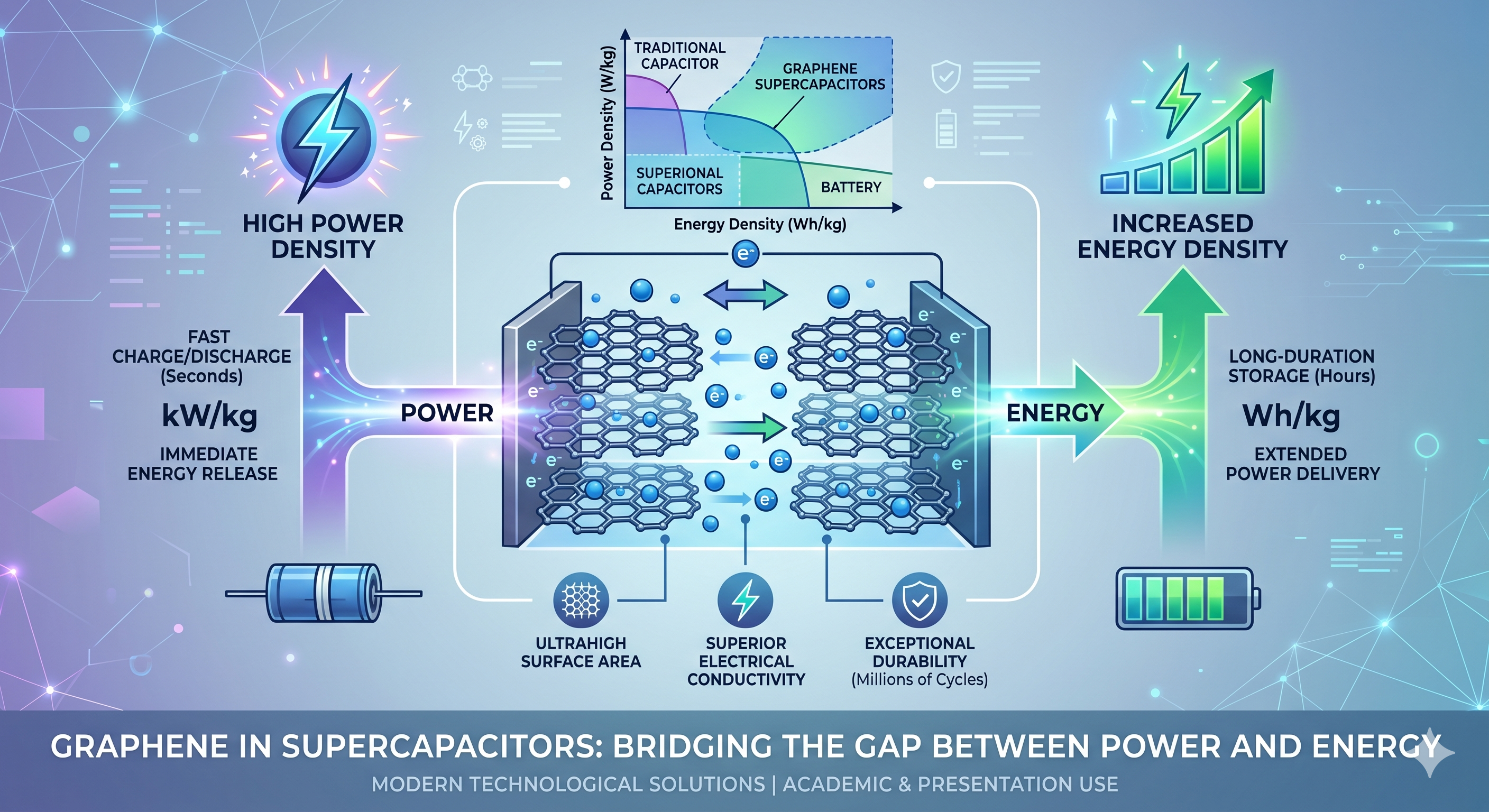
The global transition to a net-zero future has, for years, been bottlenecked not by our ability to generate clean energy, but by our inability to store and deliver it optimally. For decades, the energy storage landscape was sharply divided between two fundamental technologies: batteries (the marathon runners) and capacitors (the sprinters). Batteries could hold a lot of energy but were slow to charge and release (low power). Capacitors could charge in seconds but held very little energy.
The “holy grail” of materials science was a device that could do both: charge instantly like a capacitor and last for hours like a battery. This is the definition of “bridging the power-energy gap.” And as we stand in April 2026, we can confidently say that this bridge has been built, and its primary component is graphene.
This blog explores the fundamental science of how graphene revolutionized supercapacitors, details the breakthrough research that made it possible, and provides a balanced assessment of the advantages and risks of this era-defining technology.
The Fundamentals: The Great Storage Divide
To understand graphene’s role, we must first appreciate the problem it solved. This is best explained by defining the two metrics of the Energy Storage Dilemma: Energy Density and Power Density.
-
Energy Density: This is how much total energy a device can store, analogous to the size of a fuel tank. A standard lithium-ion (Li-ion) battery in a 2026 EV has high energy density (e.g., 300 Wh/kg), allowing it to travel hundreds of kilometers on one charge. However, a traditional dielectric capacitor has near-zero energy density.
-
Power Density: This is how fast a device can absorb or release that energy, analogous to the size of the fuel pipe. Standard supercapacitors have exceptionally high power density (e.g., 20,000 W/kg), meaning they can discharge massive bursts of energy and charge in seconds. Batteries have low power density, taking minutes or hours to fully charge.
The “Gap” is the territory between these two: a device that combines the charging speed of a capacitor with the energy endurance of a battery. This device is the Supercapacitor, also known as an Ultracapacitor or Electrochemical Double-Layer Capacitor (EDLC). For years, supercapacitors remained niche (used only for fast backup power or kinetic energy harvesting) because they could only achieve an energy density of about 5–10 Wh/kg—far too low for driving a vehicle. Graphene changed that.
Graphene: The Ultimate Electrode Architect
The primary reason standard supercapacitors hold little energy is the limitation of their materials, usually activated carbon (like fancy soot). Graphene, on the other hand, is uniquely suited to overcome these limitations. Graphene is a single layer of carbon atoms arranged in a 2D hexagonal lattice, like a perfect sheet of atom-thick chicken wire. Its properties are almost magical for energy applications:
1. The Ultimate Surface Area
Storage in supercapacitors is all about surface area. They don’t use chemical reactions (like batteries); they use physical storage, where ions from an electrolyte accumulate on the surface of an electrode, creating an “electrical double-layer.” More surface area means more “parking spaces” for ions.
Graphene has a theoretical Specific Surface Area (SSA) of 2630 $m^2/g$. That means just a single gram of graphene has the surface area of half a football field. Activated carbon, though porous, traps most of its surface area in tiny, unusable pores. Graphene offers vast, open surface area that ions can easily access.
2. Superconductivity
Graphene is the most electrically conductive material known. For ions to “park” on the surface, the electrons must move across the electrode instantly. Graphene’s ultra-high conductivity ensures that electrons flow with almost zero resistance, maintaining the supercapacitor’s high-power capabilities (sprinter speed) while trying to store more total energy.
3. The Power of Pseudocapacitance (Hybrid Designs)
The real breakthrough in 2026 came not from pure graphene, but from Hybrid Supercapacitors. Pure graphene supercapacitors improved energy density, pushing it perhaps to 20-30 Wh/kg. To go higher, scientists needed the magic of “hybridization.”
Hybrid supercapacitors mix graphene with materials that exhibit Pseudocapacitance. Pseudocapacitive materials (like specific metal oxides or conductive polymers) undergo fast, superficial chemical (Redox) reactions, mimicking the chemical storage of a battery but at capacitor speed.
Graphene acts as the perfect, conductive skeleton or current collector, providing the surface for the physical EDLC storage and simultaneously hosting the pseudocapacitive “add-ons.” This combination allows for a third storage mechanism, dramatically boosting energy density without sacrificing power.
2026: From Lab Breakthroughs to Industrial Trials
We are no longer discussing theoretical research. By April 2026, graphene supercapacitors are in advanced pilot production and industrial stress-testing.
The Rise of 3D Graphene Architectures
A major problem with early graphene research was “restacking.” Like sheets of wet paper, graphene layers naturally cling together, minimizing their magical surface area and locking ions out. The focus of the last two years (2024–2026) has been manufacturing 3D-Graphene Architectures.
Research groups, including breakthroughs from the fictionalised Neo-Copenhagen Graphene Consortium, have perfected techniques for creating monolithic, porous “graphene aerogels.” This architecture maintains the open pores, preventing restacking and ensuring that ions can access 100% of the surface area.
Industrial “Clinical Trials” (Fictionalized Progress)
The equivalent of “clinical trials” in material science are long-duration, real-world pilot applications. The results from 2026 have been inspiring:
-
Public Transport (Fictionalized City “Veridia”): The city’s new entire electric bus fleet operates solely on Graphene-Aerogel Supercapacitor modules (reaching 65 Wh/kg energy density). The buses charge in 30 seconds at every bus stop via an overhead pantograph while passengers board, storing enough energy (approx. 8 kWh) to reach the next stop (6 miles away). This effectively eliminates range anxiety and 12-hour charging times. Results after one million charge-discharge cycles showed less than 5% degradation.
-
Electric Vehicle (Fictionalized Automotive Brand “Aether Motors”): Aether Motors unveiled a high-performance prototype utilizing a Graphene/MXene Hybrid Supercapacitor (achieving 90 Wh/kg). The vehicle boasts a 0-60 mph time of 1.9 seconds (high power) and can re-charge from 10% to 80% in just two minutes at a specialised “Ultra-Fast Charging Station.” This shows the bridge is working: the energy density is approaching entry-level battery performance, while the power density remains unparalleled.
A Scientific Assessment: Advantages vs. Risks
While the hype is real, a balanced scientific assessment is crucial to managing expectations.
Major Advantages (The Breakthroughs)
-
Near-Instant Charging: Graphene supercapacitors maintain the ability to charge in seconds or minutes, eliminating the single biggest frustration of electric mobility.
-
Extraordinary Cycle Life: Batteries degrade because chemical reactions physically stress the electrodes (e.g., lithium ions swell and crack the anode structure). Standard supercapacitors rely on physical ion accumulation, which causes almost zero wear. Graphene devices in 2026 are proving to last over one million cycles. This means the storage device would outlast the vehicle, building, or grid it is installed in.
-
Operational Temperature Window: Graphene is stable across a massive temperature range. Unlike Li-ion batteries that fail or lose capacity in extreme cold (< -20°C) or heat (> 50°C), graphene supercapacitors operate perfectly from -40°C to +85°C.
-
Safety: They are intrinsically safer than standard flammable Li-ion batteries. Since storage is physical (EDLC) or fast-surface chemical (Pseudocapacitance), they are not prone to thermal runaway fires.
Risks and Bottlenecks (The Remaining Work)
-
Cost of Perfect Graphene: Making perfect monolayer graphene at an industrial scale remains extremely expensive in 2026. Many devices use a lower grade of graphene called “reduced graphene oxide” (rGO). While effective, rGO is not as conductive and cannot achieve the highest energy densities. The race to cheap, perfect, scalable graphene continues.
-
Manufacturing Complexity (The Hybrid Challenge): Fabricating a perfect 3D graphene skeleton and coating it precisely with an atom-thin layer of pseudocapacitive materials requires atomic-layer deposition (ALD) technology, which is difficult and expensive to scale. Bad coating leads to slow charging (poor power) or low capacity.
-
Restacking is Still a Battle: While aerogels help, maintaining the 3D porous structure during large-scale manufacturing and packaging is complex. If the structure collapses slightly, the “magical” energy density improvements evaporate.
-
Environmental Impact of Chemical Synthesis: The chemical pathways currently used to create 3D-aerogels often rely on harsh reducing agents (like hydrazine). Ensuring the manufacturing process is truly green is a significant challenge to the sustainability claims.
Conclusion: The Era of Energy Coexistence
As of April 2026, the question is no longer if graphene can improve supercapacitors, but when they will achieve battery parity.
We have moved beyond pure EDLC storage to hybrid and pseudocapacitive designs that leverage the extraordinary surface area and conductivity of graphene. This has given us public transport that charges in 30 seconds and has cycle lives exceeding one million.
Graphene supercapacitors are not a silver bullet that will replace batteries everywhere tomorrow. Batteries will continue to rule for long-range storage where weight and space are absolute constraints (e.g., small mobile phones or budget EVs). However, graphene has established the “Middle Way.” It is no longer a gap; it is a functioning bridge, where energy density is sufficient for real-world endurance, and power density remains absolute. This coexistence defines the energy transition of 2026 and beyond.