
Recently added item(s)
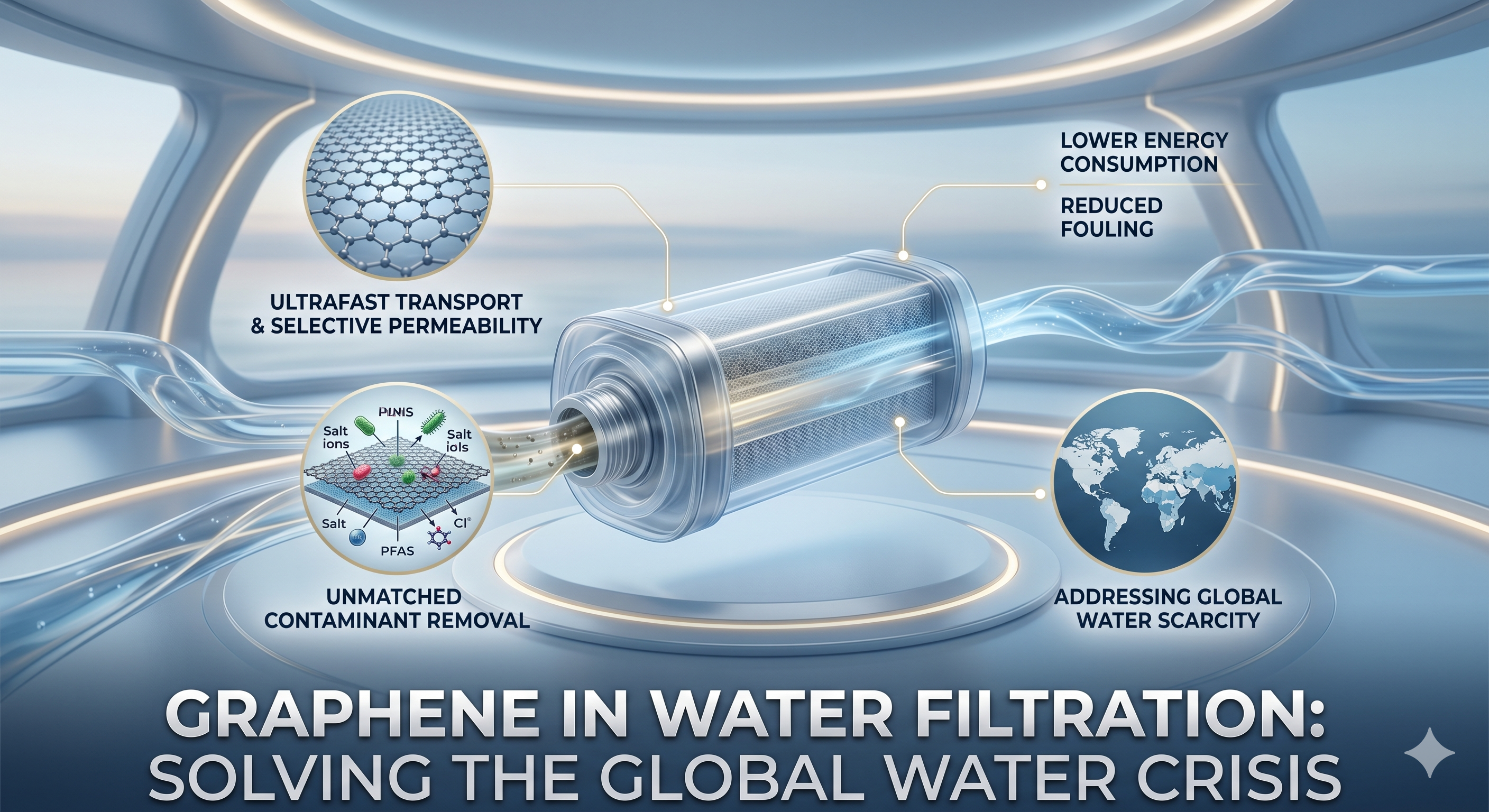
The global water crisis is one of the most pressing challenges of the 21st century. As of 2026, nearly two billion people live in water-stressed regions, and that number is projected to rise. Traditional desalination and filtration methods, while effective, are often energy-intensive, expensive, and unable to filter out modern contaminants like “forever chemicals” (PFAS).
However, a revolutionary solution is emerging from the world of nanotechnology: Graphene. Often hailed as a “miracle material,” graphene is a single layer of carbon atoms that is incredibly strong, flexible, and—most importantly—possesses unique properties that make it the ultimate filter.
1. The Science of the “Atomic Sieve”
At its core, graphene is a two-dimensional sheet of carbon. When layered to form Graphene Oxide (GO) membranes, it creates a labyrinth of sub-nanometer channels. These channels are so precise that they can act as an “atomic sieve.”
-
Size Exclusion: The gaps between graphene layers can be tuned to allow water molecules ($H_2O$) to pass through while physically blocking larger salt ions, bacteria, and microplastics.
-
Capillary Action: Surprisingly, water flows through these nano-channels hundreds of times faster than it does through conventional membranes. This “ultrafast transport” is due to the smooth, frictionless surface of graphene and its unique interaction with water molecules.
2. Breaking the PFAS Barrier: Recent Research (2025-2026)
One of the most significant breakthroughs in 2025 came from researchers at Monash University. They developed a specialized graphene oxide filter designed specifically to capture PFAS (per- and polyfluoroalkyl substances).
Standard Reverse Osmosis (RO) membranes typically remove only about 35% of short-chain PFAS molecules. The new GO-βCD (beta-cyclodextrin modified graphene oxide) membrane creates an energetic barrier that blocks these “forever chemicals” with near-perfect efficiency while maintaining high water flow. This discovery is a game-changer for municipal water supplies that have been contaminated by industrial runoff.
3. Desalination: Turning the Oceans into Drinking Water
Traditional desalination relies on high-pressure Reverse Osmosis, which consumes vast amounts of electricity. Graphene is disrupting this sector in two ways:
-
Lower Pressure Requirements: Because water moves so easily through graphene, the energy required to push water through the membrane is significantly reduced.
-
Solar-Thermal Desalination: Recent studies in 2024 and 2025 have showcased “graphene aerogels.” These ultra-light materials float on the ocean surface, soak up sunlight, and convert it into heat with 95% efficiency. This heat evaporates the water, leaving salt and impurities behind—a process that requires zero electricity and is ideal for remote coastal communities.
4. Advantages: Why Graphene Wins
The move toward graphene-based filtration is driven by several key benefits:
-
Unmatched Flux Rates: Graphene membranes can offer water flux rates up to 50 times higher than conventional polymer membranes.
-
Antifouling Properties: Graphene is naturally resistant to “biofouling” (the buildup of bacteria and algae). This means the filters last longer and require less chemical cleaning, which reduces the overall environmental impact.
-
Targeted Filtration: Unlike current filters that often strip water of healthy minerals (like calcium and magnesium), graphene membranes can be “tuned” to keep beneficial nutrients while removing toxic heavy metals like lead and arsenic.
5. Risk Assessment: Navigating the Challenges
While the potential is enormous, the transition to a graphene-filtered world is not without risks and hurdles.
Technical and Environmental Risks
-
Membrane Stability: In the past, graphene oxide sheets had a tendency to “swell” when immersed in water, which widened the gaps and allowed salt to leak through. While chemical “cross-linking” has largely solved this in 2026, maintaining stability over years of industrial use is still being monitored.
-
Nanoparticle Leaching: There are valid concerns about whether nano-sized graphene particles could shed into the drinking water. Current “clinical” safety evaluations focus on the long-term biological impact of graphene ingestion. While most studies suggest the membranes are stable, rigorous “leach testing” is mandatory for certification.
Economic Risks
-
Scalability: Producing high-quality graphene at the kilometer-scale required for industrial water plants remains more expensive than traditional plastic-based membranes. However, as manufacturing methods like “shear alignment printing” mature, prices are falling rapidly.
6. The “Clinical” Perspective: Health and Safety Studies
In the context of water filtration, “clinical studies” refer to toxicology reports and long-term exposure assessments.
A comprehensive review published in early 2026 highlighted that while graphene itself is a carbon-based material (like the charcoal in your Brita filter), its nano-form requires caution. Current safety protocols ensure that graphene is “anchored” to a substrate or embedded in a polymer matrix, preventing any material from entering the human body. Research indicates that when properly integrated, graphene-enhanced water is as safe as, or safer than, water treated with chlorine-heavy traditional methods.
7. The Road Ahead: 2026 and Beyond
The year 2026 is widely considered the “Year of Graphene Commercialization.” We are seeing the first large-scale municipal pilot programs in water-stressed regions like India and Northern China.
Companies like NematiQ and various international consortiums are now producing graphene membranes that can be retrofitted into existing water treatment plants. This means we don’t need to rebuild our infrastructure; we just need to upgrade the “engine” of the filtration system.
Conclusion
Graphene is no longer a “future” technology—it is a present-day solution to the global water crisis. By offering a way to desalinate ocean water and purify contaminated groundwater more efficiently, more cheaply, and more thoroughly than ever before, it stands as a pillar of 21st-century sustainability. As we continue to refine the manufacturing process and ensure long-term environmental safety, the dream of clean water for everyone, everywhere, is finally within reach.