
Recently added item(s)
In the industrial world, electricity isn’t just something that flows through wires; it’s something we often need to embed directly into materials. From the touchscreens on our phones to the tires on our cars and the electrodes in our batteries, we rely on “conductive additives” to turn insulating plastics and rubbers into functional, electronic components.
For over a century, Carbon Black has been the undisputed king of this domain. It is cheap, reliable, and abundant. However, a new challenger—Graphene—has emerged from the realm of nanotechnology, promising performance levels that Carbon Black can only dream of. But is “newer” always “superior”?
In this detailed analysis, we will compare these two carbon titans to see which one truly earns the crown for next-generation applications in 2026.
1. Defining the Contenders: Morphology Matters
To understand why they perform differently, we must look at their shapes. In the world of additives, morphology (shape) is destiny.
-
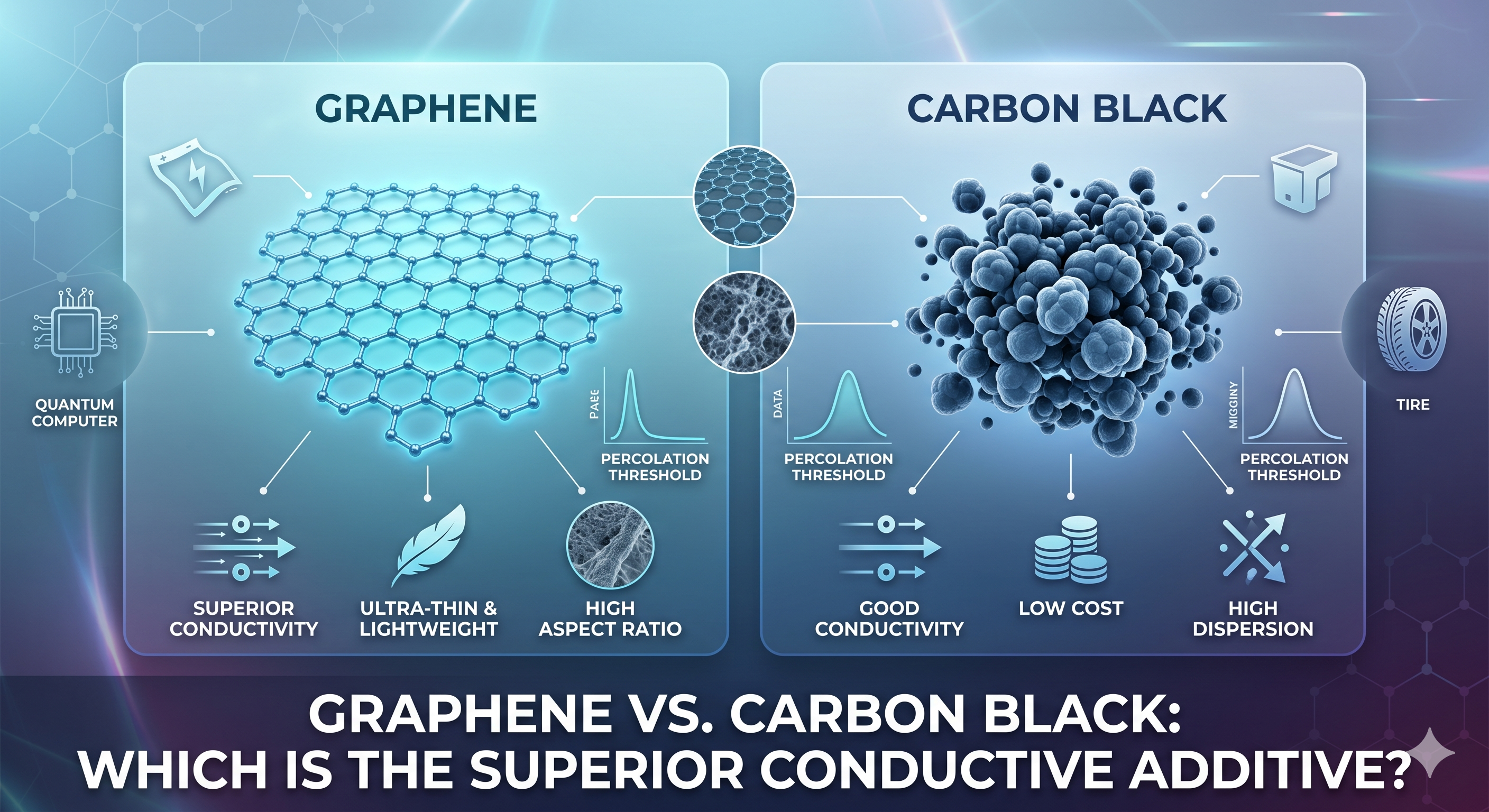
Carbon Black (CB): Imagine tiny, soot-like “nanoballs.” Carbon black consists of spherical particles that clump together into grape-like clusters (aggregates). To create a path for electricity, these spheres must touch each other to form a continuous chain. This is a 0D (zero-dimensional) structure.
-
Graphene: Imagine a single, ultra-thin “sheet” of paper made of carbon atoms. Graphene is a 2D (two-dimensional) material. Because it is a flat sheet, it has a much larger surface area and can bridge long distances within a material using very little mass.
2. The Percolation Threshold: Doing More with Less
The most critical metric for any conductive additive is the percolation threshold. This is the minimum amount of additive you need to add before the material suddenly becomes conductive.
-
Carbon Black Efficiency: Because they are spheres, you usually need a lot of them to create a solid path. Often, you have to add 5% to 15% carbon black to a polymer to make it conductive. This high loading often makes the final plastic brittle and heavy.
-
Graphene Efficiency: Because graphene sheets are wide and flat, they “find” each other much more easily. Scientists in 2026 have demonstrated percolation thresholds as low as 0.1% to 1%.
Winner: Graphene. It allows materials to stay light and flexible while achieving superior conductivity.
3. Battery Evolution: The Race for Energy Density
The most intense battleground between these two materials is the EV (Electric Vehicle) battery market.
Current Industrial Research (2025-2026)
Recent studies in high-silicon anodes have shown that Carbon Black struggle to maintain contact as the battery expands and contracts during charging. This leads to “dead zones” in the battery.
Graphene, being flexible and sheet-like, acts as a conductive “wrap.” It maintains electrical contact even as the battery particles change shape. 2026 data from major battery manufacturers indicates that replacing a portion of Carbon Black with Graphene can improve “fast-charge” performance by 30% and increase cycle life by 20%.
4. Biomedical and Wearable Applications: Sensing the Future
When it comes to medical devices and “smart” clothing, the choice between Carbon Black and Graphene isn’t just about electricity; it’s about biocompatibility and sensitivity.
Clinical Perspectives and Biosensors
-
Sensitivity: Graphene’s 2D structure makes it incredibly sensitive to surface changes. In recent clinical prototypes for “Smart Bandages,” graphene-based sensors were able to detect bacterial growth (by sensing pH changes) 10 times faster than carbon black sensors.
-
Prosthetics: In 2025, a pilot clinical study used graphene-infused silicones to create artificial “nerves” for prosthetic hands. The high conductivity at low loading allowed the silicone to remain as soft as human skin, whereas carbon black versions were too stiff for natural movement.
5. Thermal Conductivity: Staying Cool Under Pressure
Electricity often generates heat, and managing that heat is vital for electronics and tires.
-
Carbon Black: It is a relatively poor thermal conductor. In high-performance tires, it helps with grip but traps heat, which can lead to tire degradation.
-
Graphene: It is the “king of cool.” It has the highest thermal conductivity of any known material. Adding graphene to tires or electronics doesn’t just make them conductive; it turns the entire material into a massive heat sink. This is why 2026’s “ultra-high-performance” tires are increasingly adopting graphene-rich formulas.
6. Advantage vs. Risk Assessment: The Practical Reality
Graphene
-
Advantages: Extreme efficiency, lightweight, adds mechanical strength, superior heat dissipation, high sensitivity.
-
Risks: Price. Even in 2026, graphene is significantly more expensive than carbon black. There is also the “Dispersion Challenge”—if you don’t mix graphene perfectly, the sheets clump together and behave like expensive graphite.
Carbon Black
-
Advantages: Ultra-low cost. The global supply chain for Carbon Black is mature and massive. It is also very easy to mix into industrial rubbers and plastics without specialized equipment.
-
Risks: High loading required, makes materials heavier/brittler, poor thermal management, potential health concerns regarding “ultrafine” dust during manufacturing.
7. The Hybrid Approach: The Best of Both Worlds?
As we stand in 2026, the industry is moving away from an “either-or” mentality. The most successful modern formulations use a Hybrid Strategy.
By using a large amount of cheap Carbon Black to provide the “bulk” conductivity and a small “seasoning” of Graphene to act as long-distance bridges, companies are achieving high performance at a manageable cost. This hybrid approach is currently the “gold standard” for the latest smartphone heat-dissipation sheets and high-end EV batteries.
8. Conclusion: Who Wins?
If we look at pure performance, Graphene is the clear winner. It is objectively superior in terms of conductivity, weight, and thermal management.
However, if we look at economic viability, Carbon Black remains the champion for 90% of the world’s products. You don’t need a graphene-infused plastic fork or a graphene-filled trash bag.
The Verdict: Graphene is the “Secret Sauce” for the high-tech future—aerospace, high-end EVs, and medical wearables. Carbon Black is the “Salt of the Earth” that will continue to power the mass-market commodities for decades to come.