
Recently added item(s)
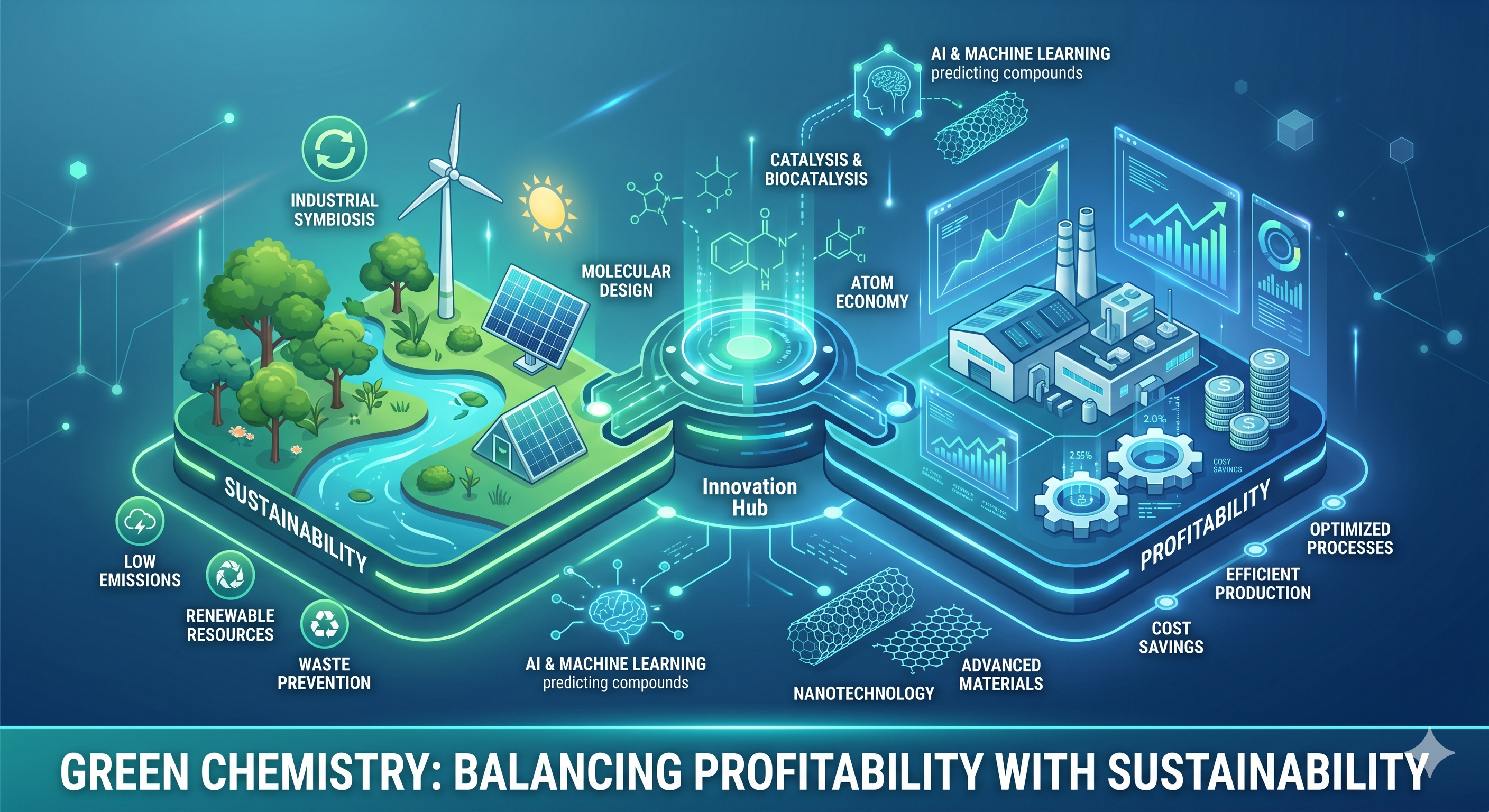
The global chemical industry is undergoing a paradigm shift. For decades, the metric of success was defined almost exclusively by yield and profit margins, often at the expense of environmental health and worker safety. However, a new discipline—Green Chemistry—is proving that the perceived “trade-off” between economic gain and ecological responsibility is a false dichotomy. By redesigning chemical processes from the molecular level up, industries are discovering that sustainability is not just a moral obligation but a powerful engine for long-term profitability.
The Genesis of a Greener Future: The 12 Principles
Green Chemistry is not a separate branch of chemistry; it is a philosophy of manufacturing. Formulated in the late 1990s by Paul Anastas and John Warner, the 12 Principles of Green Chemistry provide a roadmap for creating a circular economy. These principles focus on:
-
Waste Prevention: It is better to prevent waste than to treat or clean it up after it is formed.
-
Atom Economy: Synthetic methods should be designed to maximize the incorporation of all materials used in the process into the final product.
-
Safer Solvents and Auxiliaries: The use of auxiliary substances (solvents, separation agents, etc.) should be made unnecessary whenever possible and innocuous when used.
-
Design for Energy Efficiency: Energy requirements should be recognized for their environmental and economic impacts and should be minimized.
In the modern industrial context, these principles are being integrated into “Industrial Symbiosis” models, where the waste of one process becomes the raw material for another.
The Economic Engine: Why Sustainability is Profitable
The transition to green chemistry is increasingly driven by the “bottom line.” While the initial Research and Development (R&D) costs for green alternatives can be high, the long-term economic benefits are multifaceted:
-
Resource Efficiency and Waste Reduction: In traditional manufacturing, “E-factor” (the ratio of waste to product) can be staggering. In the pharmaceutical industry, it is not uncommon to produce 100kg of waste for every 1kg of medicine. Green chemistry reduces this waste, directly lowering disposal costs and raw material expenses.
-
Regulatory Compliance and Risk Mitigation: Governments worldwide are tightening restrictions on hazardous substances (e.g., REACH in Europe). Companies that proactively switch to non-toxic alternatives avoid the heavy fines and legal liabilities associated with environmental contamination.
-
Consumer Demand and Brand Equity: Modern consumers, particularly Gen Z and Millennials, are willing to pay a premium for “clean” products. A commitment to green chemistry enhances brand reputation, providing a competitive edge in saturated markets.
Catalysis: The Silent Hero of Green Synthesis
One of the most effective ways to balance profit and planet is through catalysis. A catalyst is a substance that speeds up a chemical reaction without being consumed. In green chemistry, the development of highly selective catalysts allows for:
-
Lower Operating Temperatures: Reducing the energy required for synthesis.
-
Higher Purity: Minimizing the formation of unwanted by-products.
-
Recyclability: Modern catalysts, especially those using earth-abundant metals like iron or nickel, can be recovered and reused, significantly cutting costs.
Current research is heavily focused on biocatalysis—using enzymes to perform complex chemical transformations. Enzymes operate at room temperature in water-based environments, offering a stark contrast to traditional industrial methods that require high pressure and toxic organic solvents.
Nanotechnology and Advanced Materials: A Synergetic Approach
Advanced materials, including carbon nanotubes and graphene, are playing a pivotal role in the green revolution. These materials are being utilized to create “smart” systems that enhance sustainability in several ways:
-
Ultra-efficient Water Purification: Graphene-based membranes can filter out contaminants and desalinate water with significantly less energy than traditional reverse osmosis.
-
High-Performance Energy Storage: Sustainable energy depends on batteries and supercapacitors. Using nanomaterials to increase the conductivity and lifespan of energy storage devices is essential for the transition away from fossil fuels.
-
Lightweighting in Transport: Carbon-reinforced polymers are drastically reducing the weight of vehicles and aircraft, leading to massive fuel savings and reduced CO₂ emissions over the lifespan of the machine.
Benefit-Risk Assessment: A Candid Evaluation
Every technological leap involves a balance of risks and rewards. Transitioning to green chemistry is no exception.
The Advantages
-
Enhanced Safety: Eliminating flammable solvents and toxic reagents creates a safer work environment, reducing insurance costs and the risk of industrial accidents.
-
Energy Security: Moving toward bio-based feedstocks reduces reliance on volatile fossil fuel markets.
-
Innovation Catalyst: The search for green alternatives often leads to entirely new products with superior performance characteristics that traditional methods could not achieve.
The Risks and Challenges
-
Capital Expenditure (CAPEX): Replacing legacy infrastructure with green-compliant machinery requires significant upfront investment.
-
Scale-up Hurdles: A green process that works perfectly in a 1-liter laboratory flask may face unpredictable challenges when scaled to a 10,000-liter industrial reactor.
-
Performance Parity: In some cases, bio-based plastics or solvents may not yet match the durability or performance of their petroleum-based counterparts, though this gap is closing rapidly.
Case Studies: From Lab to Industrial Reality
Real-world applications demonstrate the feasibility of this transition. For instance, Nike revolutionized its shoe manufacturing by switching to a “water-based” solvent system, significantly reducing VOC (volatile organic compound) emissions while maintaining bond strength.
In the agricultural sector, the development of “Green Pesticides”—derived from plant essential oils or fungal spores—is offering a way to protect crops without the devastating impact on bee populations and soil health associated with traditional neonicotinoids.
Furthermore, recent industrial trials in Carbon Capture and Utilization (CCU) are turning CO₂ emissions into building materials and synthetic fuels. By viewing CO₂ as a carbon source rather than a waste product, companies are literally creating value out of thin air.
Artificial Intelligence: Accelerating the Discovery Phase
The integration of AI and Machine Learning is perhaps the most exciting development in the field. Discovering a “green” molecule or catalyst used to take a decade of trial and error. Today, AI-driven simulations can predict the behavior of thousands of chemical combinations in seconds. This digital “High-Throughput Screening” allows researchers to identify non-toxic, efficient candidates for everything from battery electrolytes to biodegradable surfactants with unprecedented speed.
The Road Ahead: A Circular Paradigm
The future of chemistry is circular. The goal is a world where the concept of “waste” is obsolete. This requires a holistic view of the product lifecycle—from extraction to disposal (or rather, re-integration).
As we look toward 2030 and beyond, the chemical industry will not be judged solely by its annual turnover, but by its “Total Value Contribution.” This metric accounts for economic profit alongside environmental restoration and social wellbeing.
Green chemistry is the vehicle for this transformation. It proves that we do not have to choose between a thriving economy and a thriving planet. By being smarter, more efficient, and more creative with our molecular designs, we can secure a prosperous future that respects the finite boundaries of our Earth.