
Recently added item(s)
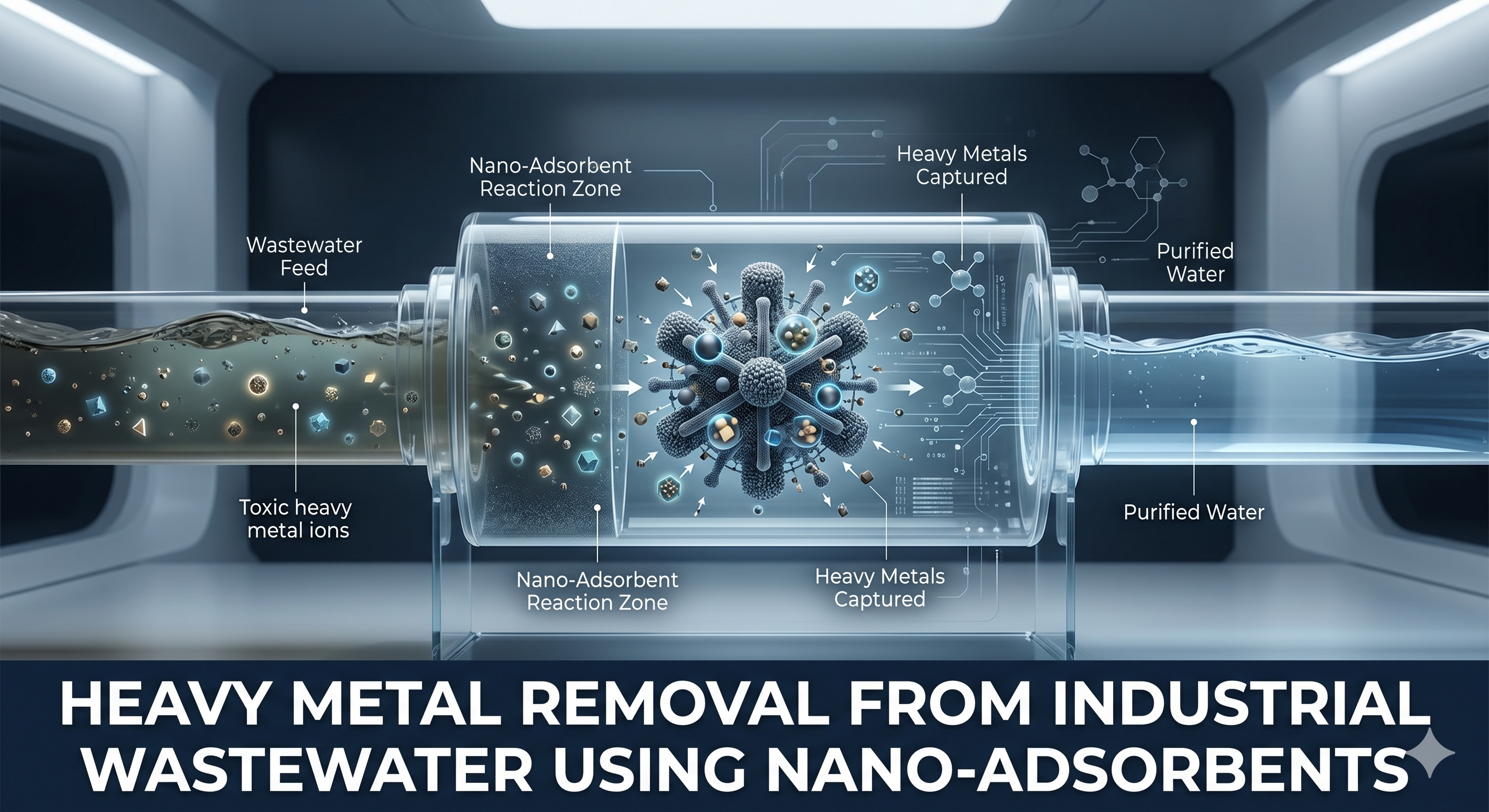
Water is the lifeblood of global industry, yet it is also the primary victim of industrial success. Every year, millions of tons of heavy metals—byproducts of mining, electronics manufacturing, textile dyeing, and metal plating—are discharged into our waterways. Unlike organic pollutants that might eventually break down, heavy metals are “forever” contaminants. They do not degrade; they accumulate.
Traditional water treatment methods, while effective to a point, often struggle to remove these metals once they reach low but still toxic concentrations. This is where nanotechnology steps in. By utilizing nano-adsorbents, we are entering a new era of water purification where we can target and remove toxic ions with molecular precision.
The Heavy Metal Crisis: Why Traditional Methods Fall Short
Heavy metals such as lead (Pb), mercury (Hg), cadmium (Cd), and chromium (Cr) are highly toxic even at parts-per-billion levels. They are bioaccumulative, meaning they move up the food chain, eventually landing on our dinner plates and causing severe neurological, renal, and reproductive issues.
Common treatment methods like chemical precipitation, ion exchange, and membrane filtration have served us for decades. However, they face significant hurdles:
-
Chemical Precipitation: Produces large volumes of toxic sludge that requires further expensive disposal.
-
Ion Exchange: High cost of resins and limited effectiveness in complex wastewater mixtures.
-
Reverse Osmosis: Extremely energy-intensive and prone to “fouling” (clogging).
Nano-adsorbents solve these issues by offering a high-capacity, low-energy, and highly selective alternative.
What are Nano-Adsorbents?
At the most basic level, adsorption is the process by which atoms, ions, or molecules from a gas, liquid, or dissolved solid adhere to a surface. Think of it like a high-tech “magnetic sponge.”
Nano-adsorbents are materials engineered at the scale of 1 to 100 nanometers. Because they are so small, they possess a massive surface-area-to-volume ratio. A single gram of certain nanomaterials can have a surface area equivalent to several football fields. This provides an almost limitless number of “active sites” for heavy metal ions to latch onto.
The Top Contenders: Types of Nano-Adsorbents
Not all nanomaterials are suited for every metal. Researchers have developed a “periodic table” of adsorbents tailored for specific industrial needs.
1. Carbon-Based Nanomaterials (CNTs and Graphene)
Carbon nanotubes (CNTs) and graphene oxide (GO) are the superstars of the nanotechnology world. Their hexagonal lattice structure provides a perfect platform for chemical modification. By adding “functional groups” like oxygen or nitrogen to their surface, scientists can make these materials specifically attracted to lead or copper.
2. Magnetic Nanoparticles (Iron Oxides)
One of the biggest challenges in using nanoparticles is recovering them from the water after they have “soaked up” the toxins. Magnetic nanoparticles (like magnetite) solve this brilliantly. Once the water is clean, a simple external magnetic field can pull all the metal-laden nanoparticles out of the liquid, making the process incredibly efficient for large-scale industrial tanks.
3. Metal Oxide Nanoparticles
Oxides of aluminum, titanium, and magnesium are widely used due to their low cost and high stability. Titanium dioxide (TiO2), for instance, can serve a dual purpose: it can adsorb heavy metals and, when exposed to UV light, it can also break down organic pollutants through photocatalysis.
4. Zero-Valent Iron (nZVI)
Nano-sized zero-valent iron is a powerful “reducing agent.” It doesn’t just hold onto the metals; it can actually change their chemical state. For example, it can turn highly toxic and soluble Chromium(VI) into the less toxic and solid Chromium(III), which then precipitates out of the water naturally.
Recent Research and Clinical/Environmental Studies
The field is shifting from laboratory “beaker” experiments to real-world industrial applications.
Green Synthesis Breakthroughs
A major trend in recent research is the “Green Synthesis” of nano-adsorbents. Instead of using harsh chemicals to create nanoparticles, researchers are using plant extracts (like green tea or citrus peels) as reducing agents. Studies published in Journal of Hazardous Materials (2025) have shown that “green” iron nanoparticles are just as effective at removing arsenic from groundwater as their chemically synthesized counterparts, but with a much lower environmental footprint.
Multi-Metal “Cocktail” Treatment
Real industrial wastewater is never pure; it is a “soup” of different metals and salts. Recent studies have focused on “High-Entropy Alloy” nanoparticles and mixed-matrix membranes. These are designed to remove five or six different types of heavy metals simultaneously without the ions competing for space on the adsorbent surface.
Safety and Cytotoxicity Studies
While not “clinical trials” in the medical sense, significant toxicological studies (often termed “Nano-safety studies”) are being conducted. Researchers at major environmental institutes are testing the effects of “spent” adsorbents on aquatic life. The goal is to ensure that while we are removing lead, we aren’t accidentally introducing new nano-sized risks into the ecosystem.
Advantage–Risk Evaluation
For an industrial facility looking to upgrade its treatment plant, the decision to adopt nanotechnology involves a careful weighing of pros and cons.
The Advantages
-
Unmatched Efficiency: Nano-adsorbents can remove over 99% of heavy metals, even when they are present in trace amounts that traditional filters miss.
-
Selectivity: You can “tune” the nanoparticles to ignore harmless minerals (like calcium) and only target toxic ones (like mercury).
-
Regenerability: Many nano-adsorbents can be “washed” and reused dozens of times, which lowers the long-term cost of materials.
-
Compact Footprint: Because they are so efficient, the physical size of the treatment facility can be significantly reduced.
The Risks and Challenges
-
Nanotoxicity: There is a risk that the nanoparticles themselves could leak into the environment if the filtration system fails. This “secondary pollution” is a primary concern for regulators.
-
High Initial Cost: Producing high-quality carbon nanotubes or functionalized graphene still requires a higher upfront investment than buying bulk lime or alum for traditional precipitation.
-
Aggregation: Nanoparticles have a natural tendency to “clump” together (aggregate). When they clump, they lose their high surface area, effectively turning back into a standard-sized material and losing their “nano-powers.”
-
Complex Recovery: Separating non-magnetic nanoparticles from the treated water requires ultra-fine membranes, which can increase operational complexity.
The Future: Toward “Smart” Water Treatment
The next frontier for this technology is the integration of Artificial Intelligence and Real-time Sensors. Imagine a treatment plant where sensors detect a spike in Cadmium levels and automatically release the exact dose of functionalized nano-adsorbents needed to neutralize it.
Furthermore, we are seeing the rise of 3D-Printed Nano-filters. Instead of having loose particles in a tank, the nanoparticles are embedded into a 3D-printed ceramic or polymer structure. This allows water to flow through easily while ensuring the nanoparticles stay locked in place, eliminating the risk of nano-leakage.
Conclusion: A Clear Path Forward
Heavy metal removal is no longer just an environmental obligation; it is a resource recovery opportunity. Many of the metals we remove from wastewater—such as copper, nickel, and silver—are valuable. By using nano-adsorbents to capture these metals in a concentrated form, industries can transition from “waste treatment” to “metal mining” from their own effluent.
While challenges regarding cost and safety remain, the trajectory is clear. Nanotechnology provides the only viable path to achieving “Zero Liquid Discharge” (ZLD) goals in a world where water scarcity is becoming our most pressing geopolitical issue.