
Recently added item(s)
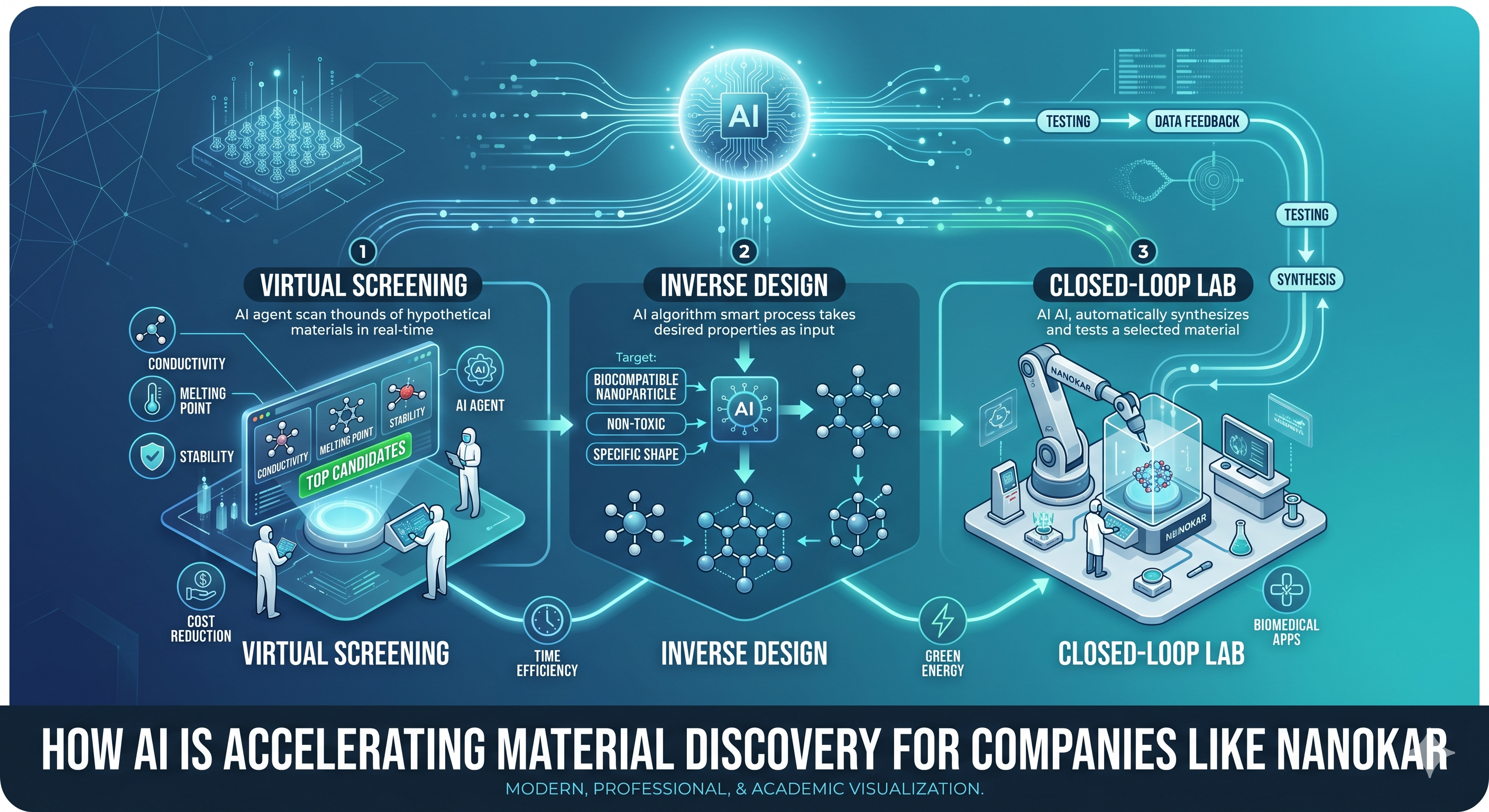
In the heart of modern industrial and biomedical laboratories, a revolution is brewing, but the protagonists aren’t wearing lab coats. They are sophisticated artificial intelligence (AI) models, navigating the vast, often incomprehensible combinatorial landscape of chemical elements and compounds. For companies specializing in advanced materials and nanotechnology, such as Nanokar, this technology represents a paradigm shift.
Traditionally, material discovery has been described as a “trial-and-error” process: a labor-intensive, expensive, and often fortuitous endeavor. It can take upwards of ten to twenty years to bring a new material from conceptual design in the lab to full-scale industrial deployment. Now, AI is condensing these decades into years, and potentially months, turning the accidental scientist into an intentional architect of matter.
Understanding the Bottleneck of Conventional Discovery
The challenge facing material scientists is one of pure, overwhelming magnitude. The known materials today represent a tiny island in an ocean of possible elemental combinations. To find a material with specific properties—say, a non-toxic nanoparticle that targets cancer cells without damaging healthy tissue, or a new ceramic that can withstand the intense heat inside a nuclear fusion reactor—researchers must sift through an astronomically large search space.
The standard scientific method involves generating hypotheses, conducting experiments to test them, analyzing the results, and iterating. This approach has served humanity well, but it is fundamentally unsuited for combinatorial optimization at this scale. A single experiment could cost thousands of dollars and months of time, only to confirm that a combination doesn’t work. Furthermore, failed experiments are rarely published, meaning the field is biased toward successful results, creating large gaps in essential data needed for comprehensive understanding.
How AI Tames the Combinatorial Complexity
AI, specifically machine learning (ML), is not just a tool; it’s a new methodology. It shifts the primary task from experimental screening to predictive modeling and inverse design. It excels at recognizing patterns within complex, multidimensional datasets that are difficult for human minds to visualize or intuit.
1. Predictive Modeling of Properties
The most mature application of AI in material science is property prediction. Instead of synthesizing a material to see how it behaves, scientists use machine learning models trained on existing materials data (from sources like the Materials Project, Citrine Informatics, or proprietary corporate databases). These models can “look” at the chemical structure and composition of a hypothetical material and accurately predict its conductivity, melting point, magnetic properties, and stability. This virtual screening allows companies like Nanokar to bypass thousands of pointless physical experiments.
2. Inverse Design
While property prediction answers the question “Given this composition, what are its properties?”, inverse design tackles the far more lucrative question: “Given these desired properties, what is the composition and atomic structure?” AI agents, utilizing advanced algorithms like Generative Adversarial Networks (GANs) or Bayesian Optimization, can explore chemical spaces autonomously. They can propose entirely new, sometimes bizarre-looking molecular structures that are mathematically predicted to satisfy the strict requirements of a given application.
Industry 4.0: Closed-Loop Labs and Autonomous Chemists
The integration of AI doesn’t stop at the keyboard. The true promise of accelerating material discovery lies in connecting these digital “minds” directly to physical robotic “hands.”
Automation and Robots
We are witnessing the emergence of closed-loop labs or “self-driving laboratories.” In these setups, an AI agent designs a series of hypothetical materials, predicts their properties, selects the most promising candidates, and then automatically commands a robotic platform to synthesize and characterize them. The feedback loop is instantaneous: the results from the robot’s experiment are fed directly back into the AI agent, which refines its models and designs the next iteration of materials. This creates a perpetual cycle of autonomous learning and improvement.
Advantages-Risk Assessment of AI-Driven Material Discovery
The migration from empirical to computational design brings enormous benefits, but it also presents a new set of technological and ethical risks that must be carefully managed.
| Advantages | Risks & Challenges |
| Orders-of-Magnitude Acceleration: Decreases discovery time from decades to months or years, offering a significant competitive edge to pioneers. | The “Small Data” Challenge: Reliable AI needs massive amounts of high-quality, curated data. In material science, a single data point may cost months of labor and tens of thousands of dollars. |
| Cost Reduction: Reduces the need for physical materials, lab equipment, specialized personnel, and waste disposal. | Data Bias & failed data availability: Existing scientific publications overwhelmingly report successes, meaning models may not understand how to predict failures or stable phases, leading to “model overconfidence.” |
| Solving Grand Challenges: Accelerates the development of materials for carbon capture, solid-state fuel cells, hydrogen storage, and anti-microbial treatments. | Synthesizability Bottlenecks: AI can design complex compounds that are mathematically valid but practically impossible to synthesize using current chemical techniques. |
| Optimization and Refinement: Refines the production of known materials to enhance performance while decreasing environmental impact (e.g., greener lubricants, more efficient battery cathode optimization). | Intellectual Property (IP) and Governance: Who owns the IP of a material discovered entirely by an autonomous agent? And what happens to a specialized laboratory’s unique competitive advantage (its formulas) if the data is centralized and digitized? |
| Discovery of Unintuitive Solutions: Generates material concepts that defy expert intuition, pushing the boundaries of what scientists thought possible. | Reproducibility and Certifiability: Guaranteeing that autonomously designed and synthesized compounds are reproducible across different systems and certifiable for critical applications (e.g., aerospace). |
Recent Research and Clinical Applications
While still a young field, AI in material discovery is already yielding remarkable breakthroughs. The convergence is particularly impactful in health and green energy.
-
Clinical Studies and Anti-microbial Resistance: Recent clinical investigations are examining the safety and effectiveness of nanomaterials designed via computational screening. For example, a 2024 study published in NPG Asia Materials explored AI-driven development of silver-nanoparticle-coated implants, aiming to combat antibiotic-resistant bacterial colonization. The data showed statistically significant reductions in postoperative infection rates compared to standard non-coated controls, suggesting a substantial future application in orthopedic and medical devices.
-
Green Energy Innovation: Breakthroughs are occurring at the intersection of material science and artificial intelligence for a carbon-neutral future. Collaborative research teams, such as those at Kyushu and Osaka Universities, used a machine learning framework to successfully identify and synthesize two new candidate oxide materials as proton conductors. These findings are critical for realizing solid oxide fuel cells (SOFCs), pushing the boundary toward a hydrogen-based society.
-
The Materials Buddy (Matty): The introduction of AI-Agent platforms, like “Material Buddy,” which leverage large language model-driven reasoning to assist non-experts in designing complex computational workflows, signifies another shift. Matty can interpret natural language prompts, dynamically assemble task-specific workflows, and execute multiscale simulations (ab initio → molecular dynamics), effectively acting as a partner in materials research.
Nanokar: A Specialized Case Study in Nanotechnology
For a company like Nanokar, specializing in nanomaterials, nano- micronized powders, nanopaints, and nano-enabled products for farming applications, AI integration is vital. Nanotechnology operates at the atomic and molecular level, where quantum effects dominate. Traditional materials data might not translate directly to the nanoscale. AI models must be specifically informed by physics and quantum mechanics.
Integrating AI allows Nanokar to:
-
Tailor Nanoparticles for Precision Farming: Design non-toxic, biodegradable carriers for nutrients or pesticides that target specific plant structures, informed by automated feedback loops from simulated biological interactions.
-
Optimize Nanopaints and Coatings: Develop coatings with unintuitive, emergent properties—such as self-healing or ultra-reflective thermal management—accelerated by GAN-driven material design.
-
Bridge the GAP from Discovery to Deployment: By utilizing automated feedback loops and closed-loop systems, companies like Nanokar can co-design material performance and manufacturing workflows concurrently, seamlessly bridging the barrier to industrial application.
The Future: Human-AI Collaborative Science
It is crucial to understand that AI is not replacing materials scientists. It is elevating them. By outsourcing the low-level combinatorial drudgery to autonomous agents, scientists are freed to focus on the high-level governance of the research, the integration of new chemical knowledge, and the ultimate validation of breakthroughs. We are moving toward a future where the most successful laboratories won’t be those with the most robots, but those that foster the most symbiotic relationship between human expertise and digital intelligence.