
Recently added item(s)
The world of materials science is undergoing a quiet but profound revolution. For centuries, humanity has utilized metals in their bulk forms to build bridges, forge tools, and wire cities. However, in recent decades, scientists have discovered that when you take a seemingly ordinary metal and shrink it down to an almost incomprehensibly small size, the fundamental rules of physics and chemistry change. At the nanoscale, gold can become a deep red or purple liquid, silver becomes a potent weapon against bacteria, and iron can be manipulated to hunt down cancer cells.
This is the domain of metallic nanoparticles—particles that measure between 1 and 100 nanometers in at least one dimension. To put that scale into perspective, a single nanometer is one-billionth of a meter; your fingernail grows about one nanometer every second.
But a critical question remains: how exactly do scientists and engineers manufacture something so small? Creating uniform, stable, and pure metallic nanoparticles is an incredible feat of modern engineering. In this comprehensive beginner’s guide, we will explore the fascinating methods used to synthesize metallic nanoparticles, dive into the latest clinical research utilizing these materials, and candidly assess the advantages and risks of this transformative technology.
The Fundamental Approaches: Top-Down vs. Bottom-Up
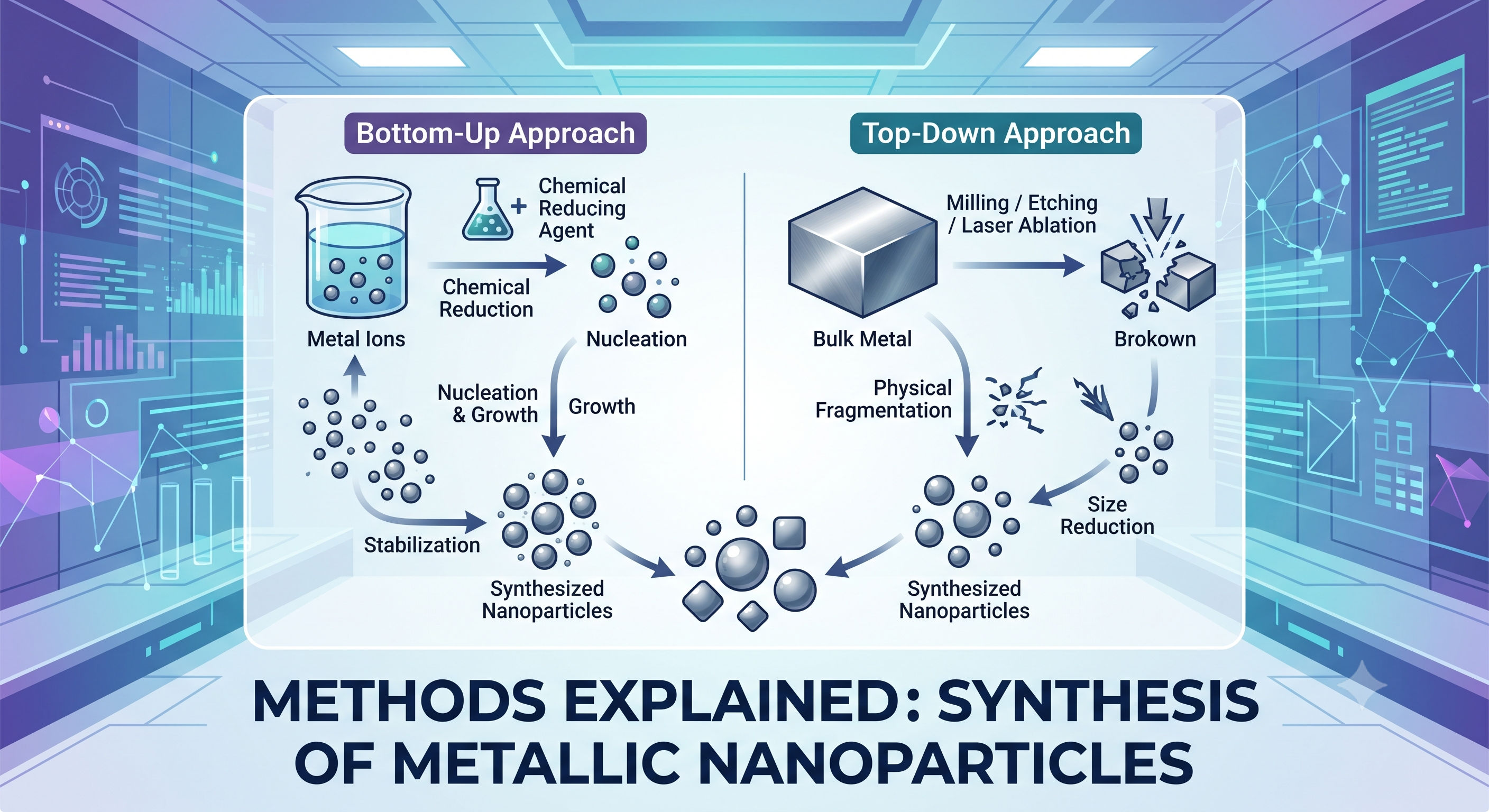
Before diving into specific techniques, it is essential to understand that all nanoparticle synthesis falls into one of two overarching philosophies: the “Top-Down” approach and the “Bottom-Up” approach.
Think of the Top-Down method like a sculptor carving a statue out of a massive block of marble. You start with a bulk metal and use immense physical force or energy to break it down into nanometer-sized fragments.
Conversely, the Bottom-Up method is like building a house out of Lego bricks. You start at the atomic or molecular level, causing individual metal atoms to chemically bond and cluster together until they grow into a perfectly sized nanoparticle. Each approach has its own distinct advantages, industrial applications, and unique challenges.
Top-Down Synthesis Methods: Breaking Down the Bulk
Top-down methods are primarily physical. They are often favored in heavy industrial manufacturing where producing massive quantities of nanomaterials is more critical than achieving perfect atomic precision.
1. High-Energy Ball Milling
This is one of the most common industrial methods for reducing bulk metals into nano metal powders. In this process, macroscopic metallic powders (often starting at around 40 to 50 micrometers in size) are placed into a heavy-duty, rotating cylindrical chamber alongside heavy, hardened grinding media (usually steel or ceramic balls). As the chamber spins at high speeds, the immense kinetic energy of the balls colliding with the metal powder literally crushes and fractures the material. Over an extended period—sometimes days—the continuous mechanical stress breaks the metal down to the nanoscale. While highly effective for scaling up production, the primary challenge of ball milling is preventing contamination from the grinding balls themselves and ensuring the particles do not cold-weld back together.
2. Laser Ablation
This is a highly precise physical method often used in laboratory settings to create ultra-pure nanoparticles. A solid block of the target metal (such as pure gold or silver) is submerged in a liquid solution. A high-powered, pulsed laser is then fired at the metal. The intense, localized heat from the laser vaporizes the surface of the metal, creating a localized plasma plume. As this superheated metal vapor instantly cools in the surrounding liquid, it condenses into perfectly spherical metallic nanoparticles. Because no chemical reducing agents are used, laser ablation produces extremely pure nanoparticles, making them ideal for sensitive biological and medical applications.
3. Sputtering and Physical Vapor Deposition (PVD)
Often used in the electronics and semiconductor industries, these methods involve placing a bulk metal target in a vacuum chamber. The metal is bombarded with high-energy inert gas ions (like argon), which physically knocks individual metal atoms off the surface. These ejected atoms then travel through the vacuum and condense onto a cooler substrate, forming ultra-thin nanoscale films or distinct nanoparticles.
Bottom-Up Synthesis Methods: Building Atom by Atom
Bottom-up methods are primarily chemical or biological. They offer unparalleled control over the final size, shape, and surface chemistry of the nanoparticle, which is crucial for advanced medical and optical applications.
1. Chemical Reduction
This is by far the most widely used laboratory and commercial method for synthesizing metallic nanoparticles. The recipe generally requires three main ingredients: a metal precursor (usually a metal salt dissolved in a liquid), a reducing agent, and a stabilizing (or capping) agent. For example, to make gold nanoparticles, scientists dissolve chloroauric acid in water. They then add a chemical reducing agent, such as sodium citrate or sodium borohydride. The reducing agent forces the gold ions to gain electrons, turning them into uncharged, solid gold atoms. These atoms rapidly bump into each other and cluster together, growing into nanoparticles. To prevent them from growing too large and clumping back into a solid chunk of metal, the capping agent wraps around the growing nanoparticles, stopping their growth at the exact desired nanometer scale and keeping them suspended in the liquid.
2. Sol-Gel Process
The sol-gel method is highly favored for creating metallic oxides. It involves converting a liquid solution (the “sol”) into a solid, network-like structure (the “gel”). Chemical precursors undergo a series of hydrolysis and condensation reactions to form a continuous solid network holding the liquid. Once the liquid is carefully dried and the remaining structure is subjected to thermal treatment (heating), it yields highly porous, precisely shaped metal oxide nanoparticles.
3. Green Synthesis (Biological Methods)
One of the most exciting and rapidly growing areas of nanotechnology is “green synthesis.” Traditional chemical reduction relies on toxic, expensive, and environmentally harmful chemicals. Green synthesis replaces these toxic reducing agents with natural biological extracts. Scientists can take extracts from plant leaves, fungi, bacteria, or even algae—which naturally contain potent antioxidant and phenolic compounds—and mix them with a metal salt solution. The plant extracts naturally reduce the metal ions into nanoparticles and simultaneously act as a capping agent. This eco-friendly, cost-effective method is revolutionizing the production of nanoparticles intended for human healthcare and environmental remediation.
Current Research and Clinical Studies
The synthesis of metallic nanoparticles is not just an academic exercise; these materials are actively saving lives and powering the technologies of tomorrow. Clinical research into nanomedicine is currently one of the most heavily funded areas of global science.
Targeted Cancer Therapeutics (Photothermal Therapy)
Traditional cancer treatments, like chemotherapy, flood the entire body with toxins, causing severe damage to healthy cells. Gold nanoparticles are changing this paradigm. In ongoing clinical studies, researchers engineer gold nanoparticles coated with specific antibodies that only bind to cancer cells. Once injected into a patient, the gold particles accumulate exclusively inside the tumor. Doctors then shine a harmless Near-Infrared (NIR) laser through the patient’s skin. Because of a quantum phenomenon called Surface Plasmon Resonance, the gold nanoparticles absorb the laser light and instantly convert it into intense, localized heat. This literally cooks the tumor from the inside out without harming the surrounding healthy tissue.
Advanced Medical Diagnostics and MRI
Superparamagnetic Iron Oxide Nanoparticles (SPIONs) are heavily researched and already utilized in clinical settings as advanced contrast agents for Magnetic Resonance Imaging (MRI). When these metallic nanoparticles are introduced into the bloodstream, they dramatically enhance the visibility of soft tissues, allowing radiologists to detect micro-tumors, vascular blockages, and cellular inflammation much earlier than previously possible.
Antimicrobial Applications and Wound Care
Silver nanoparticles are uniquely toxic to bacteria, viruses, and fungi, but relatively safe for human cells. They work by continuously releasing silver ions that puncture bacterial cell walls and destroy their DNA. Today, silver nanoparticles are synthesized directly into advanced wound dressings, surgical instruments, and burn creams. Clinical trials have repeatedly demonstrated that silver nanoparticle dressings heal severe burns faster and prevent lethal hospital-acquired infections far more effectively than traditional antibiotics, especially in an era of antibiotic-resistant “superbugs.”
Advantage vs. Risk Assessment
As metallic nanoparticles move from the laboratory into commercial products, medical treatments, and environmental applications, it is vital to balance their groundbreaking capabilities with their inherent challenges.
The Advantages
-
Exponential Surface Area: Because of their microscopic size, metallic nanoparticles have a massive surface area relative to their volume. This makes them incredibly efficient catalysts. A small handful of nano-catalysts can speed up an industrial chemical reaction faster than a massive block of the same metal, saving vast amounts of time and energy.
-
Tunable Properties: By simply tweaking the synthesis method to change the size or shape of the nanoparticle (e.g., making a nano-star instead of a nano-sphere), scientists can entirely change how the metal conducts electricity, absorbs light, or interacts with human biology.
-
Breakthroughs in Energy: Metallic nanoparticles are being actively integrated into the anodes and cathodes of modern battery systems, radically increasing the charging speed and total energy capacity of electric vehicles (EVs) and renewable energy grids.
The Risks and Challenges
-
Nanotoxicology: The primary risk of nanoparticles is their size. In a manufacturing setting, if airborne nanoparticles are inhaled, they can easily bypass the body’s natural respiratory filters, lodge deep in the lungs, and even cross the blood-brain barrier. The long-term cellular toxicity of human exposure to airborne metallic nanomaterials requires stringent, highly controlled laboratory safety protocols.
-
Environmental Accumulation: As products utilizing nanoparticles degrade (such as silver-infused clothing being washed), these particles leach into wastewater and eventually the natural environment. Research indicates that accumulated metallic nanoparticles can be toxic to aquatic ecosystems, soil microbes, and agricultural systems. The long-term environmental lifecycle of these materials is a subject of intense regulatory scrutiny.
-
Handling and Pyrophoric Hazards: In their dry powder form, certain pure metallic nanoparticles are highly reactive. Due to their immense surface energy, metals that are normally stable can become pyrophoric at the nanoscale, meaning they can spontaneously combust when exposed to the oxygen in standard room air. They often must be synthesized, stored, and handled in inert gas environments (like argon or nitrogen chambers).
-
The Agglomeration Problem: Nanoparticles inherently want to stick together to reduce their surface energy. Keeping them evenly dispersed during synthesis and preventing them from clumping back into useless bulk materials requires complex and expensive chemical engineering.
The Future of Nanoparticle Synthesis
The science of synthesizing metallic nanoparticles has evolved from trial-and-error laboratory experiments into a highly sophisticated, multi-disciplinary industry. The next frontier in this field involves the integration of Artificial Intelligence and autonomous manufacturing. By utilizing AI algorithms to continuously monitor and adjust chemical precursors, temperatures, and milling times in real-time, the industry is moving toward flawless, high-yield, continuous-flow synthesis.
As we refine green synthesis methods to protect the environment and perfect surface-coating techniques for targeted medical treatments, metallic nanoparticles will undoubtedly continue to serve as the invisible building blocks of our technological future. They prove that sometimes, to solve the world’s biggest problems, we must think on the smallest possible scale.