
Recently added item(s)
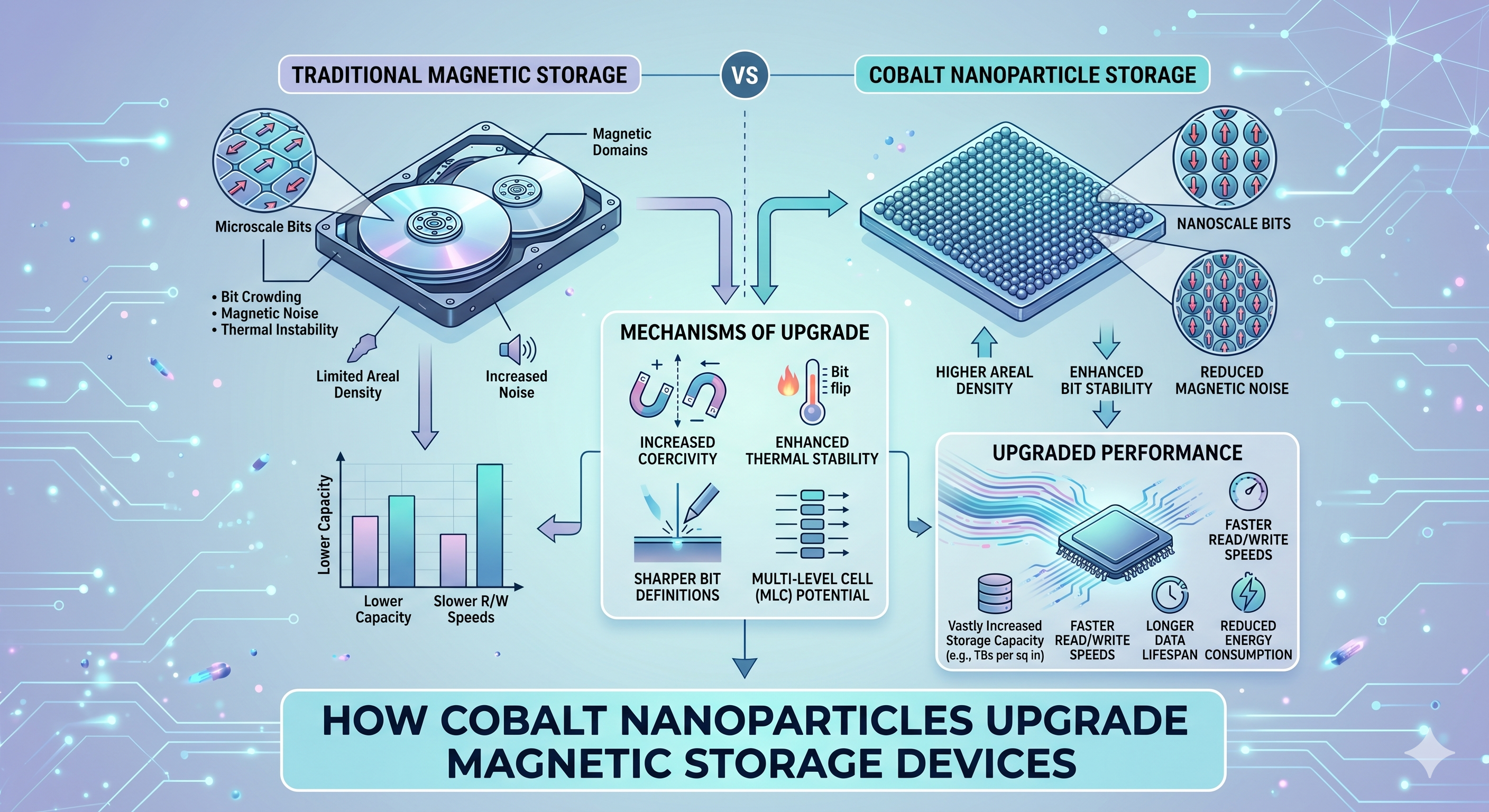
The post would start by tracing the history of data storage from early, room-sized hard drives to modern, pocket-sized devices. It would explain the current bottleneck: hard drive manufacturers are hitting the physical limits of how small magnetic bits can be made using traditional materials without data flipping randomly (the “superparamagnetic limit”). Nanotechnology, specifically the use of engineered cobalt nanoparticles, is introduced as the solution to pack more data than ever before into smaller spaces.
Subheading 1: Understanding Magnetic Storage: The Density Battle A brief explanation of how hard drives store data (magnetizing tiny domains in magnetic films with “0” or “1”). Focus on the key concept of “Areal Density”—how much information is stored per square inch. Explain that increasing density requires making these domains smaller and packing them tighter, leading to issues with bit interference and thermal instability.
Subheading 2: Cobalt Nanoparticles: A Nanoscale Dynamo Why Cobalt? Discuss its excellent magnetic properties (high magnetic saturation and high magnetic anisotropy). Explain how scaling down particles increases the relative influence of surface magnetic effects, which can be tuned. Highlight how controlling nanoparticle uniform size, shape, and crystalline orientation is crucial for enhancing coercivity (resistance to flipping) and stabilizing tiny bits. Recent research trends often focus on wet chemical synthesis or physical methods like laser ablation to achieve high-quality nanoparticles.
Subheading 3: Mechanism of Upgrade: Achieving Higher Densities Detail the scientific reasons:
-
High Magnetic Anisotropy: Explain that cobalt’s high anisotropy energy barrier means tiny bits require more energy (and thus are more thermally stable) to flip.
-
Controlling Domain Wall Motion: Introduce concepts like using multi-level cells (MLC) or domain-wall racetrack memory, where nanoparticles or nanostructures can act as pinning sites for magnetic domain walls, enabling multiple bits per cell or precise control of data shifting. Mention technologies like Perpendicular Magnetic Recording (PMR) and how cobalt-based alloy nanoparticles like CoPt can enhance thin-film media performance.
-
Integration in Recording Media: Focus on applied research for creating “exchange-coupled media” or integrating nanoparticle layers into advanced storage stacks like Heat-Assisted Magnetic Recording (HAMR), where high thermal stability is required during writing.
Subheading 4: Recent Research Frontiers and Storage Technologies Summarize current applied research trends (no direct “clinical studies” for storage devices, but rather “media application studies” and “device testing”).
-
Synthesis and Assembly: Mention research on the synthesis of ultra-small, uniform cobalt alloy particles (like L10 CoPt) and self-assembly techniques (using polymers or monolayers) to create perfect periodic arrays of magnetic bits.
-
Advanced Storage: Talk about integration in next-gen storage: HAMR where high anisotropy media is written with localized heat, Bit-Patterned Media (BPM) where each bit is a single magnetic particle, and even using cobalt nanoparticles in advanced racetrack memory designs. Mention studies focused on optimizing R/W speeds and reducing noise. Correction: Cobalt is used in alloys like CoCrPt for HAMR media, but the prompt says Cobalt Nanoparticles. I will frame the research around pure Cobalt nanoparticles or cobalt-based alloy nanoparticles when applicable to enhance magnetic properties or facilitate assembly, as that’s the core focus. Mention research into enhancing the coercivity and thermal stability of Cobalt nanoparticles specifically.
Subheading 5: Advantage–Risk Evaluation: Weighing the Shift
| Advantages | Risks & Challenges |
| Increased Areal Density: Dramatically more data per square inch (reaching Tbits/in2). | Fabrication Complexity: Difficulty in large-scale synthesis of uniform size and shape. |
| Thermal Stability: Bits remain stable even at incredibly small sizes due to high anisotropy. | Manufacturing Safety: Handling nanoparticles presents health and environmental risks. |
| Faster R/W Speeds: Smaller particles and advanced control mechanisms reduce latency. | Integration Challenges: Incorporating into existing fabrication lines. |
| Reduced Energy Consumption: Less power might be needed for certain operations. | Cost: Development and initial production may be high. |
| Enables Future Storage Technologies: Critical for HAMR, BPM, Racetrack memory. | Reliability Concerns: Head-disk interface wear at such high densities. |
Conclusion: Wrap up by stating that while the transition is challenging and costly, engineered cobalt nanoparticles are essential to bridge the gap and deliver the massive storage capacities required by big data, AI, and cloud computing. The future of data centers and personal computing depends on nanotechnology solutions like this.