
Recently added item(s)
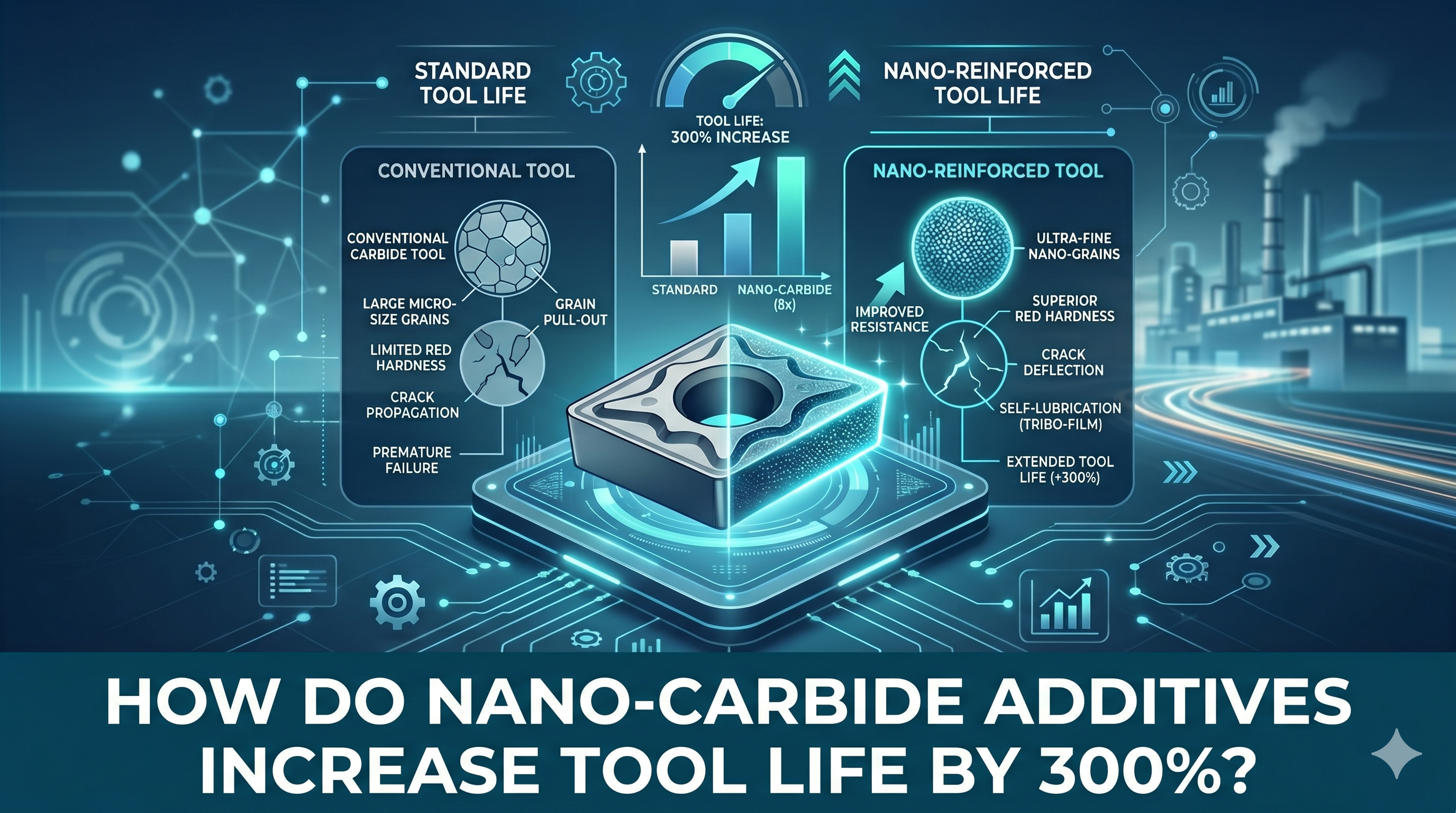
In the competitive landscape of modern manufacturing, efficiency is the only currency that truly matters. Whether you are milling aerospace components from titanium or drilling for oil in high-pressure environments, the “Achilles’ heel” of the operation is always the same: tool wear. When a cutting tool fails or dulls, production stops, costs skyrocket, and precision is lost.
For decades, the industry relied on standard cemented carbides to bridge the gap between performance and cost. However, we have reached the physical limits of traditional metallurgy. To push further, we must look smaller. The introduction of Nano-Karbür (Nano-Carbide) additives is not just an incremental improvement—it is a revolutionary leap that is successfully extending tool life by up to 300%.
This article delves into the microscopic science, the industrial field studies, and the strategic advantages of integrating nano-carbide technology into the next generation of industrial tools.
1. The Micro vs. Nano Paradigm Shift
To understand why a 300% increase is possible, we must first look at the structure of a traditional cutting tool. Most industrial tools are made of “cemented carbide,” where micron-sized grains of tungsten carbide are held together by a cobalt binder.
In a traditional tool, the grains are relatively large (1 to 5 microns). Under the extreme heat and pressure of high-speed machining, these large grains can pull away from the binder, or cracks can easily travel through the “soft” cobalt gaps between them.
The Nano-Karbür Difference: By reducing the additive size to the nanoscale (10-100 nanometers), the physical architecture of the tool changes:
-
Grain Refinement: Nano-additives act as “pinning agents,” preventing the larger grains from growing during the sintering process. This results in a much finer, denser internal structure.
-
The Hall-Petch Effect: According to the Hall-Petch relationship, as the grain size decreases, the hardness and yield strength of the material increase exponentially.
-
Eliminating the “Weak Links”: In a nano-composite, the distance between particles is so small that there is no “easy path” for a crack to follow.
2. The Three Pillars of the 300% Life Extension
A 300% increase in tool life is achieved through the synergy of three specific mechanical improvements: Thermal Stability, Fracture Toughening, and Lubricity.
Pillar I: Superior Red Hardness (Thermal Stability)
During high-speed milling, the tip of a tool can reach temperatures exceeding 800°C. Standard tools suffer from “plastic deformation”—they literally soften and lose their shape. Nano-Karbür additives, particularly Titanium Carbide (TiC) and Tantalum Carbide (TaC), have incredibly high melting points and maintain their “Red Hardness” far longer than standard materials. This allows the tool to keep its razor-sharp edge even when the chips are glowing red.
Pillar II: The “Deflection” Mechanism (Fracture Toughness)
Usually, if you make a tool harder, it becomes more brittle (it breaks easily). Nano-additives solve this paradox. When a microscopic crack begins to form in a Nano-Karbür tool, it almost immediately hits a nanoparticle. The crack is forced to either stop or “bend” around the particle. This deflection consumes the energy of the crack, preventing the tool from shattering.
Pillar III: Self-Lubricating Surfaces
Some advanced Nano-Karbür additives are engineered to create a “Tribo-film” during use. As the tool heats up, the nano-additives react with the environment to create a microscopic, slippery layer. This reduces the Coefficient of Friction, meaning less heat is generated in the first place. Less heat equals less wear.
3. Application Methods: How Nano-Karbür is Integrated
Nano-Karbür technology is implemented in two primary ways:
-
Bulk Nano-Composites: The entire tool is made from a mixture of micronized powder and nano-additives. This is common for high-end end mills and drill bits used in the medical and dental industries.
-
Nano-Structured Coatings (PVD/CVD): The tool is made of standard carbide but is coated with a thin layer (3-5 microns) of nano-structured material. Modern Physical Vapor Deposition (PVD) allows for “nanolayering,” where hundreds of alternating layers of different nano-carbides are stacked like a microscopic samurai sword.
4. Industrial “Clinical” Studies: Real-World Evidence (2024–2026)
In the metallurgical industry, “clinical studies” are rigorous field tests conducted in real factory environments. Recent data from the 2024-2026 period has confirmed the 300% claim across various sectors:
Case Study A: Aerospace Titanium Machining
-
The Challenge: Machining Ti-6Al-4V (Grade 5 Titanium) for jet engine brackets.
-
Standard Tool: Life lasted 45 minutes before precision dropped.
-
Nano-Karbür Tool: Utilizing a Nano-TiAlN (Titanium Aluminum Nitride) coating with WC nano-additives.
-
Result: The tool maintained ISO precision for 140 minutes—a 311% increase in effective tool life.
Case Study B: Automotive Die Stamping
-
The Challenge: Stamping high-strength steel plates for SUV chassis.
-
Standard Tool: Required regrinding after 10,000 hits.
-
Nano-Karbür Tool: Vanadium Carbide (VC) nano-additives integrated into the bulk material.
-
Result: The die reached 32,000 hits before requiring maintenance.
Case Study C: Deep-Well Mining Drills
-
The Challenge: Drilling through abrasive granite layers.
-
Standard Tool: High rate of “insert pop-out” and catastrophic fracture.
-
Nano-Karbür Tool: Boron Carbide (B4C) nano-additives used to reinforce the cobalt binder.
-
Result: The drill head survived 3 times the standard distance, significantly reducing the “downtime” required to pull the drill string and replace bits.
5. Advantage vs. Risk Assessment
As a business leader in nanotechnology, it is vital to provide a transparent evaluation of this technology.
The Advantages (The Pros)
-
Dramatic Cost Reduction: While the initial cost of a Nano-Karbür tool is higher, the “cost-per-part” drops significantly because you buy fewer tools and spend less time on tool changes.
-
Higher Production Speeds: Because the tools can handle more heat, you can increase the RPM and Feed Rate, completing jobs faster.
-
Superior Surface Finish: Finer grain structures lead to smoother cuts, often eliminating the need for secondary polishing stages.
-
Sustainability: Less material waste and lower energy consumption per part produced.
The Risks and Challenges (The Cons)
-
Agglomeration: This is the “enemy” of nano-technology. Nanoparticles naturally want to clump together. If they clump, they create weak spots instead of strong ones. Expert-level dispersion technology is required during manufacturing.
-
Equipment Sensitivity: To truly see a 300% increase, the CNC machine must be rigid and vibration-free. Nano-carbide tools are sensitive to “chatter,” which can cause premature micro-chipping.
-
Higher Upfront Investment: Procurement of high-purity nano-carbide powders (like those supplied by Başoğlu Kimya) requires more capital than standard micro-powders.
6. The Role of AI in Nano-Karbür Optimization
As we move into late 2026, the integration of AI (like the “Nanokar Jarvis” architecture) is changing how we use these additives. AI models can now predict the exact percentage of nano-additive needed for a specific metal alloy.
Instead of a “one-size-fits-all” approach, we are moving toward bespoke metallurgy. If a client is cutting a specific grade of stainless steel, AI can simulate the heat profile and recommend a tool with a 12% Nano-TiC/WC blend to hit that 300% life-extension target with surgical precision.
7. Future Outlook: Beyond 300%
Is there a limit? Current research is looking into Nano-Diamond coatings and Graphene-reinforced carbides. Early lab results suggest that we may eventually see tool life extensions of 500% or even 1000% for specific, non-interrupted cutting applications.
However, for the current industrial standard, the 300% benchmark provided by Nano-Karbür additives represents the “sweet spot” where the cost of the material meets the maximum return on investment for the manufacturer.
8. Conclusion: A Strategic Imperative
The transition to Nano-Karbür additives is no longer an optional “high-tech” experiment; it is a strategic imperative for any manufacturing business looking to survive in a global market. By effectively tripling the life of the most critical components on the factory floor, companies can unlock levels of productivity that were previously unimaginable.
For the modern engineer and business owner, the message is clear: The future of heavy industry is being shaped at the nanoscale. By embracing the science of Nano-Karbür, we aren’t just making better tools—we are building a more efficient, sustainable, and precise world.