
Recently added item(s)
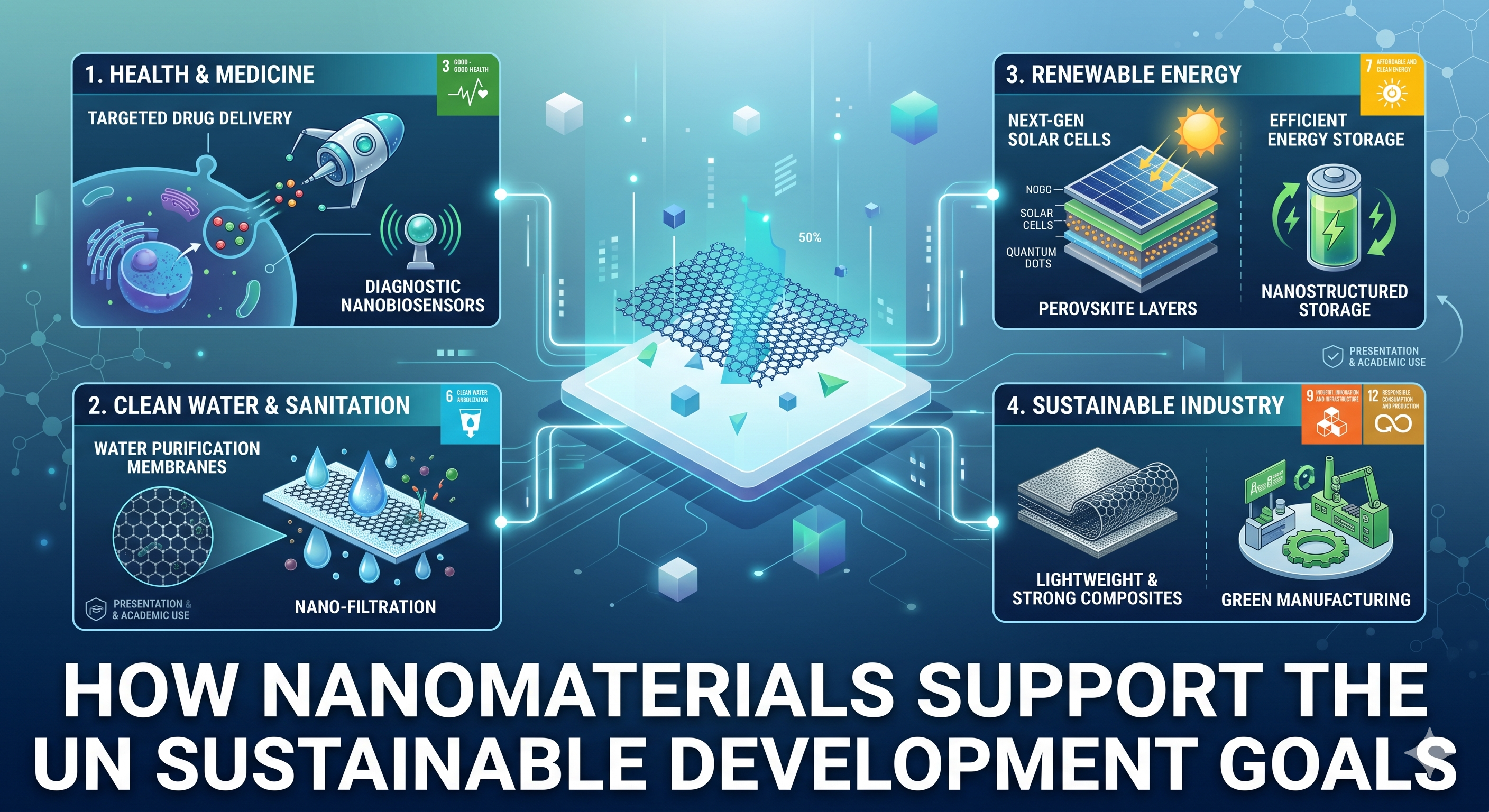
The world is facing unprecedented challenges, from the climate crisis and water scarcity to intractable diseases and food insecurity. In 2015, the United Nations adopted the 2030 Agenda for Sustainable Development, outlined by 17 Sustainable Development Goals (SDGs). These goals serve as a shared blueprint for peace and prosperity for people and the planet. Achieving them, however, requires radical innovation and new technological tools.
Enter nanotechnology—the science of the incredibly small. Nanomaterials are defined as substances having at least one dimension sized between 1 and 100 nanometers (a nanometer is one-billionth of a meter). At this scale, the classical laws of physics begin to blend with quantum mechanics, giving rise to unique optical, electrical, magnetic, and chemical properties that their “bulk” counterparts do not possess.
Nanoscience is not merely about making gadgets smaller; it is about harnessing these novel properties to solve macro-scale problems. Nanomaterials are rapidly emerging as key enablers that can support—and accelerate—the achievement of multiple SDGs. Here is a detailed look at how these small wonders are driving big changes across critical goals.
SDG 3: Good Health and Well-being
Perhaps nowhere is the impact of nanomaterials more immediately tangible than in healthcare. Traditional medicine often suffers from a “scattershot” approach, where drugs are distributed throughout the body, potentially causing severe side effects and requiring high doses to be effective.
Precision Medicine and Targeted Drug Delivery
Nanoparticles are the ultimate precision delivery vehicles. They can be engineered to encapsulate drugs, protecting them from degradation in the bloodstream, and then programmed to release their payload only when they encounter specific environmental triggers, such as the acidic environment of a tumor or a specific enzyme.
-
Clinical Studies and Examples: The most famous current application is Lipid Nanoparticles (LNPs). These nano-sized fatty spheres were crucial for the success of mRNA COVID-19 vaccines (SDG 3.3—fighting communicable diseases). They protect the delicate mRNA and deliver it safely inside host cells.
-
Cancer Therapy: Gold nanoparticles are being widely researched for photothermal therapy. They accumulate selectively in tumors; when illuminated with near-infrared light, they vibrate and generate intense heat, killing cancer cells from within while sparing healthy tissue. Several phase I/II clinical trials have investigated this approach for prostate and head and neck cancers, showing promising safety and efficacy profiles.
Advanced Diagnostics
Nanobiosensors allow for earlier, faster, and more sensitive disease detection at the point of care (e.g., in remote areas without massive laboratories). For instance, graphene-based sensors can detect single molecules of a disease biomarker in blood or saliva, allowing for intervention before symptoms even appear.
SDG 6: Clean Water and Sanitation
Access to safe water and sanitation is a basic human right, yet billions still lack it. Nanomaterials offer revolutionary solutions for water purification, desalination, and wastewater treatment (SDG 6.3 and 6.1).
Atomic-Scale Filtering
Traditional water filters can be bulky and inefficient at removing fine contaminants. Nanomembranes, particularly those made from Graphene Oxide (GO), create atomic-scale meshes. GO sheets are nearly impervious, but by tuning the distance between sheets, scientists can create channels that allow water molecules through while effectively blocking salts, heavy metals, industrial dies, and even bacteria and viruses.
-
Current Research: Researchers at the University of Manchester have demonstrated a graphene “sieve” that can effectively filter common salts out of seawater, offering hope for affordable, large-scale desalination—a potential game-changer for water-scarce regions.
Nanocatalysts for Pollution Destruction
Instead of just trapping pollutants, some nanomaterials destroy them. Titanium Dioxide (TiO2) nanoparticles act as photocatalysts. When exposed to UV light (including natural sunlight), they generate reactive oxygen species that chemically break down organic pollutants—such as pesticides and pharmaceuticals—into harmless components like water and CO2.
SDG 7: Affordable and Clean Energy
Transitioning to green, renewable energy is non-negotiable for a sustainable future. Nanomaterials are crucial for improving the efficiency and affordability of solar power, energy storage, and hydrogen production.
Boosting Solar Efficiency
Most commercial solar cells are made of silicon, which has efficiency limits. Nanotechnology is enabling the next generation of photovoltaics.
-
Perovskite Solar Cells: These cells utilize nanomaterials with a specific crystal structure. They are cheaper to produce than silicon and have seen rapid efficiency gains, jumping from 3.8% in 2009 to over 25% today in laboratory settings. Graphene is often used as a conductive electrode in these cells to improve stability and charge collection.
-
Quantum Dots: These are semiconductor nanocrystals that can absorb different colors of light depending on their size. They can be tuned to capture a wider spectrum of sunlight than traditional materials, potentially creating ultra-high-efficiency solar cells.
Revolutionizing Energy Storage
Renewable energy is intermittent; we need better batteries. Nanomaterials are addressing the limitations of Lithium-ion technology. By using nanostructured materials for anodes (like silicon nanowires or carbon nanotubes), researchers can exponentially increase the surface area for lithium ions, allowing for batteries that charge faster, hold more power, and last for many more cycles (SDG 12.5—reducing waste).
SDG 2: Zero Hunger
Modern agriculture must become more productive while using fewer resources and less harmful chemistry. Nanomaterials support “precision agriculture” (SDG 2.4).
Nano-Agrochemicals
Traditional fertilizers and pesticides are often inefficient; up to 90% can wash away or evaporate, polluting soil and water. Nano-encapsulated fertilizers and pesticides are “smart.” They release nutrients or active agents slowly over weeks or months, or only in response to triggers like soil moisture or pH levels. This minimizes wastage, reduces chemical runoff, and ensures plants receive optimal nutrition.
Sensing and Pathogen Detection
Nanobiosensors can be deployed in the soil to monitor nutrient levels, temperature, and moisture in real-time, allowing farmers to apply inputs only where and when needed. Furthermore, nanomaterial-based diagnostic kits can detect plant pathogens in the field within minutes, rather than days, preventing widespread crop loss.
SDG 12 & 13: Responsible Consumption, Climate Action, and Remediation
Beyond prevention, nanomaterials are vital for cleaning up existing ecological damage and creating a circular economy.
Clean up and Nano-Remediation
Accidental oil spills and industrial contamination of groundwater are major environmental disasters. Nanomaterials are proving to be powerful cleanup tools. Nano-Zero-Valent Iron (nZVI) particles can be injected directly into contaminated groundwater, where they chemically reduce chlorinated solvents and heavy metals, converting them into non-toxic or immobilized forms. Their small size allows them to migrate through the pores of the soil to reach the contamination source, a process much less disruptive than digging up vast areas.
Greener Manufacturing
Nanotechnology supports SDG 12 by enabling stronger, lighter materials (SDG 12.2—sustainable management of natural resources). Carbon composites reinforced with carbon nanotubes are exponentially stronger than steel but significantly lighter, leading to fuel savings in automotive and aerospace applications (supporting SDG 13—Climate Action). Green synthesis methods, which make nanomaterials using plant extracts or microorganisms rather than harsh chemicals, are also growing, ensuring the nanotechnology industry itself is sustainable.
The Critical Flipside: Advantage-Risk Assessment
The potential of nanomaterials is undeniable, but we must proceed with caution. The very properties that make them useful—high reactivity, surface area, and ability to penetrate cells—also raise unique safety concerns. A responsible, “safe-by-design” approach is necessary.
| Advantages | Risks and Challenges |
| Precision & Efficiency: Enables targeted therapies, highly efficient filters, and smart agrochemicals, reducing wastage. | Nano-Toxicity: Small size allows them to cross the blood-brain barrier, enter cell membranes, and interact with DNA in unknown ways. Some, like Certain Carbon Nanotubes, can resemble asbestos fibers if inhaled. |
| Novel Functionalities: Accesses quantum effects for new optical, electronic, and catalytic capabilities not found in bulk materials. | Environmental Accumulation: The long-term fate of engineered nanomaterials in ecosystems is unknown. How do they interact with microbes, soil, or marine life? Do they bioaccumulate up the food chain? |
| Resource Savings: Stronger, lighter materials and better storage solutions reduce natural resource consumption and energy waste. | Regulatory Gaps: Current chemical regulations (like REACH) were designed for bulk materials. New frameworks, testing protocols, and standardized safety assessments are urgently needed. |
| Decentralized Solutions: Portable nanobiosensors and small-scale nano-water filters can bring critical services to remote areas (SDG 9—Innovation). | Socio-Economic Nano-Divide: The cost of developing nanotechnology is high. There is a risk that only wealthy nations will benefit, worsening existing global inequalities (contrary to SDG 10—Reduced Inequalities). |
Moving Forward Safely
To manage these risks, “Nano-EHS” (Environment, Health, and Safety) research must keep pace with innovation. The goal is “safe-by-design”—developing nanomaterials that are inherently non-toxic or biodegradable from the outset. Transparency in labeling and robust regulatory oversight are essential to ensure public trust and responsible development.
Conclusion: The Nano-Enabled Path to 2030
Achieving the UN Sustainable Development Goals requires leveraging every tool at our disposal. While nanomaterials are not a panacea, they represent a powerful, versatile toolkit that can significantly accelerate progress. By manipulating matter at the atomic level, we can design precision medicine, atomic sieves for clean water, ultra-efficient energy technologies, and sustainable agricultural systems.
The challenges—from technical implementation and economic divides to critical toxicity concerns—must be faced with rigorous science and ethical responsibility. However, if navigated with care, these small wonders can have a truly massive impact, serving as the hidden engine that powers humanity toward a sustainable, healthy, and prosperous future for all.