
Recently added item(s)
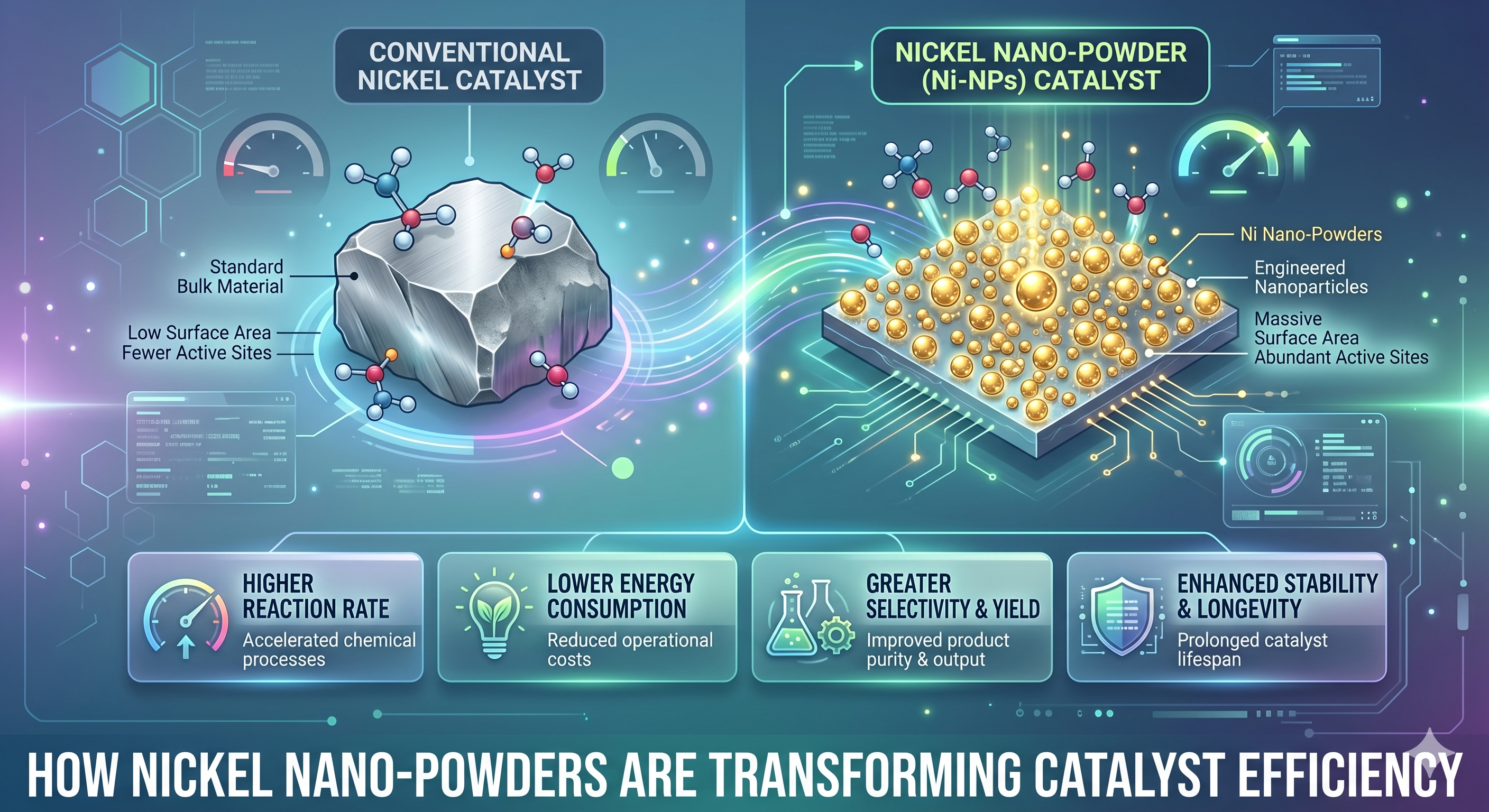
In the vast landscape of industrial chemistry, there is a group of “hidden heroes” that drive nearly 90% of all commercially produced chemical products. These heroes are catalysts—substances that speed up chemical reactions without being consumed in the process. For over a century, the crown jewels of catalysis have been precious metals like Platinum, Palladium, and Iridium. However, as the world pivots toward a sustainable, hydrogen-based economy, these metals have become a bottleneck due to their extreme cost and scarcity.
The solution to this global challenge is found in a more common, silvery-white metal: Nickel. Specifically, Nickel Nano-Powders (Ni NPs). By shrinking nickel particles down to the nanometer scale, scientists have unlocked a level of catalytic activity that rivals precious metals at a fraction of the cost. In this comprehensive guide, we explore how these tiny particles are revolutionizing everything from green hydrogen production to carbon capture, and the latest research defining their role in 2026.
The Power of the “Small”: Why Nano-Nickel?
To understand why “nano” matters, we have to think about surface area. A chemical reaction on a catalyst only happens at the surface where the “reactant” molecules touch the metal.
Imagine a solid cube of nickel. Only the atoms on the outside of the cube can participate in a reaction; the trillions of atoms inside are “dead weight.” If you take that same cube and shatter it into billions of nanoparticles, you expose almost every single atom to the outside world.
The Nano-Advantage:
-
High Surface-to-Volume Ratio: A gram of Nickel Nano-Powder can have a surface area comparable to half a football field.
-
Active Sites and Defects: At the nano-scale, the surface isn’t smooth. It is full of “steps,” “edges,” and “kinks.” These atomic-scale defects act as high-energy docking stations for molecules, lowering the energy barrier for reactions to occur.
-
Electronic Tuning: At the nano-scale, the way electrons move around the nickel atoms changes. This makes the catalyst more “eager” to swap electrons with other chemicals, speeding up the reaction.
1. The Hydrogen Revolution: AEM and Green Fuel
The most significant application of Nickel Nano-Powders in 2026 is in Green Hydrogen production. Traditionally, “Green” hydrogen (made by splitting water with renewable electricity) required expensive Iridium or Platinum electrodes.
Alkaline Exchange Membrane (AEM) Electrolysis
Research in 2025 and 2026 has shifted heavily toward AEM electrolysis. Unlike older methods, AEM allows for the use of non-precious metals. Nickel Nano-Powders, specifically those engineered with a “urchin-like” or “dendritic” morphology, are being used as the primary catalyst for the Oxygen Evolution Reaction (OER).
Recent field trials have shown that AEM electrolyzers using nano-nickel can achieve efficiencies of over 80%, reaching parity with platinum-based systems. This is a massive win for the industry, as it lowers the capital cost of hydrogen plants by nearly 40%.
2. Carbon Capture and Utilization (CCU): Turning CO2 into Wealth
As we fight climate change, we are no longer just trying to “store” Carbon Dioxide (CO2); we are trying to use it. This is known as the Sabatier Reaction, where CO2 and Hydrogen are converted into synthetic natural gas (Methane, CH4).
Nickel is the “industry standard” for this reaction. However, traditional nickel catalysts often suffer from “coking”—where carbon soot builds up on the catalyst and “chokes” it.
Research Update (2026): New studies have developed Graphene-encapsulated Nickel Nano-Powders. By wrapping the nickel in a single-atom-thick layer of graphene, researchers have created a “one-way door.” Reactant gases can reach the nickel, but the carbon atoms cannot clump together to form soot. This increases the catalyst’s lifespan from a few hundred hours to several thousand hours of continuous operation.
3. Magnetic Recovery: The “Smart” Catalyst
One of the biggest headaches in industrial chemistry is separating the catalyst from the finished product. If you are making pharmaceutical drugs or food products, you cannot leave tiny metal particles behind.
Because Nickel is ferromagnetic, Nickel Nano-Powders offer a brilliant solution: Magnetic Separation. In modern “Smart Factories,” nano-nickel catalysts are used in a liquid reaction. Once the reaction is done, a high-power electromagnet is turned on outside the tank. All the nickel particles are pulled to the side, allowing the clean product to be poured out. The magnet is then turned off, and the catalyst is reused. This “circular” approach reduces waste and ensures product purity.
4. Industrial “Clinical” Case Studies (2025–2026)
In the world of materials science, “clinical trials” often take the form of industrial pilot projects.
-
The Rotterdam Hydrogen Pilot (2025): A major energy consortium tested a 10-megawatt AEM electrolyzer using nano-nickel catalysts for 6,000 continuous hours. The results, published in early 2026, showed zero degradation in the nickel structure, proving that nano-powders can survive the harsh environment of industrial water-splitting.
-
Bio-Refinery Desulfurization: In Brazil, a pilot plant used Nickel-Molybdenum nano-powders to remove sulfur from bio-diesel. The nano-catalyst was found to be 2.5 times more efficient than standard pellets, allowing the refinery to operate at lower temperatures and save 15% on energy costs.
Advantage vs. Risk Evaluation: Balancing Efficiency and Safety
While Nickel Nano-Powders are transformative, they must be handled with the respect due to any high-performance material.
The Advantages
-
Economic Disruption: Nickel costs roughly $15–$20 per kilogram, while Platinum can exceed $30,000 per kilogram. This allows for massive scaling of green technologies.
-
Selectivity: Nano-nickel can be “tuned” to produce only the desired chemical, reducing byproducts and the need for expensive purification steps.
-
Lower Operating Temperatures: High-efficiency catalysts allow reactions to happen at 200 degrees Celsius instead of 500 degrees, dramatically reducing carbon emissions from the manufacturing process itself.
The Risks and Challenges
-
Pyrophoricity: Nickel Nano-Powders are so reactive that they can spontaneously catch fire when exposed to air (oxygen). They must be transported and stored in inert gases (like Argon) or liquid slurries.
-
Sintering: At high temperatures, nanoparticles have a tendency to “clump” together to reduce their surface energy. Once they clump, they lose their “nano” properties. Preventing this requires sophisticated “supports” like Alumina or Silica.
-
Toxicological Concerns: Clinical research on “Hard Metal Lung Disease” reminds us that inhaling metal dust is dangerous. In 2026, the industry has adopted “Wet-Handling” protocols where nano-powders are never handled as dry dust, mitigating the risk to workers.
-
Nickel Sensitivity: About 10-15% of the population has a nickel allergy. While this isn’t an issue for sealed industrial catalysts, it is a consideration for the disposal and recycling of these materials.
The Future: High-Entropy Alloy (HEA) Nano-Powders
The next frontier, currently in the “lab-to-pilot” phase in 2026, is the creation of Nickel-based High-Entropy Alloys. Instead of using pure nickel, scientists are creating nano-powders that contain five or more elements (e.g., Nickel-Iron-Cobalt-Chromium-Manganese) in equal parts.
These “super-catalysts” are showing unprecedented stability. In some cases, the presence of the other metals “locks” the nickel atoms in place, preventing sintering even at white-hot temperatures. This could be the final key to making 100% efficient, carbon-neutral aviation fuel a reality by 2030.
Conclusion
Nickel Nano-Powders are more than just a chemical additive; they are the fundamental building blocks of the next industrial revolution. By taking a common metal and reimagining it at the nanometer scale, we have created a tool that is affordable enough for the entire world to use, yet powerful enough to solve our most pressing environmental challenges.
As the CEO of Nanokar and Başoğlu Kimya, Sefer Baş, often emphasizes, the transition to a sustainable future isn’t just about “new energy”—it’s about the new materials that make that energy possible. Nickel Nano-Powders are leading that charge, ensuring that the engine of global industry runs cleaner, faster, and more efficiently than ever before.