
Recently added item(s)
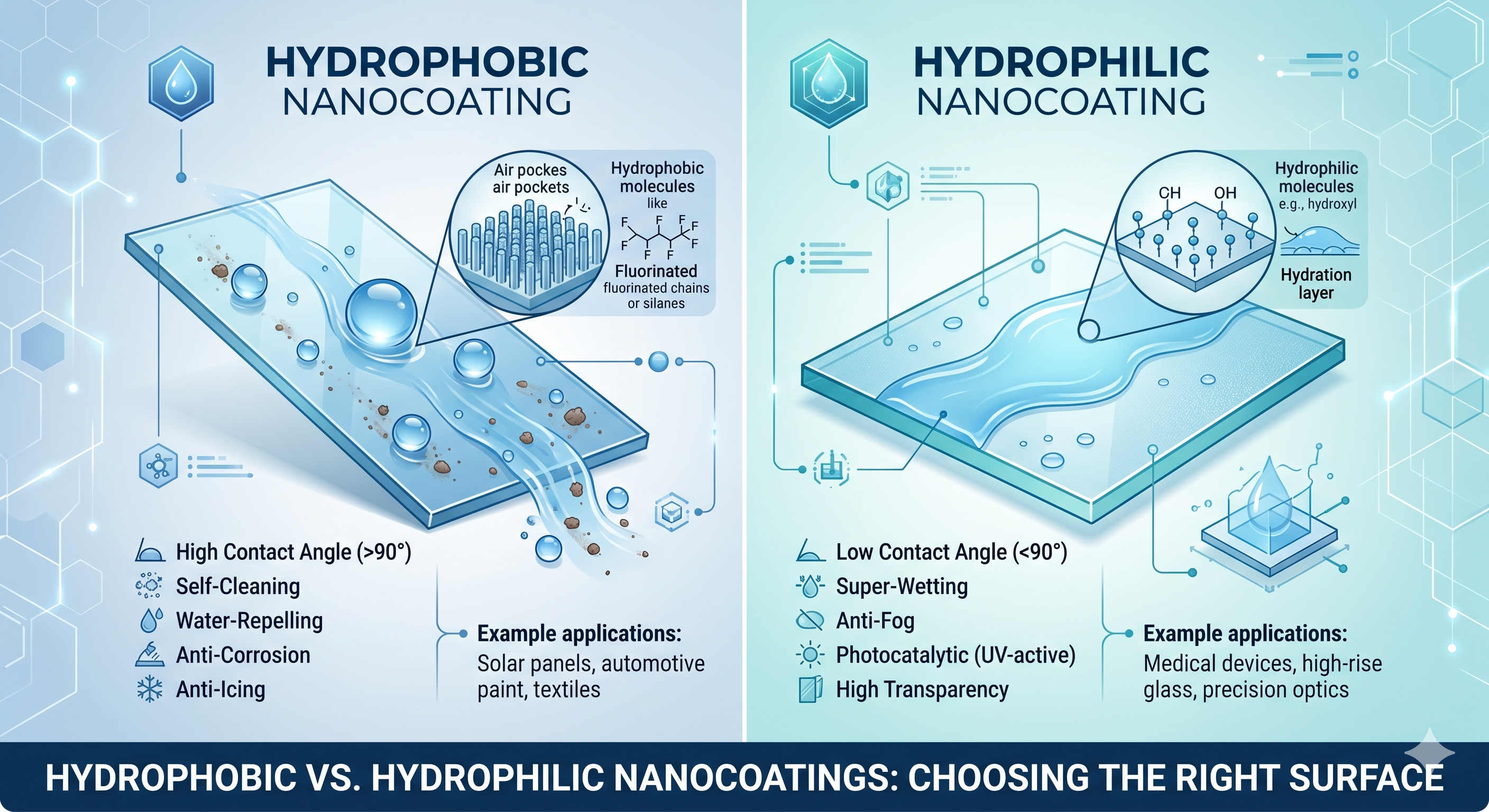
In the realm of materials science, the surface of an object is its first line of defense and its primary interface with the world. For decades, we treated surfaces as static boundaries. However, with the advent of nanotechnology, we have gained the ability to “program” surfaces at the molecular level. This has led to the rise of two dominant, yet polar opposite, technologies: Hydrophobic and Hydrophilic nanocoatings.
Understanding the distinction between these two is not just an academic exercise—it is a critical industrial decision. Whether you are protecting a solar farm in the desert, preventing fog on a surgeon’s visor, or ensuring the longevity of a skyscraper, choosing the right “water-relationship” can mean the difference between success and catastrophic failure.
1. The Science of Surface Energy: The Contact Angle
To understand nanocoatings, we must first understand the Contact Angle. When a droplet of water hits a surface, it forms a specific shape. This shape is determined by the balance between the liquid’s internal cohesion and its adhesion to the surface.
-
Hydrophobic (Water-fearing): If the water droplet beads up into a sphere, the surface is hydrophobic. This typically occurs when the contact angle is greater than 90 degrees.
-
Hydrophilic (Water-loving): If the water spreads out into a thin, uniform film, the surface is hydrophilic. This occurs when the contact angle is less than 90 degrees (often much lower, close to 0 degrees in “superhydrophilic” cases).
At the nanoscale, these properties are achieved by altering the surface topography or by applying molecular layers that change the surface’s “free energy.”
2. Hydrophobic Nanocoatings: The “Lotus Effect”
Hydrophobic coatings are inspired by nature, most famously the Lotus leaf. While the leaf looks smooth to the human eye, it is actually covered in microscopic wax-covered bumps. This creates a “trapped air” layer that prevents water from ever truly touching the solid surface.
How They Work
Modern hydrophobic nanocoatings often use fluorinated polymers or silanes. These molecules have very low surface energy. When water hits them, it cannot “wet” the surface. Instead, the water remains in a spherical bead and, due to gravity or wind, rolls off.
The “Self-Cleaning” Mechanism
As the water droplets roll, they pick up dirt, dust, and contaminants. This is known as the Self-Cleaning Effect. In industrial settings, this reduces the need for manual cleaning and prevents the accumulation of organic growth or salt crusts.
Primary Applications:
-
Automotive: Rain-repellent coatings for windshields and ceramic coatings for paint protection.
-
Solar Energy: Keeping panels clean in dusty environments to maintain maximum light absorption.
-
Textiles: “Ever-dry” clothing and stain-resistant upholstery.
3. Hydrophilic Nanocoatings: The “Sheeting” Revolution
While hydrophobic surfaces repel water, hydrophilic surfaces embrace it. To the uninitiated, this might seem counterintuitive—why would you want a surface to get wet? The answer lies in the concept of Hydrophilic Sheeting.
How They Work
Hydrophilic coatings, often made of Titanium Dioxide ($TiO_2$) or specialized surfactants, have very high surface energy. When water hits the surface, it doesn’t form beads. Instead, it “sheets” out, creating a continuous, ultra-thin film of water.
The Anti-Fog and Photocatalytic Power
Because the water forms a flat film rather than tiny beads, light can pass through it without scattering. This makes hydrophilic coatings the gold standard for Anti-Fog applications. Furthermore, many hydrophilic coatings are Photocatalytic; when exposed to UV light, they chemically break down organic dirt, which is then simply washed away the next time it rains.
Primary Applications:
-
Architecture: Self-cleaning glass for skyscrapers where manual window washing is dangerous and expensive.
-
Medical Devices: Catheters and stents are often coated to be hydrophilic to reduce friction against biological tissues and prevent blood clots.
-
Precision Optics: High-end camera lenses and surgical endoscopes.
4. Current Research and “Clinical” Industrial Studies
The field is currently moving away from “static” coatings toward “responsive” or “smart” surfaces.
Recent Study: The Rise of Omniphobic Surfaces
A 2025 study published in Advanced Functional Materials highlighted the development of Omniphobic coatings. These surfaces don’t just repel water; they repel oils, alcohols, and even hazardous chemicals. By using a “Liquid-Infused Porous Surface” (SLIPS) architecture, researchers created a surface that “heals” its liquid layer when scratched, maintaining hydrophobicity even under extreme mechanical wear.
Clinical Insights in Healthcare
In the medical sector, “clinical” evaluations of hydrophilic nanocoatings on orthopedic implants have shown a 40% reduction in bacterial adhesion. By creating a “hydration layer” around the implant, the coating prevents proteins from sticking, which is the first step in biofilm formation and subsequent infection.
Switchable Surfaces
New research is focusing on pH-responsive or Thermo-responsive coatings. Imagine a solar panel that is hydrophilic in the morning (to wash away dew and dust) but switches to hydrophobic in the afternoon (to repel heavy storm rain). These “switchable” surfaces are currently in the prototype phase but represent the future of the industry.
5. Advantage vs. Risk Evaluation: Making the Choice
Choosing between these two is a game of trade-offs. There is no “perfect” coating, only the “right” coating for the specific environment.
Hydrophobic Evaluation
-
Advantages: Superior at shedding bulk water, excellent for corrosion protection, and provides a “high-tech” bead-up aesthetic.
-
Risks: If the coating is damaged, water can get trapped under the beads, leading to localized “pitting” corrosion. Furthermore, hydrophobic surfaces are often susceptible to “oil-fouling”—if an oily film covers the nanostructure, the hydrophobic effect is instantly lost.
Hydrophilic Evaluation
-
Advantages: Exceptional for visibility (anti-fog), chemically breaks down organic stains (photocatalytic), and is generally more “biocompatible” for internal medical use.
-
Risks: In environments with extremely hard water (high mineral content), the “sheeting” effect can lead to uniform mineral scaling across the entire surface as the water evaporates. They also require a “wetting” event (rain or spray) to actually perform their cleaning function.
6. Decision Guide: Which One Do You Need?
When consulting with industrial clients, we use a simple set of criteria to determine the path forward:
-
Is Visibility the Priority? (e.g., Eyewear, Endoscopes, Sensors) -> Choose Hydrophilic.
-
Is the Environment Oily or Greasy? (e.g., Kitchen hoods, Engine parts) -> Choose Oleophobic/Hydrophobic.
-
Is the Goal to Prevent Rust? (e.g., Marine hulls, Steel structures) -> Choose Hydrophobic.
-
Is the Surface Hard to Reach? (e.g., High-rise windows) -> Choose Photocatalytic Hydrophilic.
-
Is the Goal to Maximize Fluid Flow? (e.g., Microfluidics, Pipelines) -> Choose Superhydrophobic.
7. The Environmental and Safety Perspective
As we scale these technologies, we must consider the “Life Cycle Assessment.”
-
PFAS Concerns: Many traditional hydrophobic coatings relied on “forever chemicals” (PFAS). Current research is aggressively pivoting toward Fluorine-Free hydrophobic solutions based on silicon and carnauba-like structures to meet new environmental regulations.
-
Nanoparticle Shedding: There is ongoing research into whether nanocoatings “shed” particles into the water table. Most modern “covalent-bonding” nanocoatings are extremely stable, but regular abrasion testing is required to ensure long-term environmental safety.
Conclusion
The choice between hydrophobic and hydrophilic nanocoatings is a choice between two different philosophies of environmental interaction. Hydrophobia is the art of Resistance—pushing the world away to keep the interior pure. Hydrophilia is the art of Integration—using the properties of water to maintain a clean and clear interface.
As nanotechnology continues to mature, the line between these two will blur. We are moving toward a world of hybrid, multi-scale surfaces that can adapt to their surroundings. For the entrepreneur and the engineer, staying informed on these molecular nuances is no longer optional—it is the key to building products that truly last.