
Recently added item(s)
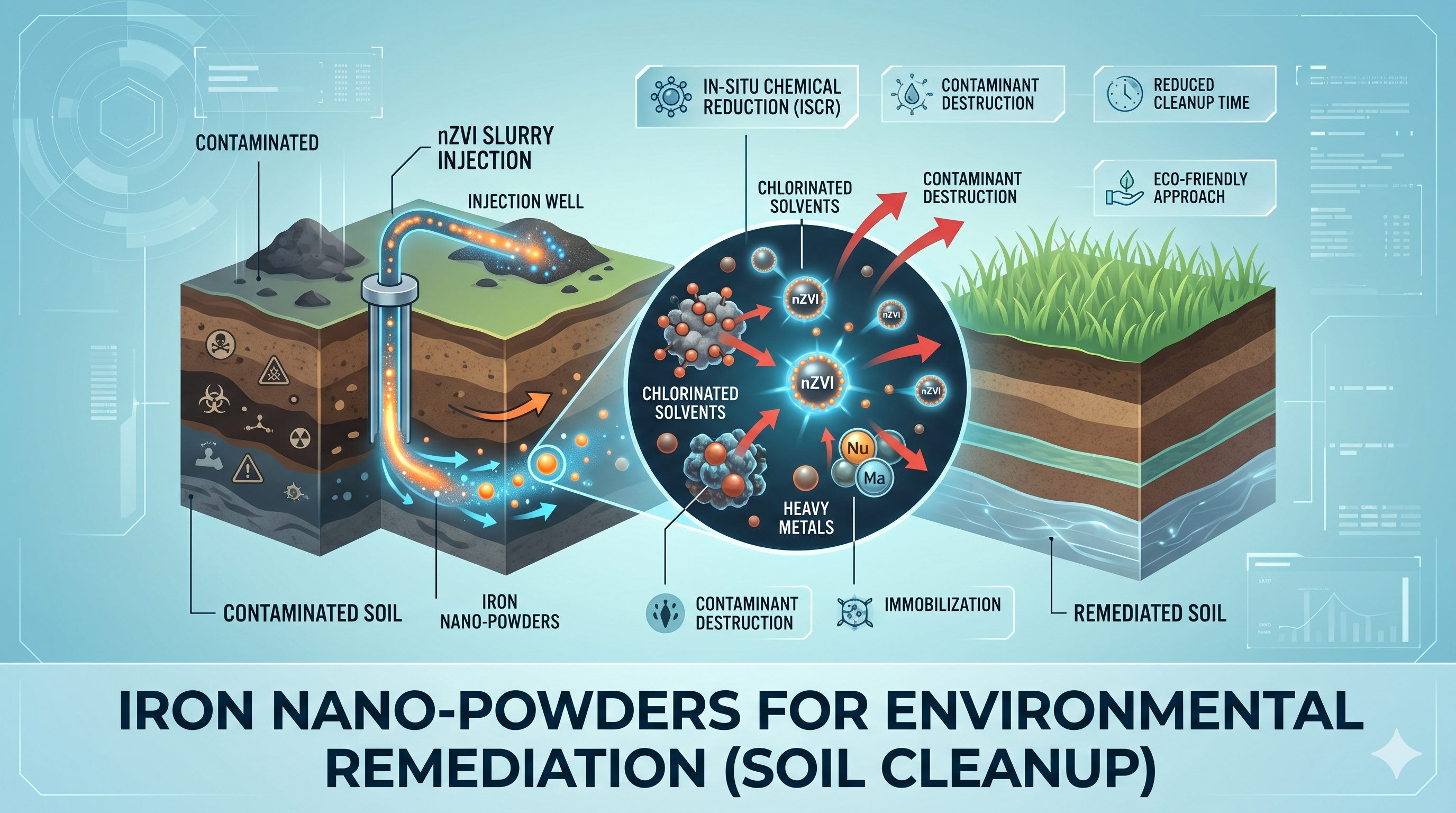
In the industrial history of the last century, we have often treated the Earth as a silent partner that could absorb any spill, leak, or waste product. Today, we are facing the consequences: vast tracts of land contaminated with heavy metals, chlorinated solvents, and toxic pesticides. Traditional soil cleanup methods—like “dig and dump”—are expensive, disruptive, and often just move the problem from one place to another.
However, a revolutionary solution is rising from the field of nanotechnology. Nanoscale Zero-Valent Iron (nZVI), often referred to as iron nano-powders, has become the “Swiss Army Knife” of environmental remediation. These tiny particles, often 1,000 times smaller than the thickness of a human hair, act as high-energy scavengers that can neutralize toxins directly in the ground without moving a single shovelful of dirt.
As we move through 2026, iron nano-powders are transitioning from experimental laboratory tools to the global standard for “in-situ” (on-site) environmental restoration.
The Chemistry of the “Redox” Strike
Why iron? Iron is one of the most abundant elements on Earth, but in its Zero-Valent (Fe0) state, it is chemically “hungry.” Iron atoms want to lose electrons to reach a more stable state (oxidation).
When we introduce iron in nano-powder form into contaminated soil, it initiates a series of Redox (Reduction-Oxidation) reactions. The iron “donates” its electrons to the pollutants.
-
Chlorinated Solvents: In a process called reductive dechlorination, nZVI strips the chlorine atoms off toxic molecules like TCE (Trichloroethylene), turning them into harmless gases like ethane or methane.
-
Heavy Metals: When nZVI meets toxic metals like Hexavalent Chromium (Cr-VI), Lead, or Arsenic, it transfers electrons to them, changing their chemical state. This makes them insoluble, causing them to “stick” to soil particles so they can no longer travel into groundwater.
The “Nano” advantage here is purely mathematical. Because the surface area of a nano-powder is so immense, the reaction happens hundreds of times faster than it would with iron filings or scrap metal.
Recent Research Frontiers (2025–2026): Beyond Pure Iron
The early versions of nZVI faced a major hurdle: they were too reactive. They would often react with water or oxygen in the soil before they ever reached the target pollutant. Recent research breakthroughs in 2025 and 2026 have solved this through “Material Intelligence.”
1. Sulfidated nZVI (S-nZVI)
The current “state-of-the-art” in 2026 is Sulfidated Nano-Iron. By treating the iron particles with specific sulfur compounds, researchers have created a “passivation layer.” This layer acts like a selective filter: it prevents the iron from reacting with water (wasted energy) but allows it to react aggressively with chlorinated pollutants. This has increased the “lifespan” of a single injection from a few weeks to over six months.
2. Green Synthesis: The Eco-Friendly Turn
As an environmental tool, the production of nZVI should also be clean. 2026 has seen a surge in “Green Synthesis” methods. Instead of using harsh chemical reducers, scientists are using polyphenols extracted from green tea, coffee grounds, or agricultural waste to reduce iron salts into nanoparticles. These “Green nZVI” particles come pre-coated with natural organic molecules that help them move more easily through the soil.
3. Emulsified Nano-Iron (EZVI)
Because oil and water don’t mix, many pollutants (like DNAPLs) hide in the soil as oily droplets. Recent field studies have successfully used “Emulsified Zero-Valent Iron,” where the iron nano-powders are trapped inside a vegetable oil droplet. The oil “hunts” the oily pollutants, and once they touch, the iron destroys them from the inside out.
Industrial Field Studies: Success Stories in 2026
The effectiveness of iron nano-powders is no longer a matter of theory; it is a matter of record.
-
The Dry Cleaner Legacy Project (2025): In a major urban center in Europe, a former dry-cleaning site had contaminated the local groundwater with high levels of PCE (Perchloroethylene). Traditional pumping would have taken 20 years. Instead, a series of “Nano-Curtains” were injected into the soil. Within 12 months, contaminant levels dropped by 94%, allowing the site to be safely redeveloped into residential housing.
-
Mining Tailings Remediation (South America): A 2026 pilot study in Chile utilized S-nZVI to treat arsenic-heavy soil around an abandoned copper mine. The nano-iron successfully “immobilized” 99% of the leachable arsenic, preventing it from entering the local river system during the rainy season.
-
The AI-Nano Synergy: In current 2026 operations, engineers are using Autonomous Injection Agents. AI sensors monitor the groundwater chemistry in real-time and adjust the concentration of the iron nano-powder slurry being injected. This ensures maximum cleanup with zero wasted material.
Advantage vs. Risk Assessment: A Balanced View
In materials science, there is no such thing as a “perfect” solution. We must evaluate iron nano-powders through a lens of pragmatic risk management.
The Advantages
-
In-Situ Treatment: There is no need to dig up the soil. This saves millions in transportation and disposal costs and keeps the local ecosystem intact.
-
Speed: What takes years for “natural attenuation” (nature’s own cleanup) can be achieved in months with nZVI.
-
Versatility: Iron nano-powders can handle a “cocktail” of different pollutants simultaneously—a common scenario in old industrial zones.
-
Low Impact: Once the iron has done its job, it simply turns into various forms of iron oxide (essentially rust), which are naturally occurring minerals in the soil.
The Risks and Challenges
-
Mobility Control: A major concern is “unintended migration.” If the nanoparticles travel too far, could they reach a drinking water well? Current 2026 regulations require the use of Magnetic Anchoring or polymer coatings to keep the particles “tethered” to the treatment zone.
-
Aggregate Formation: Like many nanoparticles, iron has a tendency to clump together (agglomerate). If they clump, they lose their surface area and sink. This requires the use of stabilizers like CMC (Carboxymethyl Cellulose) to keep them dispersed.
-
Impact on Soil Microbiome: While iron is a nutrient, a sudden “flood” of nanoparticles can temporarily disrupt local soil bacteria. Longitudinal studies are currently monitoring how long it takes for the soil “micro-community” to return to normal (usually 3 to 6 months post-treatment).
Comparison: Nano-Iron vs. Traditional Methods
| Feature | nZVI (Nano-Iron) | Pump-and-Treat | Soil Vapor Extraction |
| Strategy | Destroy on-site | Extract and filter | Vacuum out gases |
| Timeframe | 6 – 18 months | 10 – 30 years | 2 – 5 years |
| Cost | High material, low labor | Very high (long term) | Moderate |
| Effectiveness | High (Deep source) | Moderate (Surface only) | Limited to gases |
| Disruption | Minimal (Injection) | High (Infrastructure) | Moderate |
The Future: The “Smart” Soil Era
By the end of the decade, we expect to see “Self-Destructing” Nanoparticles. These will be engineered to neutralize the pollutant and then immediately dissolve into harmless iron nutrients that actually help plants grow. The fusion of Soil Genomics and Nanotechnology will allow us to tailor the nano-powder to work in harmony with specific local bacteria that also eat pollutants, creating a dual-action “Bio-Nano” cleanup force.
Conclusion
Iron nano-powders represent the pinnacle of environmental engineering. They remind us that the same industrial ingenuity that created our pollution problems can also be used to solve them. By manipulating iron at the nanometer scale, we have turned a simple metal into a precise, powerful, and increasingly sustainable tool for healing the Earth.
For the environmental professional, the choice is clear: the future of remediation is small, fast, and remarkably “slick.”