
Recently added item(s)
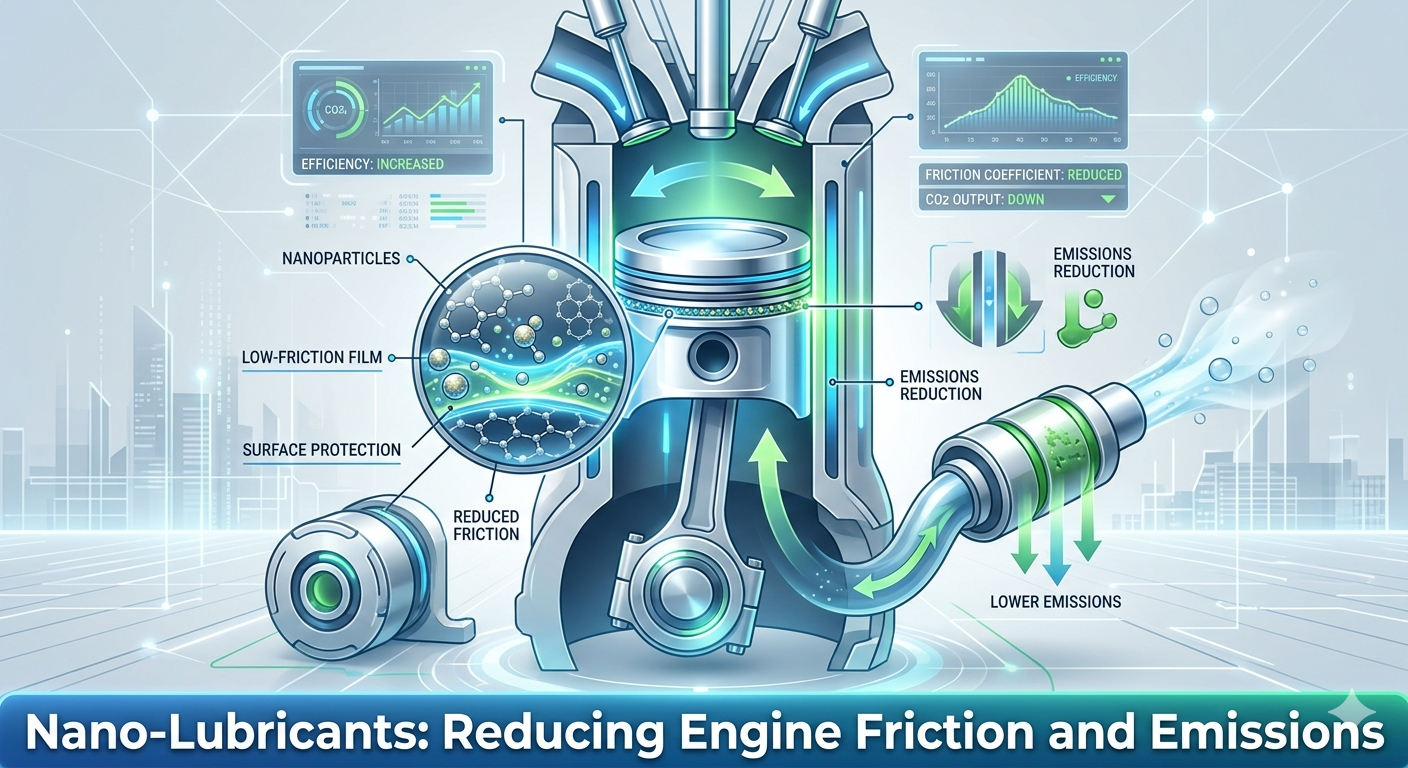
In the heart of every internal combustion engine, a fierce battle is constantly being fought. It is a battle against friction—a silent thief that steals fuel energy, wears down vital components, and amplifies harmful emissions. For over a century, traditional lubricants have been the primary defense line, providing a thin, protective sheathing between moving metal parts. However, as the automotive world faces unprecedented pressure to improve fuel economy and reduce its carbon footprint, traditional chemistry is reaching its limit.
Enter the next frontier of lubrication: nano-lubricants. By harnessing the extraordinary properties of nanomaterials, engineers are developing lubricants that don’t just reduce friction—they actively repair surfaces, dissipate heat more effectively, and offer a promising path toward cleaner, more efficient transportation. In this detailed exploration, we will delve into the science behind these microscopic marvels, evaluate the current state of research, and weigh the remarkable advantages against the potential risks of this emerging technology.
The Invisible Battleground: Why Engines Need Lubrication
To understand the impact of nanotechnology, we first need to appreciate the scale of the problem. Every engine, no matter how smooth it feels, is a labyrinth of moving metal contacts. A piston ring sliding within a cylinder, a crankshaft spinning within its bearings, or cam lobes pushing valves—all are interfaces where metal meets metal at high speed and under immense pressure.
On a microscopic level, even the most polished surface looks like a mountain range, full of jagged peaks called asperities. When two surfaces slide past each other, these peaks collide, adhere, and break apart. This interaction creates the force we know as friction. This force generates heat, causes mechanical wear, and consumes a significant portion of the fuel’s energy before it can ever turn the wheels. Studies indicate that direct frictional losses can consume approximately 8% of the total energy in a passenger car’s fuel.
Traditional Lubricants and Their Limits
Traditional engine oils are complex cocktails composed of a base oil (mineral or synthetic) and a package of additives (detergents, anti-oxidants, anti-wear agents). In standard operating conditions, they provide three levels of protection:
-
Hydrodynamic Lubrication: At high speeds, the oil forms a thick, pressurized wedge that completely separates the two surfaces. They “float” on oil, and friction is very low.
-
Boundary Lubrication: Under extreme load or at low speed (like during start-up or heavy acceleration), the oil film thins dramatically. Peak asperities begin to collide. Traditional “anti-wear” additives work here by reacting chemically with the metal surface to create a weak, sacrificial layer that shears easily, protecting the base metal.
-
Mixed Lubrication: The regime where surfaces transition between hydrodynamic and boundary.
Boundary lubrication is the most stressful state and where the majority of engine wear occurs. This is the regime where the old additive chemistry is struggling to meet the demands of modern, downsized, turbocharged engines that run hotter and under greater loads.
The Nano-Revolution: What Are Nano-Lubricants?
Tribology is the science of friction, wear, and lubrication. Nano-lubricants represent a paradigm shift in tribology. At their core, a nano-lubricant is a base oil that has been “doped” with a precise concentration of engineered nanoparticles.
Nanoparticles are defined as materials where at least one dimension is between 1 and 100 nanometers. A nanometer is one-billionth of a meter. For perspective, a strand of human DNA is about 2.5 nanometers wide, and a standard piece of paper is 100,000 nanometers thick. When materials are reduced to this nanoscale, they often exhibit entirely new properties—optical, electrical, and, crucially, mechanical—that differ from their bulk form. These new properties are driven by the particles’ incredibly high surface area-to-volume ratio and increased surface energy.
In lubrication, these engineered nanoparticles don’t just sit in the oil; they interact directly with the sliding surfaces, introducing entirely new friction-reducing mechanisms that traditional chemical additives cannot match. Ideal concentrations are typically low, often between 0.1% and 5.0% by weight.
The Four Pillars of Nano-Lubrication: How They Work
Nanoparticles are often described as “smart additives” because they adapt to the conditions of the surface. Instead of relying solely on a sacrificial chemical reaction, they use physics and geometry to solve tribological problems. We can categorize their primary mechanisms into four dominant pillars:
1. The Mending or “Pothole” Effect (Surface Repair)
Think of nanoparticles as a tiny road repair crew. As an engine runs, its surfaces develop microscopic wear scars, grooves, and depressions. Because of their incredibly high surface energy, nanoparticles are naturally attracted to these damaged areas. They tend to settle in and adhere to the worn surfaces, effectively “potholing” the micro-depressions. This filling process reduces the real contact area between the jagged peaks (asperities) of the two sliding surfaces, which, in turn, reduces friction and slows further wear.
2. The Rolling Ball Bearing Effect
One of the most intuitive models of nano-lubrication applies to spherical or fullerene-like (football-shaped) nanoparticles, such as Nano-Copper Oxide ($CuO$) or Tungsten Disulfide ($WS_2$) spheres. These nanoparticles infiltrate the gap between the sliding surfaces. Because of their hard, stable core, they act like millions of atomic-scale ball bearings, transforming the sliding friction into less energy-intensive rolling friction.
3. The Sliding Sheet Effect (2D materials)
This mechanism is specific to a class of materials known as 2D or layered materials, such as Graphene, Hexagonal Boron Nitride (hBN), and Molybdenum Disulfide ($MoS_2$). These materials are structured like microscopic stacks of sheets. The bonds within each sheet are incredibly strong, but the bonds between the sheets are weak. Under the intense pressure and shear forces of boundary lubrication, these stacks “exfoliate”—meaning the individual sheets slide off each other with minimal force. These micro-sheets are deposited onto the metal surfaces, creating a multi-layered, low-shear film that prevents direct metal contact and allows for extremely low friction.
4. Tribofilm Formation (Micro-Polishing)
Under extreme pressures and temperatures, some metallic or metal-oxide nanoparticles can undergo a physical-chemical transformation at the sliding interface. They may react with the surface or degrade and decompose, forming a protective, robust tribofilm. This tribofilm is tougher and smoother than the sacrificial films created by traditional additives. This mechanism often leads to a “micro-polishing” effect, where the tribofilm further reduces the cumulative surface roughness over time, improving the contact area for future lubrication.
Materials Matter: The Stars of Nano-Lubrication
Several different nanomaterials are currently dominating tribology research. Each brings a unique set of properties to the lubricant cocktail:
-
Nano-Copper ($Cu$), Nano-Copper Oxide ($CuO$): Among the first to be studied, they are excellent at surface mending and tribofilm formation. Copper has a natural ability to “heal” wear tracks. Recent comparative research suggests that high levels of these additives in base oils can achieve a dramatic reduction in the coefficient of friction (up to 75%) under high-load conditions compared to base oil alone.
-
Nano-Tungsten Disulfide ($WS_2$) and Nano-Molybdenum Disulfide ($MoS_2$): Known as layered transition metal dichalcogenides (TMDs). When synthesized as fullerene-like spheres, they excel at the rolling mechanism. When synthesized as sheets, they dominate the sliding sheet mechanism. They have exceptional thermal and pressure stability.
-
Hexagonal Boron Nitride (hBN): Often called “white graphite,” hBN is a 2D material known for its excellent thermal stability and non-conductive properties. Studies on diesel engine oils demonstrate that optimized hBN additives significantly reduce friction and wear by forming a stable, low-friction tribofilm containing boron and oxygen on critical components.
-
Graphene and Carbon Nanotubes (CNTs): The superstars of modern material science. Graphene, a single atom-thick sheet of carbon, offers the highest surface mending potential of any known material due to its immense aspect ratio. Hybrid additives combining graphene and CNTs are being developed to create stable suspensions where the tubes prevent the sheets from stacking back together.
Reducing Engine Friction and Emissions: The Scientic Evidence
The central promise of nano-lubricants is to transform microscopically low friction into macroscopically high efficiency. This isn’t just theory; it is supported by a growing body of robust tribological testing and initial real-world field trials.
The Chain Reaction: Friction to Fuel to Climate
-
Friction Reduction: Nanoparticles introduced into the critical boundary regimes of an engine (piston rings, cam lobes) can reduce the coefficient of friction by 10% to 50% compared to base oils, depending on the material and concentration.
-
Fuel Economy: By reducing these frictional losses, the engine wastes less fuel energy. Laboratory engine tests demonstrate improvement in fuel economy, with results typically reporting increases of 3% to 5%. Practical field tests, such as those conducted on commercial truck fleets, have shown average increases in fuel economy of up to 6%.
-
Emissions Reduction: Reduced fuel consumption translates directly to a reduction in carbon dioxide ($CO_2$) emissions. Perhaps more crucially, by forming tougher, tighter tribofilms at the piston-cylinder interface, nano-lubricants can improve the “engine ring sealing,” preventing oil leakage into the combustion chamber. This optimization can reduce other hazardous tailpipe exhaust pollutants, such as Carbon Monoxide (CO) and Nitrogen Oxides (NOx), with some studies reporting reductions in CO and NOx of approximately 20% and 10%, respectively.
Beyond MPG: Extended Life Expectancy
Nano-lubricants don’t just save fuel; they save the engine itself. Studies indicate wear reduction of up to 78% in critical components, primarily by preventing metal-to-metal contact during boundary lubrication. By filling worn areas and micro-polishing surfaces, they slow down the engine’s aging process, prolonging its life expectancy and contributing to sustainable material utilization.
Current Research and Evidence: Robust Testing, Not Humans
A critical note on the term “clinical studies”: In the automotive world, we do not conduct clinical trials on humans. Instead, the evidence standard is established through hierarchical engineering testing:
-
Tribology Testing (Tribometers): Initial testing using instruments like Block-on-Ring or Pin-on-Disk tribometers. These tests subject small samples of material, coated in the nano-lubricant, to controlled pressures, temperatures, and sliding speeds to precisely measure friction and wear rates. Multiple testing facilities are confirming substantial reductions (up to 78% in wear and 17% in coefficient of friction) for optimized graphene-hBN hybrids.
-
Engine Dynamometer (Dyna) Testing: Fully assembled engines are mounted on a stand and connected to a dynamometer, which measures their power and torque output while strictly controlling fuel input and running cycles. Studies on motorcycles and pickup trucks show that novel graphene/CNT nano-additives can increase torque and horsepower by averages of 7% and 2.4%, respectively, while increasing brake thermal efficiency.
-
Field Fleet Trials: The ultimate test. Commercial vehicles are run under their normal operational loads for months, with fuel and oil carefully monitored. Trials on truck fleets have validated laboratory findings, reporting an average 6% fuel economy gain.
Current research in 2025 and 2026 is moving beyond just confirming benefits. Scientists are now focusing on the “hybrid” effect—combining different types of nanoparticles to create a synergic effect, such as using graphene for surface mending and spherical $WS_2$ for rolling.
Advantages vs. Risks: An Unbiased Evaluation
While the potential is revolutionary, every new technology has hurdles. The transition from lab success to mass-market adoption requires a balanced assessment.
Key Advantages
-
Breakthrough Efficiency: Offers a potential 3-6% fuel economy gain, crucial for meeting stringent future emission standards without needing dramatic engine redesigns.
-
Exceptional Wear Resistance: Extends the lifecycle of the engine, reducing long-term maintenance costs.
-
Reduced Emissions: Directly lowers $CO_2$, CO, and NOx output, improving global environmental sustainability.
-
Thermal Stability: Many nanomaterials retain their lubricity at temperatures that would cause traditional chemical additives to degrade.
-
Smart Mending: Unique ability to proactively fill and “heal” minor engine wear.
Key Risks and Challenges
-
Dispersion and Stability (Agglomeration): This is the single largest technical hurdle. Nanoparticles are attracted to each other and naturally want to clump together (agglomerate). Once clumpy, they become unstable, settle out of the oil, or can even plug filters, rendering them useless. Creating stable, long-lasting suspensions for the full life of an engine oil (up to 15,000 miles) is technically challenging. Over-concentration can weaken performance due to excessive agglomeration.
-
Manufacturing Costs: Producing high-quality, defect-free nanomaterials (like pure single-layer graphene) remains incredibly expensive. Current nano-lubricants are premium products, and their cost-benefit must be calculated.
-
Environmental and Health Safety (Toxicity): This is a critical regulatory concern. If nanoparticles are burned during normal engine operation and exit the tailpipe, they might be hazardous if inhaled. Furthermore, the environmental impact of certain nanomaterials, if spilled or when the spent oil is disposed of, is not fully understood. Studies are ongoing to prioritize materials that are bio-compatible and less mobile in ecosystems, such as functionalized carbon-based nanomaterials.
-
Integration and Interaction: New nano-additives must not interfere with the detergents, dispersants, or other conventional components already in engine oil. The interaction is not always predictable.
Conclusion: The Path Ahead
The internal combustion engine is not obsolete, but it must continue to evolve. Nano-lubricants represent one of the most promising technological leaps available today to improve its sustainability. By transitioning friction reduction from the macro-scale chemistry of boundary layers to the nano-scale physics of rolling, sliding, and surface mending, these microscopic additives are offering an unprecedented chain reaction of benefits.
Initial field tests and robust dynamometer data are confirming that optimized nano-lubricants can shave percentages off fuel consumption and emission levels, providing a meaningful contribution to climate goals. However, the technology is not yet mature. Responsible development must focus on solving the stability and dispersion challenges, reducing production costs to make them viable for average motorists, and, most crucially, ensuring the safety of these materials throughout their lifecycle. We are witnessing the beginning of the nano-revolution in the engine room; it is up to the combination of further research and stringent safety standards to decide how far it can take us.