
Recently added item(s)
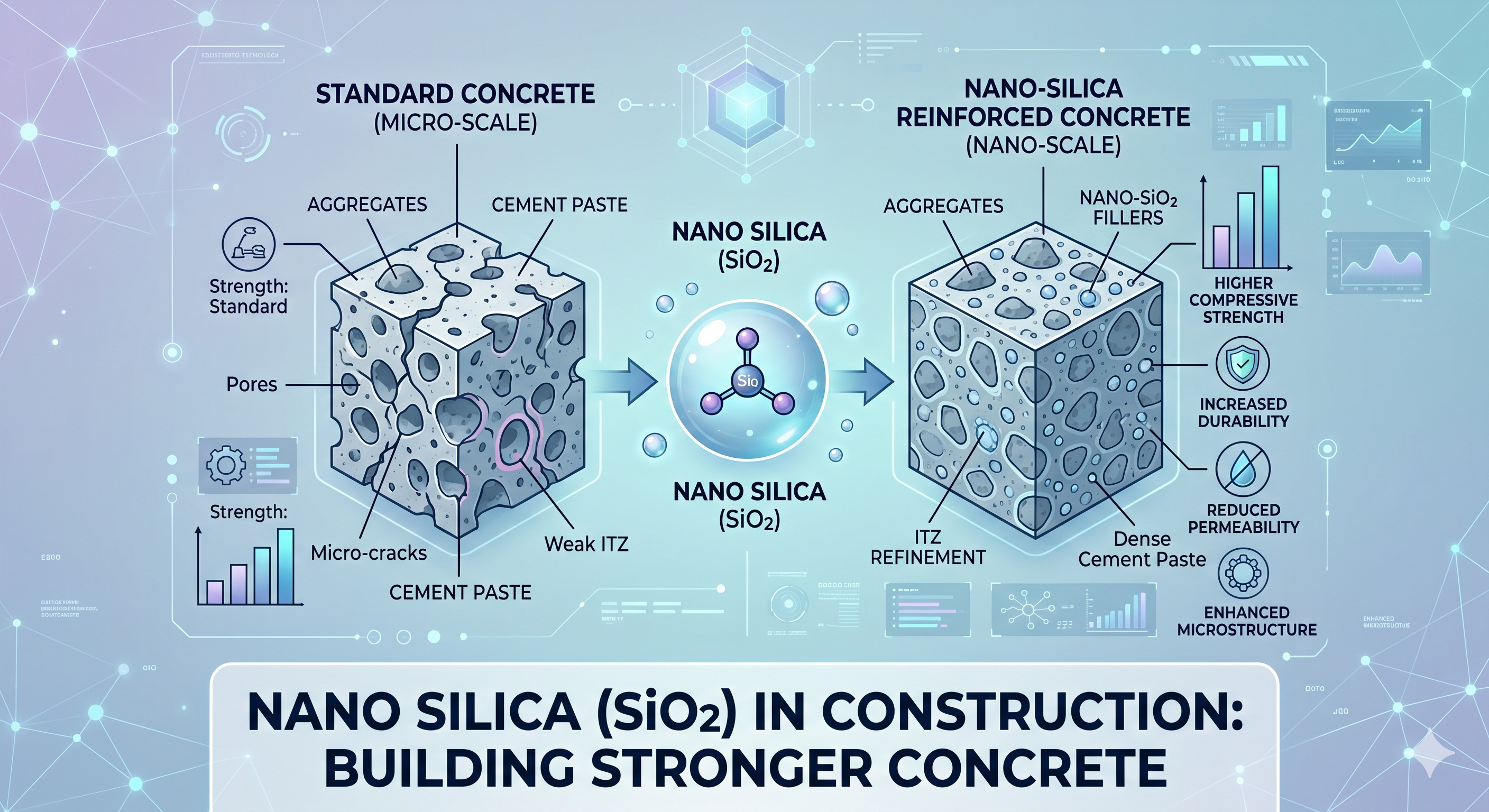
Concrete is the foundation of modern civilization. From towering skyscrapers to critical infrastructure like dams and bridges, it is the most widely used man-made material on Earth. Yet, the construction industry is under constant pressure to improve this essential material. We need buildings that last longer, require less cement, and can withstand increasingly harsh environmental conditions. The traditional approach of adding micro-materials, like silica fume, has pushed concrete’s performance far, but we have reached a plateau.
To make concrete fundamentally stronger, smarter, and more durable, we must look to the nanoscale. The secret weapon leading this construction revolution is Nano Silica (SiO2). Far from being science fiction, nanotechnology is actively building the future of super-strong concrete, changing how we engineer the very “glue” that holds our structures together.
What is Nano Silica (SiO2)? The Nanoscale Power Player
Nano Silica (SiO2) is amorphous (non-crystalline) silicon dioxide engineered to have particle sizes typically ranging from 5 to 50 nanometers. To put that into perspective, a single strand of human hair is approximately 80,000 to 100,000 nanometers wide.
What makes these tiny particles so powerful isn’t just their chemical composition; it is their extraordinary specific surface area. A single gram of nano silica can have a surface area equivalent to several football fields. This massive active area is the key to its immense chemical and physical influence when added to a concrete mix.
While traditional additives like silica fume are also SiO2, they operate on the micrometer scale. Nano silica is a dramatic leap forward, interacting with concrete at the atomic and molecular level, unlocking properties that were previously impossible to achieve.
The Double-Action Mechanism: How Nano Silica Strengthens Concrete
The effect of nano silica on concrete is two-fold: a direct physical effect and a powerful chemical reaction.
1. The Physical Effect: A Master Filler
On a microscopic level, concrete is a porous material. Even high-quality mixes contain tiny capillary pores and micro-cracks, which are the main entry points for water, chlorides, and other aggressive substances that cause deterioration. Nano silica particles are so incredibly small that they act as a “master filler.” They physically plug these nanopores within the cement paste and, critically, at the Interfacial Transition Zone (ITZ)—the weak interface between the cement paste and the aggregates. This physical packing creates a denser, more cohesive structure.
2. The Chemical Effect: Unlocking More C-S-H Glue
Concrete gets its strength from the “glue” created when cement reacts with water, known as Calcium Silicate Hydrate (C-S-H) gel. However, this reaction also produces a weaker byproduct: Calcium Hydroxide (CH), which contributes little to strength and can dissolve over time, creating more pores.
This is where the pozzolanic power of nano silica shines. Due to its massive surface area, nano silica is extremely reactive. When added to concrete, it reacts with the surplus and weak Calcium Hydroxide (CH) to form additional, incredibly strong C-S-H gel. In essence, nano silica converts a weakness into concrete’s primary strength, maximizing the bond throughout the material’s microstructure.
Beyond Normal limits: Key Improvements in Concrete Properties
The physical and chemical effects of nano silica translate into dramatic performance boosts for the hardened concrete.
Explosive Compressive Strength Gain
Compressive strength—concrete’s ability to resist being squeezed—is the most fundamental metric. Research consistently shows that incorporating just a small percentage of nano silica (optimal dosages are often 1-3% by weight of cement) can increase compressive strength by 15% to 25%, and in some targeted studies of specialized mixes, even higher gains are reported.
Crucially, this gain is evident at both early ages (e.g., 3 and 7 days) and standard ages (28 days). Early-age strength gain is a massive benefit for constructors, allowing for faster removal of formwork and accelerating the entire construction timeline.
A New Standard of Durability
Durability is about concrete’s ability to resist deterioration over decades. This is where nano silica is a game-changer. The refined microstructure, clogged pores, and denser ITZ mean concrete’s permeability is drastically reduced. This acts as an invisible shield, preventing the ingress of chloride ions (which cause steel reinforcement to rust) and sulfates (which cause concrete to swell and crack). Studies confirm significant improvements in:
-
Rapid Chloride Penetration Resistance (RCPT): Confirmed reductions in chloride ion flow, crucial for marine and coastal structures.
-
Abrasion Resistance: Denser concrete surfaces resist wear and aggregate loss, extending the life of road pavements and industrial floors.
-
Freeze-Thaw Resistance: Reduced pore volume limits the water available to freeze and cause internal cracking.
Enhanced Fresh Concrete Properties
The benefits start even before concrete hardens. Nano silica can improve the mix’s viscosity and cohesion, making it more resistant to bleeding and segregation—where water rises to the surface or aggregate separates. It provides better flowability for self-compacting concrete, ensuring it fills complex formwork without leaving voids.
Major Field validation: Construction’s Analog to “Clinical” Studies
While laboratory tests provide the foundation, construction science requires field validation on a monumental scale, analogous to clinical trials in medicine, to prove a material’s performance in real-world scenarios. Here are examples of current research frontiers and large-scale applications:
-
Ultra-High-Performance Concrete (UHPC): Nano silica is a primary component of UHPC, the world’s strongest form of concrete. Major projects like highway bridges (e.g., the Mars Hill Bridge in the USA), where thin, super-light, and ultra-durable sections are required, utilize nano silica-modified UHPC to achieve compressive strengths exceeding 150 MPa (over 20,000 psi).
-
Marine and Coastal Infrastructure Case Studies: Current research is intensely focused on maritime structures where concrete faces extreme chloride attack. For instance, proposed guidelines and case studies for coastal defense systems and harbor infrastructure use nano silica concrete to achieve the ultra-low permeability required to extend structural lifespan in aggressive marine conditions by up to 50% compared to conventional concrete. Large-scale testing in Indian road pavement has already shown a 56% improvement in Cantabro weight loss (aggregate cohesion).
-
Eco-Friendly Cement Reduction: Major research aims to use nano silica’s extreme pozzolanic activity to partially replace cement, which is responsible for a significant portion of global CO2 emissions. The construction study “analogous to a large clinical trial” is proving that reducing cement content by 10-20% and adding just 1-2% nano silica can maintain or even exceed the original strength, significantly reducing construction’s carbon footprint.
Nano Silica vs. Silica Fume: A Major Leap, Not a Simple Substitute
| Feature | Silica Fume (SiO2) | Nano Silica (SiO2) |
| Scale | Micrometer ($\mu$m) | Nanometer (nm) |
| Particle Size | Typically 0.1 – 1 $\mu$m | Typically 5 – 50 nm |
| Specific Surface Area | ~20 m²/g | ~100 – 600 m²/g |
| Pozzolanic Reactivity | High | Extremely High |
| Optimal Dosage | ~5-15% | ~1-3% |
| Key Advantage | High Strength, Durability | Early-Age Strength, Ultra-Low Permeability, ITZ Refinement, Cement Reduction |
Nano silica is not just silica fume on a smaller scale; it offers uniquely advanced properties, especially early-age strength gain and microstructural refinement, making it the premier choice for demanding projects.
The Advantage-Risk Evaluation: A Realistic Blueprint for constructors
Choosing any new technology requires a careful balance of its spectacular benefits against its real-world challenges.
The Clear Advantages
-
Revolutionary Strength and Durability: Creates buildings and infrastructure with extended lifespans, reducing maintenance costs.
-
Accelerated Construction: Faster early-age strength gain speeds up schedules.
-
Sustainable Construction: Enables significant reductions in cement content, lowering concrete’s carbon footprint.
-
Enabling Extreme Engineering: Essential for UHPC and structures in aggressive environments.
The Risks and Challenges
-
Particle Agglomeration (Dispersion Issues): Because they have a huge surface area, nano silica particles have an immense tendency to stick together, forming large clumps (agglomeration) that actually decrease strength. Achieving uniform dispersion within the mix is the biggest technical challenge and requires specialized mixing techniques or chemical dispersants.
-
Optimal Dosage Finding: More is not always better. Exceeding the optimal dosage (often 2-3%) can increase agglomeration and hurt workability, requiring extensive lab testing for each project.
-
High Initial Cost: Nano silica is significantly more expensive than traditional materials like cement or silica fume. This requires a strong long-term cost-benefit analysis.
-
Health and Safety: While safe when embedded in the final hardened concrete, the dry powder form of nano silica poses a serious health risk if inhaled. Nanoparticles can enter deep into the lungs. This requires strict H&S protocols, specialized handling equipment, or the use of colloidal nano silica (nano silica pre-dispersed in a liquid), which eliminates the inhalation risk.
The Future Outlook: The Trend of the Built Environment
The potential for nano silica in concrete is boundless. We are seeing a powerful trend towards hybridization. Researchers are combining nano silica with other nanomaterials, like carbon nanotubes, or combining it with traditional supplementary cementitious materials (e.g., using both fly ash and nano silica) to create synergistic effects that overcome individual weaknesses, such as reducing the overall cost while maximizing performance. The focus is also on perfecting the dispersion and H&S methods to make nano silica safer and easier to use on a massive industrial scale. In the long term, nano silica is the pathway to building sustainable, ultra-durable, and even “smart” concrete structures that can last a century.
Conclusion
Nano silica is no longer just a futuristic concept for construction; it is a proven, high-performance material that is actively strengthening the concrete foundations of our world. By mastering nanotechnology, the construction industry can achieve compressive strengths and durability levels that were previously unattainable with micro-additives. It offers a blueprint for accelerating construction, reducing cement consumption, and building a more resilient, sustainable future. While constructors must carefully navigate the challenges of cost and dispersion and enforce strict H&S protocols for handling nanoparticles, the long-term rewards make nano silica the undeniable key to building the super-concrete of the future.