
Recently added item(s)
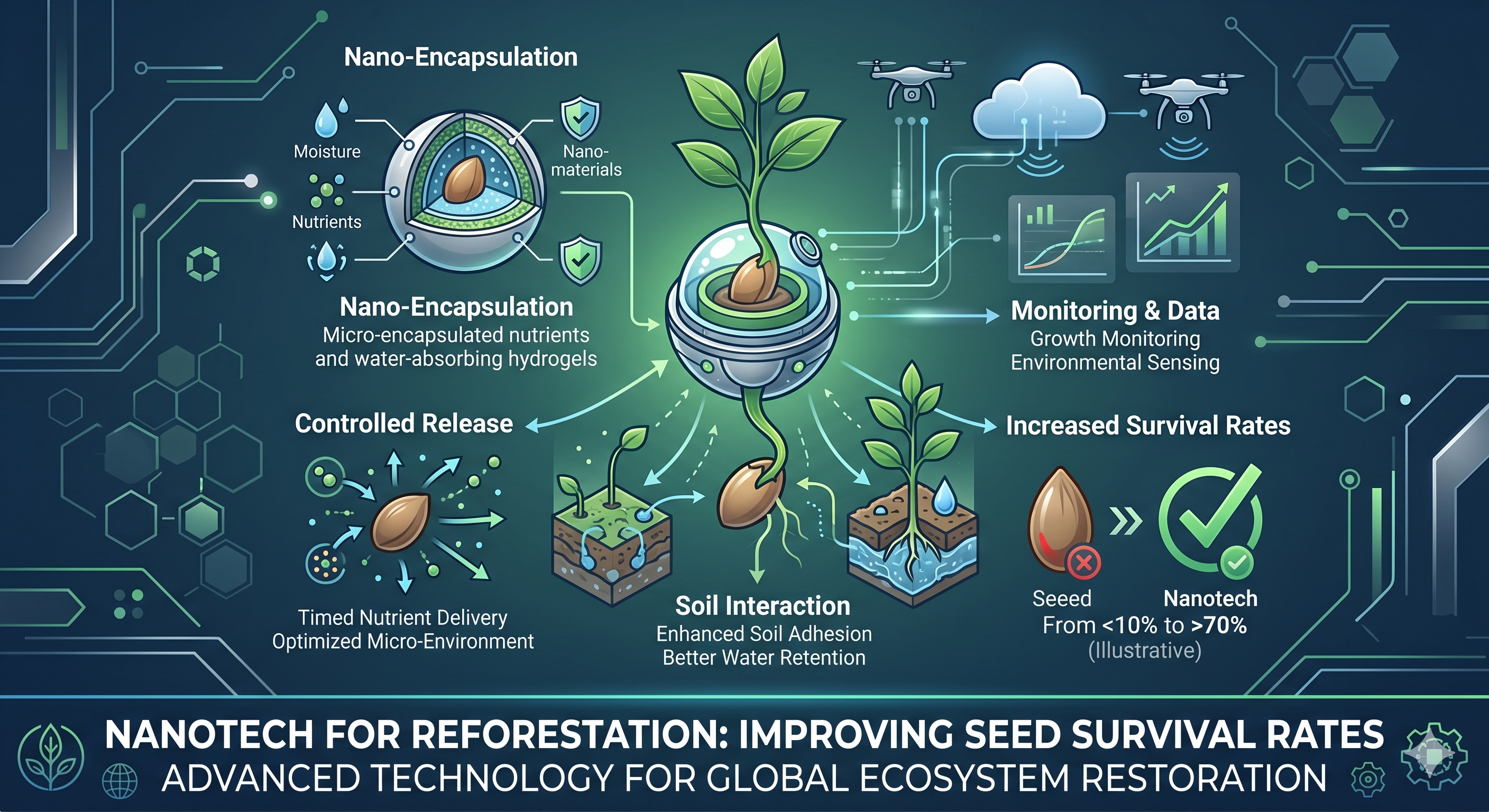
The planet is facing an unprecedented environmental crisis. Deforestation is occurring at an alarming rate, driven by industrial expansion, agricultural demands, and the increasing frequency of climate-change-induced wildfires. Reforestation—the act of replanting forests—is one of our most potent weapons against biodiversity loss and carbon sequestration. However, a silent, microscopic bottleneck threatens these massive efforts: the abysmally low survival rate of seeds planted in the wild.
In natural settings, only a tiny fraction of seeds scattered by trees survive to become saplings. In engineered reforestation projects, the rates are often better, but still shockingly inefficient. In harsh arid environments or degraded soils, survival rates can dip below 10%. This is not just a biological failure; it is an economic and logistical nightmare for global restoration efforts.
Enter nanotechnology. This “small science” is making a massive impact on reforestation by creating “smart seeds” equipped to survive the brutal realities of nature. By manipulating matter at the atomic and molecular levels (the nanoscale), scientists are developing innovative tools to dramatically improve seed germination and survival, transforming reforestation from a high-stakes gamble into a calculated science.
The Reforestation Bottleneck: The Struggle of the Seed
To appreciate the nano-solutions, we must understand the hurdles. When a seed is placed in the soil, its struggle for existence begins immediately.
-
Drought and Water Stress: The primary cause of seed failure is a lack of water. A newly germinated seed has a tender root that must quickly find moisture. If the soil dries out during this critical window, the seedling dies.
-
Pathogens and Fungi: Soil is teeming with bacteria and fungi. Many species cause “damping-off,” a disease that rots seeds and tender seedlings before they can establish themselves.
-
Predation: Birds, rodents, and insects consume massive quantities of planted seeds.
-
Nutrient Deficiency: Degraded soils (often the target of reforestation) lack the essential nutrients required for the initial burst of seedling growth.
-
Mechanical Stress: Hard, compacted soils can physically prevent the embryonic root (radicle) from penetrating the ground.
Traditional solutions involve massive planting efforts—throwing billions of seeds at the problem, knowing most will die—or planting older saplings, which is prohibitively expensive and labor-intensive to scale globally.
Enter the Nano-Saviors: Science at the Seed Level
Nanotechnology offers a way to address these stressors precisely where the interaction happens: at the surface of the seed and the immediate soil environment (the rhizosphere). Nanomaterials are defined as having at least one dimension between 1 and 100 nanometers (a nanometer is one-billionth of a meter). At this scale, materials exhibit unique physical and chemical properties.
Here is how scientists are applying nanotech to save seeds:
1. Advanced Nanocomposite Coatings: The Seed Shield
Traditional seed coating has been used for decades, primarily to attach pesticides or dyes. Nanotech takes this to a new level. Scientists are developing nanocomposite films that act as “smart shields” for the seed.
These coatings, often made from biodegradable polymers like chitosan (derived from shellfish waste), are embedded with functional nanomaterials. They are designed to be semi-permeable, allowing oxygen and water to enter but blocking pathogenic fungi and bacteria.
Current research explores incorporating carbon nanotubes (CNTs) into these coatings. CNTs are incredibly strong and can physically penetrate hard seed coats without damaging the embryo inside. They act as “nano-straws,” channeling water from the soil directly into the seed center, speeding up germination and increasing hydration even in dry soils.
2. Smart Delivery Systems: Precision Nanocapsules
One of the most powerful applications is “controlled release” or “precision delivery.” Imagine a nanocapsule that contains fertilizers, fungicides, or beneficial microbes.
Instead of saturating the soil with chemicals (most of which wash away), these nano-encapsulated payloads are attached directly to the seed. Crucially, they are designed with “triggers.” For example, a nanocapsule containing fertilizer might only dissolve when specific root enzymes are detected, or when soil temperature is optimal for growth.
Other researchers are developing nanocapsules that respond to drought triggers. They contain hydrogels (water-absorbing polymers) that remain dormant until the soil dries out, at which point they release stored water directly around the developing root system.
3. Nano-Priming: Energizing the Embryo
“Priming” is a technique where seeds are soaked to initiate metabolic processes but not to the point of full germination, then dried again before planting. Nano-priming involves soaking seeds in solutions containing specific nanoparticles.
Research has shown that metallic nanoparticles, such as Zinc Oxide (ZnO), can be used in nano-priming solutions. At very low, precisely controlled concentrations, ZnO nanoparticles are absorbed by the seed embryo, where they enhance enzyme activity associated with breaking down stored food (starch). This “primes” the seed with metabolic energy, allowing it to germinate faster and more vigorously once it is planted in the soil. Faster germination means the seedling spends less time in its most vulnerable state.
Current Research, Field Trials, and Ecological Equivalents
Because “clinical trials” are a term reserved for human medicine, the agricultural and ecological equivalents are rigorous field trials. While still a relatively young field, the data emerging from these trials is highly promising.
Drought and Desertification Trials
Severe drought in semi-arid regions is the biggest killer of reforestation efforts. Studies published in journals like ACS Nano and Nanomaterials have highlighted successful trials using nanocomposite coatings. For example, research on acacia trees (vital for reforestation in Africa and the Middle East) demonstrated that seeds coated with CNT-integrated hydrogels had germination rates 60-70% higher than uncoated seeds under drought simulation conditions.
Addressing Microbial Pathogens
A significant body of research focuses on using metallic nanoparticles, such as silver (Ag) and copper (Cu), known for their antimicrobial properties. In field simulations of soils heavily contaminated with damping-off fungi, Ag-nanoparticle-coated seeds showed significantly higher survival rates than seeds treated with standard commercial fungicides. The nanoparticles act on the cellular membranes of the fungi without needing to penetrate the seedling.
Ecological Field Deployment and Scaling
The next phase, currently underway in academic-industry partnerships, involves deploying these technologies at scale using aerial drones. Organizations are testing the viability of “seed pods” (encapsulated mixtures of soil, nanonutrients, and smart-coated seeds) dropped from drones into remote or wildfire-ravaged terrain. Data from these deployments will be critical in assessing the long-term impact on ecosystem health beyond just initial survival rates.
The Advantage–Risk Evaluation
As with any powerful technology, a balanced assessment is essential.
Advantages (The Potential)
-
Drastically Higher Survival Rates: The primary benefit. Increasing survival from 10% to 50% or 70% fundamentally shifts the economics and feasibility of global reforestation.
-
Cost Efficiency in Restoration: While the nanotech seed itself is more expensive to produce, the drastic reduction in seed waste and the decreased need for labor-intensive manual planting (or re-planting) leads to lower long-term costs.
-
Reduced Chemical Footprint: By encapsulating fertilizers and pesticides and attaching them only to the seed (milligram quantities per hectare) rather than spraying whole fields (kilograms per hectare), chemical pollution is drastically reduced.
-
Rehabilitating Extreme Environments: Smart seeds allow for reforestation of difficult areas, such as salt-affected lands or regions suffering from advanced desertification, which natural regeneration cannot touch.
-
Accelerated Growth: Nano-priming can result in saplings that grow taller and with stronger root systems faster, accelerating the timeline to a stable forest ecosystem.
Risks and Challenges (The Constraints)
-
Environmental Toxicity (Ecotoxicology): This is the most significant concern. What happens when metallic nanoparticles, like Silver, Copper, or Zinc Oxide, accumulate in the soil over time? Do they harm beneficial soil bacteria, mycorrhizal fungi (vital for tree health), or earthworms? Long-term ecotoxicological studies are required to ensure we aren’t trading one environmental problem for another.
-
Manufacturing Costs: Currently, producing large quantities of specialized nanoparticles and encapsulating seeds requires sophisticated equipment, limiting its accessibility in low-income regions that often need reforestation the most.
-
Regulatory Hurdles: The use of nanomaterials in open environments is relatively new. Regulatory frameworks for nanotechnologies in agriculture and ecology are still being developed by bodies like the EPA (in the US) and the European Commission, potentially delaying deployment.
-
Knowledge Gaps: We still don’t fully understand the molecular-level interactions between diverse nanoparticle types and different seed embryos. Extensive research is needed across multiple tree species.
Conclusion: A Small Technology for a Big Planet
Nanotechnology for reforestation is not a futuristic concept; it is an emerging scientific reality. By addressing the fundamental bottleneck of low seed survival, nanotech transforms reforestation from a well-intentioned gamble into a high-precision ecological science.
The development of nanocomposite shields, controlled-release nanocapsules, and nano-priming energy boosts equips seeds with a survival toolkit they never evolved naturally. This allows global conservation efforts to move from purely reactive conservation to proactive, large-scale ecosystem engineering.
The challenges—primarily understanding long-term ecological risks and managing manufacturing costs—are significant and must be addressed with transparency and rigorous research. However, the potential reward—the rapid restoration of biodiversity, the stabilization of global carbon cycles, and the defense against desertification—is too massive to ignore. The science of the extremely small may hold the key to saving the extremely large: the forests of our planet.