
Recently added item(s)
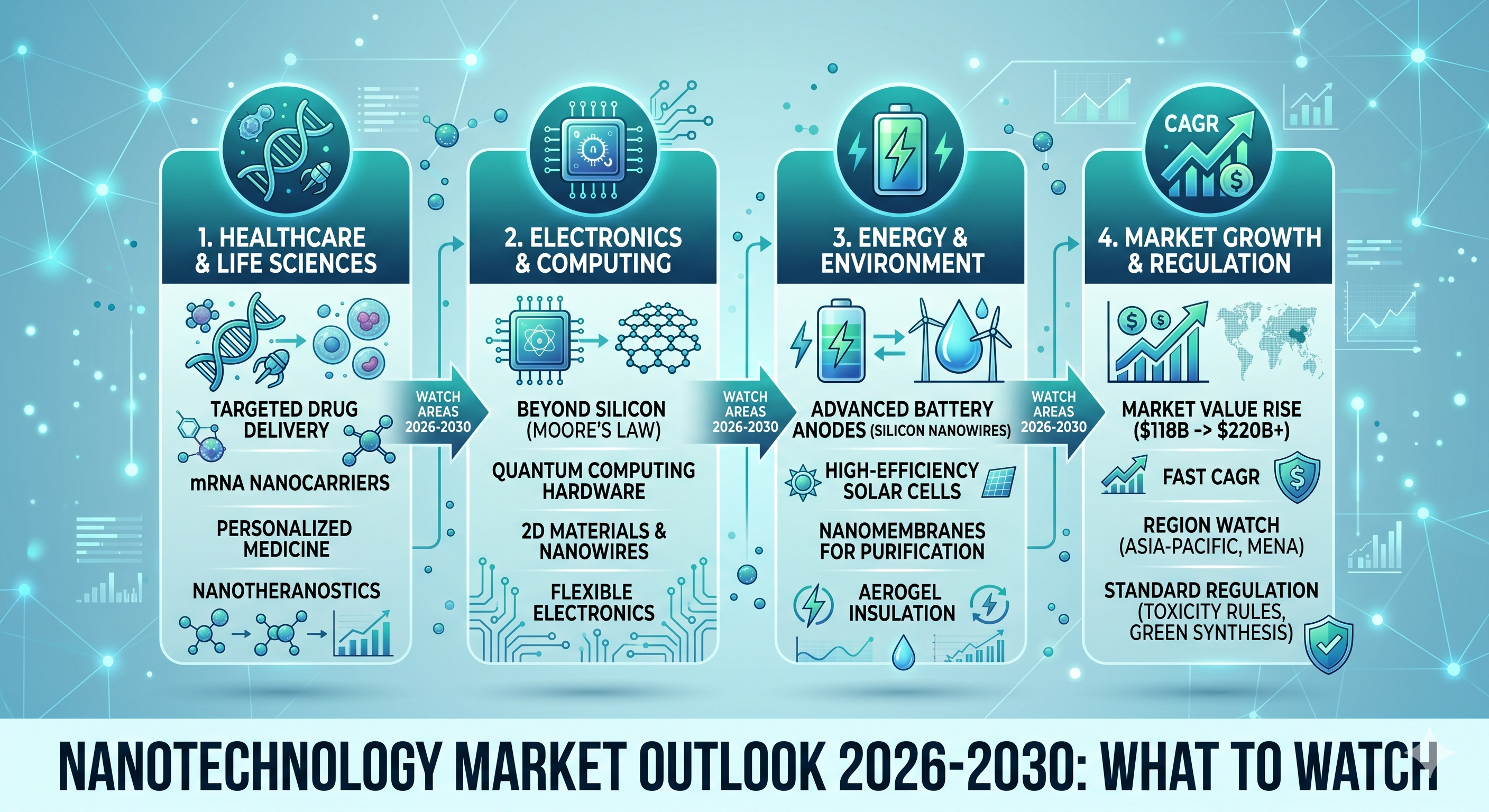
As we look ahead from our vantage point in mid-2026, the promised “molecular revolution” is no longer a futuristic concept—it is a pervasive industrial reality. Nanotechnology, the science of manipulating matter at the atomic level (typically under 100 nanometers), has quietly transitioned from specialized laboratory experiments to the very backbone of modern manufacturing, healthcare, and energy systems. The decade leading up to 2026 focused on discovery; the years between 2026 and 2030 will be defined by integration, standardization, and pervasive intelligence.
The global nanotechnology market, valued at USD 118.7 billion earlier this year, is projected to nearly double, reaching USD 220.8 billion by 2031, with a strong compound annual growth rate (CAGR) of over 13% during this outlook period. Asia-Pacific currently holds the largest market share, driven by clustering electronics supply chains, while the Middle East and Africa are experiencing the fastest relative growth. For investors, engineers, clinicians, and consumers, understanding the trajectories between 2026 and 2030 is essential.
Here is the comprehensive outlook on what to watch in the world of nanotechnology.
The New Standard in Medicine: Precision Therapeutics and Smart Delivery
Perhaps no sector has been as profoundly transformed by nanotechnology as healthcare. As of May 2026, we are witnessing the stabilization of personalized nanomedicine. The “one-size-fits-all” drug model is rapidly eroding in favor of targeted delivery systems that ensure maximum efficacy with minimal side effects.
The Rise of Multi-Functional Nanocarriers
In May 2026, the medical community is focusing heavily on the scalability of multi-functional drug delivery systems. During the 2020-2025 period, Lipid Nanoparticles (LNPs) proved their worth globally by delivering mRNA vaccines. Today, LNPs have shifted from being a “pandemic solution” to a versatile backbone for precision therapies. They are currently being adapted not just for next-generation vaccines, but for gene therapies targeting rare genetic disorders and advanced cancer treatments.
Functionalization is the key watchword. Researchers are now attaching specific molecules (ligands) to the surface of nanoparticles that act as homing devices, allowing the carrier to bind only to diseased cells—for example, cancer cells expressing a unique protein—while sparing healthy tissue.
Clinical Trials and Theranostic Breakthroughs
The 2026-2030 outlook will be defined by the results of numerous Phase III clinical trials concerning theranostics—the combination of diagnostics and therapy within a single nanoscale platform. We are tracking a groundbreaking trial expected to publish Phase III results in late 2027 concerning “Smart Theranostic Nanoplatforms” for brain tumor treatment. These nanoparticles cross the blood-brain barrier, use gold cores to enhance medical imaging accuracy (allowing real-time monitoring of tumor borders), and concurrently release a potent chemotherapy agent triggered only by the specific pH level within the tumor.
Current (2026) research publications are also highlighting the translational potential of two-dimensional (2D) materials like MXenes for ultra-sensitive biosensing, paving the way for non-invasive, continuous monitoring of biomarkers in diabetic or cardiac patients.
BeyondMoore’s Law: Nanomaterials Redefining Electronics and Computing
The electronics industry, the oldest large-scale customer of nanotechnology, faces a performance ceiling. Traditional silicon transistors can no longer be miniaturized much further without running into fundamental quantum interference problems. Between 2026 and 2030, we will watch the commercial proliferation of alternative nanomaterials.
Quantum Dots: From Displays to Quantum Computing Components
Tiny semiconductor particles known as Quantum Dots (QDs) whose properties change based on their size are already pervasive in premium display technologies. Asian OEMs have clustered their supply chains in 2026 to mass-produce cadmium-free QD inks, pushing displays to Rec. 2020 color standards.
However, the major shift to watch between 2028 and 2030 is the migration of Quantum Dot technology from displays to quantum computing hardware. QDs are being developed as stable “qubits”—the basic unit of quantum information—operable at warmer temperatures than traditional superconducting qubits. This could be the breakthrough required to bring quantum computing out of the specialized lab into broader industrial use.
The Maturity of Graphene and Nanowires
We are finally seeing Graphene, a one-atom-thick sheet of carbon, move from “wonder material” to “reliable material.” While scaling production remained a challenge for decades, by early 2026, standardized manufacturing processes have reduced costs sufficiently for graphene to be integrated into high-volume products. Watch for its integration into transparent conductive films for flexible touchscreens and as a barrier to prevent heat loss in semiconductor packaging, significantly improving battery life in portable devices.
Sustaining the Planet: Nano-Enabled Energy and Green Solutions
The “EU Green Deal” and similar global policies have catalyzed massive investment in nanotechnology for energy-efficient solutions, a trend that will accelerate between 2026 and 2030. Climate goals are increasingly reliant on molecular engineering.
The Battery Anode Revolution
Energy storage remains the primary bottleneck for electric vehicle (EV) adoption and renewable energy integration. Between 2026 and 2030, we must watch the deployment of nanoscale anodes. The short-term driver (≤2 years) is the mass commercialization of battery anode breakthroughs using silicon nanowires and carbon nanotubes. By early 2027, this integration is expected to deliver EV batteries with a sustainable 1000km range on a single 15-minute charge, effectively eliminating range anxiety.
Green Construction and Water Purification
In 2026, nano-enabled green solutions are becoming mandatory in new constructions across the EU. We are tracking the roll-out of aerogel panels—insulation materials that are 99% air but possess unmatched thermal resistance—meeting tougher environmental codes while allowing thinner walls. Furthermore, nanomembranes for desalination are reducing the energy required to purify water by over 40%, a critical technology as global water scarcity intensifies. Catalyst nanostructures are also being deployed to break down persistent chemical pollutants (like PFAS) directly at the source.
The Double-Edged Sword: Advantage-Risk Assessment
The expansion of nanotechnology requires a balanced assessment. As manufacturing scales and nanotechnology products permeate daily life, we must grapple with the unique risks posed by matter at this scale.
The Strategic Advantages
-
Unprecedented Precision: In medicine, this means targeted action, leading to cures with fewer side effects and shorter recovery times.
-
Resource and Energy Efficiency: Nanomaterials require fewer raw materials for stronger final products (e.g., carbon nanotube composites stronger than steel but lighter than aluminum).
-
Novel Functionality: Nanoscale devices can act as real-time biosensors or self-healing coatings that repair microcracks automatically, extending product life cycles.
The Critical Risks and Challenges
-
Nanotoxicity and Human Health Concerns: The defining characteristic of nanoparticles—their ability to penetrate biological barriers—is also their primary risk factor. Free, engineered nanoparticles, if inhaled or ingested, might interact with human cells in poorly understood ways, potentially causing inflammation or long-term damage.
-
Environmental Accumulation: While nano-enabled catalysts can clean pollutants, some non-degradable nanomaterials themselves might accumulate in ecosystems (bioaccumulation), similar to microplastics. Their long-term environmental toxicological data is still being gathered as of May 2026.
-
The Toxicology Gap and REACH Delays: A key regulatory issue to watch is the backlog in toxicity dossiers seeking approvals from bodies like the European Chemicals Agency (ECHA). The 2024 ban on certain nano-forms of gold and copper magnified uncertainty. Firms with robust, legacy safety files gain a temporary edge, while toxicology gaps delay the launch of innovative products (e.g., nano-enabled metal oxides in cosmetics). Regulatory frameworks must adapt to “safe by design” approaches.
Conclusion: Key Indicators between 2026-2030
As we move deeper into the 2026-2030 window, nanotechnology innovations are transitioning from experiment to implementation. The hype is being replaced by structural momentum. When watching the market, focus less on one-off lab breakthroughs and more on three specific indicators:
-
Regulatory Harmonization: Watch for standardized characterization rules for nanomaterial drugs (clarified FDA guidance in 2024 was just the beginning) and clearer international environmental toxicology standards.
-
Manufacturing Scale-up: The major bottleneck is no longer synthesis, but maintaining quality and consistency at ton-scale production. Companies mastering green synthesis (energy-efficient and biodegradable synthesis routes) will dominate.
-
Cross-Industry Integration: The true winners of the 2026-2030 window are not just “pure-play nanotech firms,” but chemical giants (like BASF and Dow) or contracted drug manufacturers who successfully integrate nano-building blocks into established supply chains.
The nano-revolution is here, and it is structural. We must approach it with eyes wide open to both its unparalleled capacity for human advancement and its unique responsibilities.