
Recently added item(s)
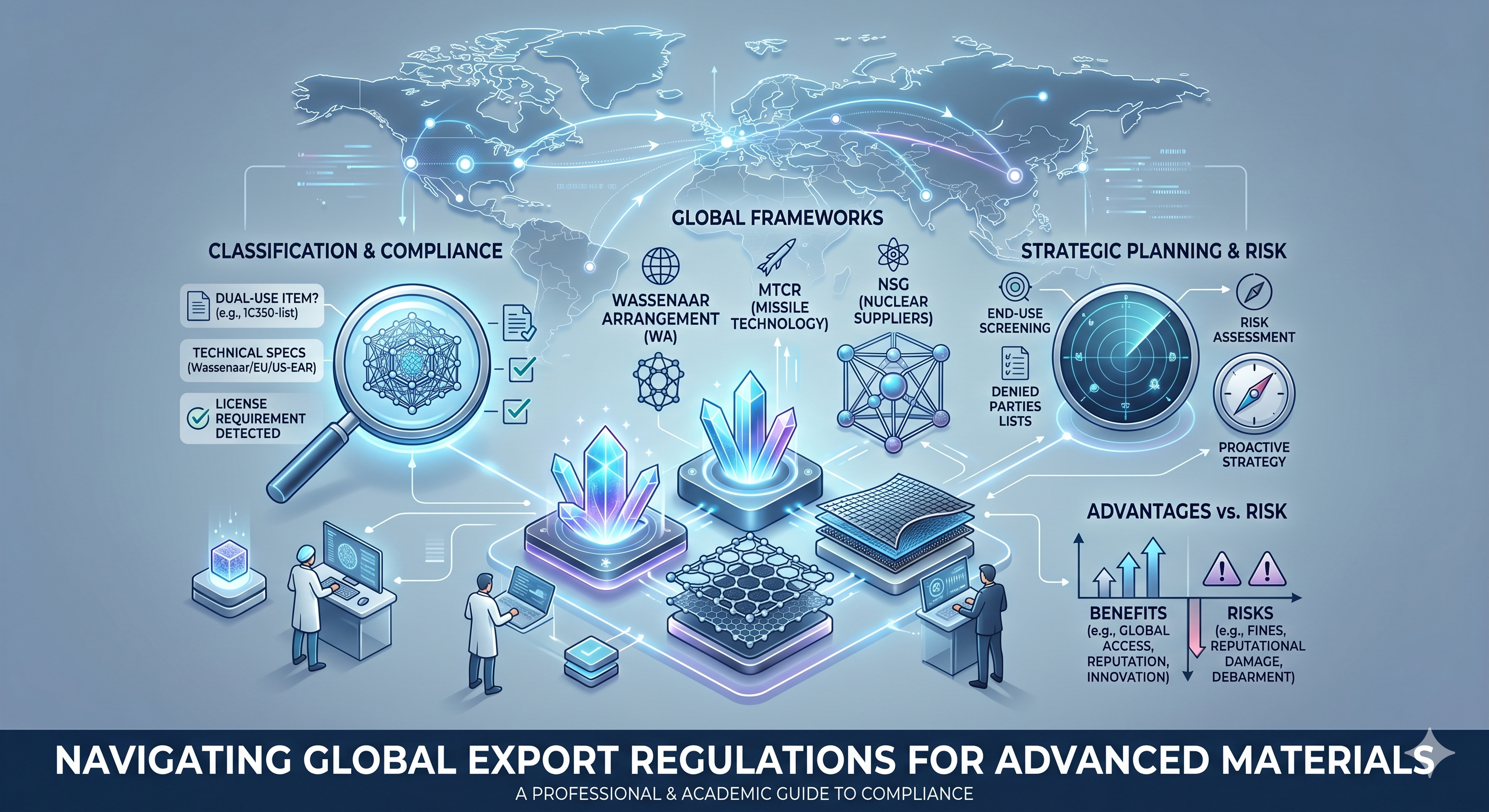
The 21st century has been termed the “Century of Advanced Materials.” We are no longer limited to the metals and plastics of the past. From the graphene that promises to revolutionize energy storage, to the advanced ceramics that enable ultra-high-speed flight, to the specialized nanomaterials that can target cancer cells, the pace of material innovation is staggering. These substances form the foundation of next-generation medical devices, renewable energy systems, and high-performance computation. However, these materials also sit at the precise intersection of profound promise and deep peril. The very properties that make a material indispensable for a new life-saving medical implant can, in the wrong hands, make it equally useful for advanced weaponry or a weapons of mass destruction (WMD) delivery system. This inherent duality is the driving force behind the complex, and often restrictive, system of global export controls for advanced materials. Navigating this regulatory labyrinth is not just an administrative burden; it is a critical scientific, strategic, and legal necessity for any research institution or company looking to take their innovation beyond domestic borders.
The Crucial Intersection: Science Meets Strategy
Export regulations are not arbitrary. They are carefully designed tools of national security, economic strategy, and international treaty. When we talk about “advanced materials,” we aren’t just talking about a category of business; we are talking about tangible assets that possess significant “dual-use” potential. Dual-use, in the context of export control, means an item can be used for both purely civil applications and military/strategic applications. A perfect example is high-strength carbon fiber. Its exceptional strength-to-weight ratio is crucial for lightweight, fuel-efficient commercial aircraft. But it’s also essential for manufacturing rocket bodies and military drones. This is why carbon fiber, particularly of certain specifications, is highly controlled.
A comprehensive view must move beyond mere compliance to understand the strategic rationale. As global geopolitical competition intensifies, controls on advanced materials are being actively weaponized as economic and security leverage. A 2024 analysis published by the Strategic Trade Review emphasized that advanced materials are increasingly being integrated into national security strategies. Materials like rare-earth elements, crucial for advanced missile systems and electronic warfare, have become centers of intense regulatory and geopolitical focus, with nations implementing restrictive export controls to protect their supply and technological advantage.
Key Regulatory Frameworks: The Global Grid
Understanding global regulations requires knowing the main international instruments and key national systems that form the control landscape.
1. International Multilateral Regimes
Most national export laws are harmonized through multilateral agreements. The core regimes include:
-
The Wassenaar Arrangement (WA): This is the foundational regime for controlling exports of conventional arms and dual-use goods and technologies. Its “Dual-Use List” provides comprehensive categories, including Category 1 (Special Materials and Related Equipment), which specifically details the technical specifications of materials under control.
-
The Missile Technology Control Regime (MTCR): Focused on limiting the proliferation of missiles and unmanned aerial vehicles (UAVs). Its “Equipment and Technology Annex” closely monitors materials essential for rocket production, such as specific composite materials and high-strength alloys.
-
The Nuclear Suppliers Group (NSG) & the Australia Group (AG): These regimes focus on preventing the proliferation of nuclear, chemical, and biological weapons, respectively. Materials controlled include graphite of nuclear quality and specialized chemicals and materials resistant to corrosive chemical agents.
2. Prominent National Systems
The U.S., China, and the EU have the most comprehensive and influential national regulations.
-
United States: The U.S. system is perhaps the most extensive. The primary regulations are the Export Administration Regulations (EAR), administered by the Department of Commerce, which cover dual-use items. The International Traffic in Arms Regulations (ITAR), administered by the Department of State, cover items specifically designed for military application (the United States Munitions List). The key challenge here is the principle of extraterritoriality, meaning that U.S. controls can apply to non-U.S. items if they incorporate controlled U.S. components or technology.
-
European Union: The EU has a centralized system for dual-use items, known as the EU Dual-Use Regulation (Regulation 2021/821). It provides a common EU-wide list of dual-use items and establishes a common authorization framework, although individual member states retain some autonomy over specific licensing decisions.
-
China: China has rapidly updated its export control laws, introducing a comprehensive Export Control Law (ECL) in 2020. This law covers a broad spectrum, including advanced materials, and has been used strategically, for instance, in implementing restrictions on critical elements like gallium and germanium in 2023, citing national security concerns.
Recent Research and Clinical Studies: A Double-Edged Sword
To understand the dynamic nature of these controls, we can look at the field of nanotechnology and advanced biomaterials, which have seen rapid advancements in both civil and potential dual-use domains.
1. Nanotechnology in Medicine (Clinical Breakthroughs vs. Proliferation Risks)
A remarkable 2024 clinical review published in NPG Asia Materials explored the use of computationally designed nanomaterials for advanced treatments, such as targeted drug delivery to cancer cells and anti-microbial coatings for medical implants. The data showed statistically significant reductions in bacterial colonization and improved therapeutic efficacy. However, the same paper noted that the knowledge and equipment used to synthesize these precise nanoparticles are not fundamentally different from those that could be used to create novel chemical or biological agents or advanced materials for kinetic weapons. A specific controlled material listed under Wassenaar Category 1C10 is “nanostructured materials,” explicitly referencing the potential for strategic applications.
2. Advanced Ceramic Composites for High-Speed Systems
Research into ultra-high-temperature ceramic matrix composites (UHTCMCs) is a primary focus for both civilian hypersonics and military defense. These materials can withstand the extreme thermal loads experienced during atmospheric re-entry or sustained supersonic flight. A 2023 study in Journal of the American Ceramic Society detailed new manufacturing methods that significantly improve the reliability and strength of these composites. This data is critical for developing spaceplanes and high-speed transit. But because this same technology is essential for developing hypersonic cruise missiles, the technical specifications and manufacturing techniques for these advanced ceramics are tightly controlled under the MTCR and Wassenaar WA-list. Any transfer of this research data or material is subject to rigorous review.
Advantages-Risk Assessment: The Regulatory Balancing Act
Navigating this complex environment is not just about avoiding penalties; it’s a strategic decision.
| Advantages of a Proactive Export Compliance Strategy | Risks & Challenges of Non-Compliance or Poor Compliance |
| Operational and Legal Certainty: Avoids severe penalties, including massive fines (sometimes in the millions), criminal prosecution, and debarment (loss of export privileges). | Severe Financial Penalties: Fines can quickly escalate, severely impacting profitability and even endangering business continuity. |
| Protected Reputation and Brand Image: Demonstrates ethical leadership and commitment to international safety norms, enhancing relationships with customers and partners. | Reputational and Brand Damage: Public association with violating proliferation norms can cause irreparable harm to a company or institution’s reputation. |
| Efficient Supply Chain and Market Access: Permits predictable, efficient shipping times and opens access to global markets and international research collaborations. | Operational Disruptions: Unlicensed exports can lead to shipment seizures, delays, and a total breakdown of the supply chain. |
| Competitive Edge: Positioned as a trustworthy partner for sensitive, high-value projects that require secure material handling. | Loss of Intellectual Property: In some systems, lack of license can complicate IP protection, while certain licensing processes may require disclosing sensitive technical data. |
| Access to Funding: Many government and institutional grants require proof of a robust export control program. | Legal Liability and Prosecution: Individuals involved in intentional or negligent violations can face personal criminal charges. |
The Path Forward: Strategies for Success
Navigating global export regulations requires a structured, multi-faceted approach.
-
Develop a Robust Export Compliance Program (ECP): This is not a “check-the-box” exercise. A comprehensive ECP must include clear policy statements, a designated Export Compliance Officer, thorough and documented training for all relevant personnel, and an annual auditing process.
-
Conduct Rigorous Material Classification: Know your material. Determine its technical specifications and check it against the relevant control lists (e.g., WA Category 1C, EAR Commerce Control List ECCNs). This often requires deep technical expertise.
-
Implement Strong End-Use and End-User Screening: A material may be uncontrolled on its own but restricted if it is intended for a controlled end-use (e.g., nuclear) or an end-user on a restricted party list. Use sophisticated screening tools.
-
Embrace Compliance by Design: Incorporate export control considerations from the earliest stages of material development and market research. This “upstream” approach prevents costly mistakes later.
-
Seek Expert Legal Counsel and Consultant Guidance: Global regulations are too complex and fluid to navigate without specialized help. Invest in legal and technical consulting.
Conclusion
The world of advanced materials holds the keys to solving our most pressing challenges, from curing disease to securing a sustainable energy future. But we cannot afford to be naive about the potential of these same materials to disrupt global security. Export controls are the mechanism through which we manage this duality. They are not a temporary hurdle; they are an enduring feature of the 21st-century strategic landscape. For companies and research institutions, a deep and proactive engagement with these regulations is not just a matter of compliance—it is a condition for responsible innovation and long-term success on the global stage. Those that view compliance as an strategic enabler, rather than a barrier, will be the ones that succeed in navigating this complex new era.