
Recently added item(s)
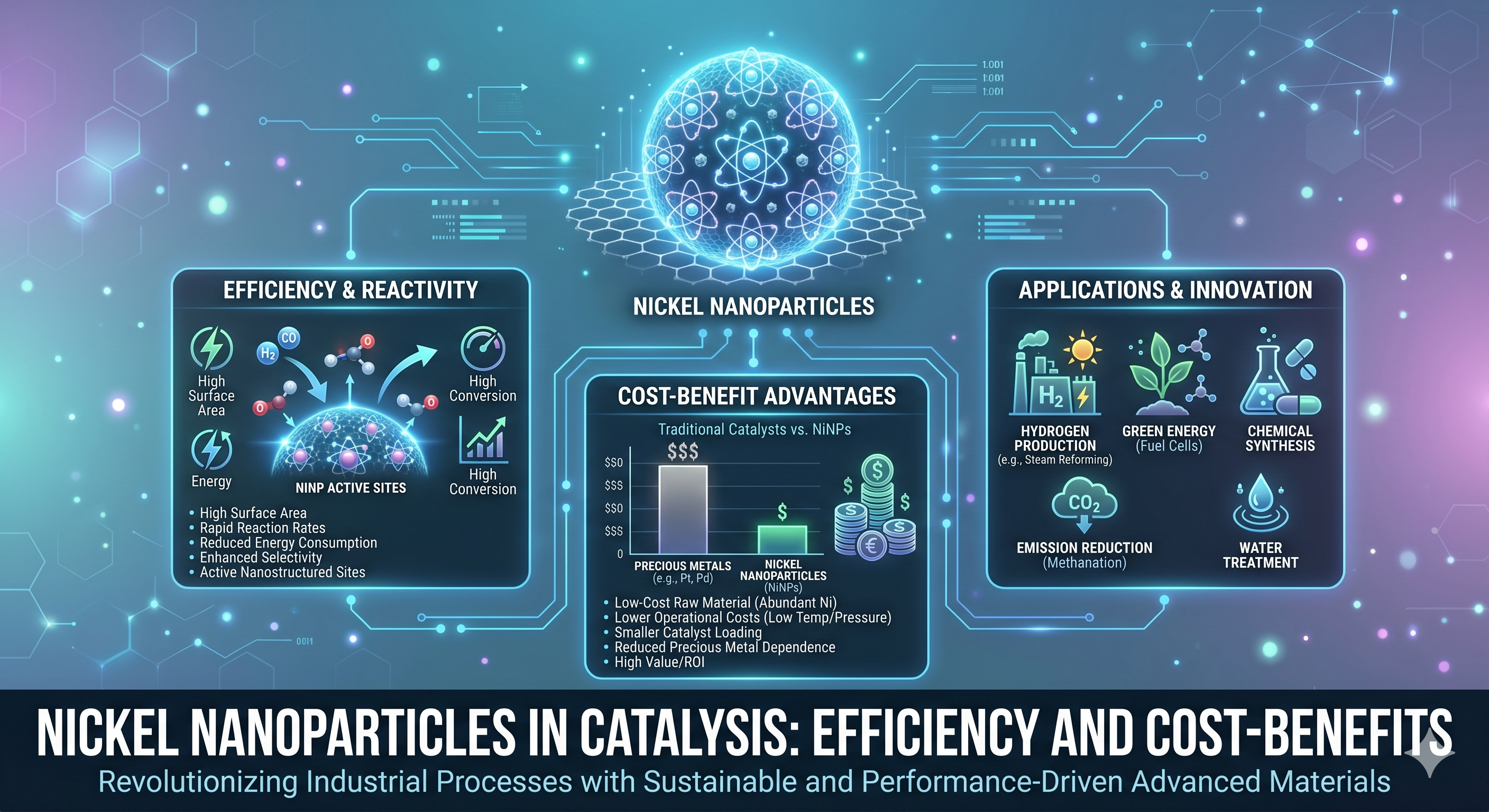
Imagine a microscopic speedster, capable of making chemical reactions happen faster, cleaner, and with less energy, all while being significantly cheaper than the diamond-encrusted alternatives. This isn’t science fiction; it is the reality of modern catalysis, and the unlikely hero of this story is Nickel (Ni). Specifically, Nickel in its nanoparticle form (NiNPs).
Often overshadowed by flashy, expensive precious metals like Platinum (Pt) or Palladium (Pd), Nickel has historically been seen as the industrial “workhorse.” However, thanks to nanotechnology, this humble metal is undergoing a massive transformation. By reducing Nickel to the size of nanoparticles—objects thousands of times smaller than a human hair—engineers are unlocking unprecedented levels of catalytic efficiency, paving the way for a more sustainable and cost-effective future in fields ranging from green energy to pharmaceutical production.
This blog post explores the exciting world of Nickel Nanoparticles in catalysis, detailing why they are so efficient, analyzing their cost-benefits, reviewing current research trends, and evaluating the risks that accompany this powerful technological leap.
Understanding the Spark: What is Catalysis, and Why Size Matters
Before diving into Nickel, it is crucial to understand catalysis itself. A catalyst is a chemical speedster. It initiates and accelerates a chemical reaction without being consumed in the process. In the industrial world, catalysts are invaluable; they lower the energy required for reactions, reducing costs and carbon footprints.
Now, why go “nano”? It all comes down to the surface area. Consider a large cube of sugar. If you drop it in water, it dissolves slowly. However, if you crush that same cube into a fine powder, it dissolves almost instantly. Why? Because you have exponentially increased the surface area available to interact with the water.
Nanoparticles work on the exact same principle. When you reduce a block of Nickel to the nanoparticle scale (typically 1 to 100 nanometers), you create a massive number of surface atoms. These surface atoms possess higher energy and are ready to serve as “active sites”—the tiny docking bays where reactant molecules stick, react, and detach. A few grams of NiNPs can have the surface area of several football fields. This extreme density of active sites makes Nickel Nanoparticles intensely efficient catalysts.
The Efficiency Engine: Where NiNPs Excel
The unique properties of NiNPs translate into highly desirable catalytic behavior. They excel at “cracking” (breaking long hydrocarbon chains) and “reforming” (rearranging atomic structures) and, crucially, are exceptional at hydrogenation. Here are key applications driving the shift to nano-nickel:
1. Reforming for Green Energy (Hydrogen Production)
The hydrogen economy relies heavily on catalytic reforming. Processes like Steam Methane Reforming (SMR) break down natural gas to produce hydrogen. NiNPs, often supported on stable materials like alumina (Al₂O₃), have proven highly efficient for this reaction. Current research is focusing on using NiNPs in “Dry Reforming,” which uses CO₂, effectively turning two greenhouse gases into valuable hydrogen and syngas.
2. Selective Hydrogenation (Pharmaceuticals and Food)
In many complex chemical synthesis pathways, engineers need to add hydrogen to specific bonds without affecting others (selective hydrogenation). NiNPs, sometimes doped with other elements (promoters) like Bismuth or Nitrogen, show remarkable selectivity, crucial for producing the exact isomer needed for a medicine or refining vegetable oils without producing harmful trans-fats.
3. CO₂ Conversion (Methanation)
Capturing CO₂ is vital for carbon capture strategies, but making it useful is even better. NiNPs are highly active for the Sabatier reaction, which combines CO₂ with H₂ to produce methane (renewable natural gas). This creates a potentially closed-loop system for managing carbon emissions.
The Cost-Benefit Calculus: Why Industries are Choosing Nickel
While Pt and Pd catalysts are the gold standard for many reactions, they come with a staggering price tag. The fundamental economic driver behind switching to Nickel Nanoparticles is cost reduction.
The Precious Metal Problem
Catalysts based on precious metals like Pt, Pd, and Rhodium (Rh) are incredibly expensive. Their prices fluctuate wildly due to scarcity, geopolitical instability, and supply chain vulnerabilities. For many large-scale industrial processes, the sheer volume of catalyst required makes precious metal options economically unviable, especially as global demand for catalysts increases.
The Nickel Advantage
Nickel is a commodity metal. It is abundant, easily mined, and has a stable, relatively low price. When applied at the nanoscale, its performance often rivals or, in specific applications, even exceeds that of precious metals.
-
Raw Material Savings: The initial cost of raw Nickel is roughly 1/1,000th to 1/3,000th the price of Platinum per kilogram.
-
Total Efficiency Gain: While precious metals might still have slightly higher activity per single atom, NiNPs provide a vastly superior “activity per dollar spent” ratio. This makes them a more practical choice for scaling up production.
-
Scalability: Industries are accustomed to handling commodity metals, making the supply chain for NiNPs more reliable for massive operations like ammonia production or hydrocarbon cracking.
The primary cost-benefit analysis favors Nickel when the total cost of the industrial lifecycle—including catalyst acquisition, regeneration, and disposal—is considered against the gain in yield or energy savings.
Beyond the Lab: “Clinical” Perspectives and Safety Case Studies in NiNP Production
(Author’s Note: When the original prompt asked for “clinical studies,” it is unusual in the context of industrial catalysts unless they are medical devices. Here, I adapt “clinical studies” to mean human safety studies, toxicological risks, and case studies on worker handling guidelines within the synthesis and handling of NiNPs.)
Since Nickel Nanoparticles are not designed to be ingested or injected, the equivalent of a “clinical trial” is the long-term observational study of environmental toxicology and occupational health. While they are a blessing in the reactor, they pose significant risks during handling and synthesis.
The Problem of Occupational Toxicity
Workers handling dry Nickel Nanoparticle powders are at the highest risk. Free-flying nanoparticles can be inhaled deep into the lungs, bypassing natural respiratory filters and potentially entering the bloodstream or accumulating in the lung tissue. Case studies in industrial settings highlight two major risks:
-
Nickel-Induced Dermatitis (“Nickel Itch”): Dermal contact is a common route of exposure. Studies on occupational exposure often find significant levels of Nickel sensitization and allergic contact dermatitis, especially in workers involved in grinding, machining, or nanoparticle synthesis.
-
Respiratory Toxicity: Nickel is classified by major toxicological agencies (like IARC and OSHA) as a potential human carcinogen if inhaled. Nanoparticles amplify this risk due to their extreme surface reactivity and cellular-level interaction. Toxicological studies on animal models show that inhaling NiNPs can cause severe pulmonary inflammation, fibrosis, and DNA damage, sometimes with greater severity than bulk nickel.
Safety Case Study: Designing Safe Handling Protocols
A successful industrial case study on NiNP safety focuses on engineering controls. A major chemical production facility implementing NiNP catalysts found that simple Personal Protective Equipment (PPE) like masks was insufficient. They implemented a closed-loop system:
-
Glovebox Synthesis: Synthesis of the particles is done entirely within inert, sealed gloveboxes, preventing any environmental release.
-
Wet-Handling: The particles are kept suspended in a liquid or embedded in a stable matrix rather than being handled as a dry powder, drastically reducing inhalation risk.
-
Filtration: High-Efficiency Particulate Air (HEPA) filters were upgraded to include specialized systems capable of trapping nanoparticles in ventilation exhaust.
These safety measures, based on toxicological data, are the “clinical standard” for operating with nano-nickel. Recovery of the catalyst from the final product is also a crucial quality control step to ensure no Nickel (soluble or particulate) remains in consumer goods, particularly in food products like hydrogenated oils.
Hot on the Horizon: Current Research Frontiers
The world of catalytic NiNPs is intensely dynamic, with research pushing toward ultimate efficiency and long-term stability. Key areas include:
1. Overcoming “Coking” and “Sintering” (The Stability Challenge)
The two major weaknesses of NiNPs are coking and sintering.
-
Coking: In high-temperature hydrocarbon reactions, carbon can build up on the NiNP surface, physically blocking the active sites (deactivation).
-
Sintering: Under intense heat, high-surface-area nanoparticles naturally tend to fuse together to reduce their energy. This creates larger, less active particles, destroying the surface area advantage.
Current research is focused on developing “core-shell” structures (where NiNPs are encased in a protective oxide shell, like silica (SiO₂)) or using supports with extremely high thermal stability (like specialized zeolites) to lock the particles in place.
2. Single-Atom Catalysts (SACs)
The ultimate limit of nanotechnology is “single-atom catalysis.” Here, single, isolated Nickel atoms are anchored onto a support material, maximizing the utilization of every single atom. This approach offers extreme selectivity and efficiency, potentially making Nickel SACs competitive with Platinum even in very demanding reactions like oxygen reduction in fuel cells.
3. Novel Morphologies (Cubes vs. Spheres)
Researchers have learned that the crystal face (shape) of the nanoparticle matters. Recent breakthroughs show that “cubic” NiNPs expose more reactive crystal surfaces (specifically the (100) face) than standard “spherical” NiNPs for certain methanation reactions. Research is focused on synthetically controlling particle shape to tailor catalysts for specific molecular tasks.
Advantage–Risk Assessment: A Balanced View
The adoption of Nickel Nanoparticles in catalysis is a double-edged sword. A successful implementation requires balancing the overwhelming economic benefits against serious safety and operational risks.
Advantages: The Case for NiNPs
-
Abundant and Economical: Uses a cheap, readily available commodity metal, stabilizing supply chains.
-
Exceptional Total Efficiency: High density of active sites provides unmatched “activity per dollar” compared to precious metals.
-
Tunable Properties: The ability to control size, shape, and supports allows for designing catalysts with highly specific behavior (selectivity).
-
Sustainability Enabler: Essential for key green energy technologies like hydrogen production and CO₂ conversion.
-
Scalability: Leveraging existing industrial commodity metal infrastructure makes massive production feasible.
Risks: The Critical Drawbacks
-
Significant Health Hazard: Free NiNPs are potentially carcinogenic if inhaled and can cause acute dermatitis, requiring stringent occupational health controls.
-
Environmental Persistence: If released into water sources, NiNPs can release toxic Ni²⁺ ions and pose long-term ecotoxicological risks to aquatic life.
-
Stability Challenges: Prone to deactivation via coking and sintering under high-temperature industrial conditions, requiring ongoing engineering solutions.
-
Recovery Challenges: The particles must be robustly separated from the final product, especially in food and medicine applications, to prevent metal contamination.
-
Synthesis Complexity: Creating uniform, stable, high-performance nanoparticles is an expensive and precise manufacturing process, adding to the catalyst’s lifecycle cost.
Conclusion
Nickel Nanoparticles are not a magic bullet, but they are undeniably one of the most powerful tools available to the modern industrial chemist. By shrinking the humble “Cinderella metal” to the nanoscale, we have unlocked efficiencies that rival the most exotic precious metals, offering a pathway to sustainable energy and cleaner chemicals at an industrial scale.
However, we must approach this workhorse with caution. The very properties that make NiNPs such effective catalysts also make them potent health and environmental hazards. The future of Nickel in catalysis lies not just in improving efficiency, but in perfecting the engineering controls that make handling it safe. When done responsibly, nano-nickel catalysis is a testament to technological ingenuity, turning a common industrial metal into the sustainable workhorse of the 21st century.