Recently added item(s)
We touch our smartphones an average of 2,617 times per day. With every swipe, tap, and scroll, our skin transfers a complex cocktail of lipids (oils), sweat, and environmental debris onto the glass. Without intervention, a modern smartphone would become a blurry, greasy mess within hours, obscuring the high-resolution displays we pay thousands of dollars for.
The secret to keeping our screens clear and smooth isn’t just “better glass”—it is a layer of nanotechnology so thin it is measured in atoms. Welcome to the world of Oleophobic Coatings, the invisible shield that represents the front line in the war against smudges and the “death of the fingerprint.”
1. The Science of Repulsion: What is Oleophobic?
The word “oleophobic” comes from the Latin oleum (oil) and the Greek phobos (fear). In materials science, an oleophobic surface is one that possesses extremely low surface energy, causing oil droplets to bead up rather than spread out.
The Contact Angle
The primary metric for measuring the effectiveness of these coatings is the Oil Contact Angle.
-
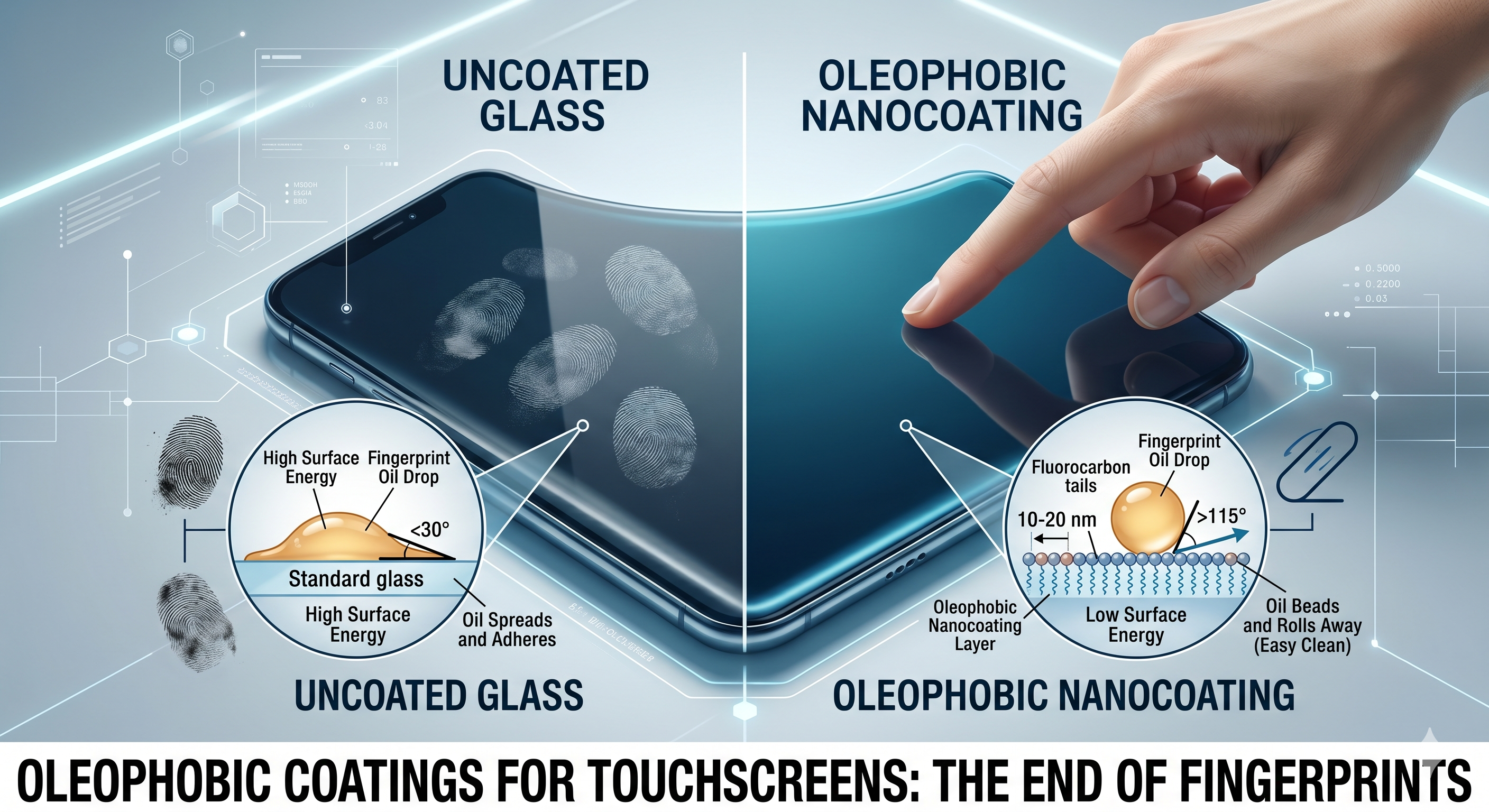
Non-coated Glass: Oil spreads out, creating a “wetting” effect. The contact angle is low (usually under 30 degrees). This makes the oil difficult to wipe away because it has “gripped” the surface.
-
Oleophobic Coated Glass: The oil forms a nearly perfect sphere. The contact angle is typically between 110 and 120 degrees. Because the oil has minimal surface contact, it can be wiped away with a simple microfiber cloth—or even the side of your pocket—without leaving a streak.
2. The Molecular Architecture: How It Works
Most modern oleophobic coatings are composed of fluorinated silanes. These molecules are engineered with a “dual-personality” structure:
-
The Anchor (Silane Head): One end of the molecule is designed to form a permanent covalent bond with the silicon dioxide ($SiO2$) in the glass. This ensures the coating doesn’t just sit on top like wax but becomes part of the glass surface itself.
-
The Shield (Fluorocarbon Tail): The other end consists of a long chain of carbon and fluorine atoms. Fluorine is the most electronegative element, and its bonds with carbon are incredibly strong and stable. This “fluorine forest” creates a low-energy barrier that oils simply cannot penetrate or adhere to.
This layer is incredibly thin—usually between 10 to 20 nanometers. To put that in perspective, a human hair is about 80,000 nanometers wide. You are touching nanotechnology every time you check your notifications.
3. Application Methods: From Lab to Pocket
Creating a coating that survives the friction of a human finger requires high-tech application methods. Manufacturers generally use one of two processes:
Physical Vapor Deposition (PVD)
This is the gold standard used by companies like Apple and Samsung. Inside a vacuum chamber, the oleophobic material is heated until it evaporates. The vapor then condenses onto the glass screen, forming an ultra-uniform, highly durable molecular bond. PVD coatings are the smoothest to the touch and last the longest.
Chemical Spraying/Dipping
For more budget-friendly devices or aftermarket screen protectors, the coating is applied as a liquid. While easier to manufacture, these coatings often lack the uniform molecular alignment of PVD-applied layers, leading to a shorter lifespan and a slightly “stickier” feel over time.
4. The Durability Challenge: Why Do Coatings Wear Off?
If oleophobic coatings are so great, why does your two-year-old phone feel “grippier” and look smudgier than a brand-new one?
The answer is mechanical abrasion. Every time you slide your phone into a pocket lined with denim, or rub it against the micro-grit found in dust, you are physically “sanding” away those nano-sized fluorocarbon tails.
Industrial “Clinical” Testing: The Steel Wool Test
In industrial quality control, manufacturers perform what is known as an Abrasion Resistance Test. A piece of steel wool or a specialized felt pad is rubbed across the coated glass under specific pressure for thousands of cycles (often up to 5,000 or 10,000 cycles).
-
A “High-Performance” Result: The water/oil contact angle remains above 100 degrees after 5,000 cycles.
-
A “Standard” Result: The coating fails after 1,000 to 2,000 cycles, explaining why heavy users notice a decline in screen clarity within 6 to 12 months.
5. Current Research: The Next Generation of “Smudge-Free”
The research landscape in 2025 and 2026 is moving beyond simple fluorine chains. Scientists are tackling the two biggest flaws of current coatings: durability and environmental impact.
1. The “PFAS-Free” Revolution
Traditional oleophobic coatings often belong to the family of PFAS (per- and polyfluoroalkyl substances), often called “forever chemicals.” Due to new environmental regulations in the EU and USA, researchers are developing Fluorine-Free Oleophobic Coatings. Current frontrunners involve silicone-based nanostructures and “liquid-like” surfaces that mimic the slippery nature of a pitcher plant’s rim.
2. Self-Healing Oleophobic Layers
One of the most exciting “clinical” breakthroughs involves embedding the coating with micro-reservoirs of fluorinated oil. When the surface layer is scratched or worn away, the reservoirs “leak” a fresh supply of molecules to the surface, effectively re-coating the screen autonomously.
3. Anti-Microbial Integration
Since our screens are breeding grounds for bacteria, new research is successfully combining oleophobic properties with silver or copper nanoparticles. This creates a surface that repels both the oil that feeds bacteria and the bacteria themselves.
6. Advantage vs. Risk Assessment
Is an oleophobic coating always a “win”? Let’s look at the balance.
Advantages
-
Optical Clarity: By preventing oil from spreading, the coating ensures that light from the pixels isn’t scattered, maintaining the “pop” of OLED displays.
-
Haptic Experience: These coatings reduce the “coefficient of friction,” making the glass feel silky smooth. This is vital for mobile gamers who need precise, fast movements.
-
Easy Maintenance: A simple wipe is all that is needed; no harsh chemicals are required.
-
Longevity of the Glass: By reducing the need for aggressive cleaning, the primary glass surface is less likely to suffer from micro-scratches over time.
Risks and Challenges
-
Chemical Sensitivity: Oleophobic coatings are the “Achilles’ heel” of smartphones when it comes to cleaning. Alcohol-based cleaners (like Windex or high-concentration rubbing alcohol) can strip a coating in a single sitting.
-
Replacement Costs: Once a coating is gone, there is no easy way for a consumer to “re-bond” a PVD-quality layer. Aftermarket “wipe-on” kits exist, but they rarely last more than a few weeks.
-
Environmental Persistence: As mentioned, the manufacturing and disposal of fluorine-based coatings present long-term ecological challenges that the industry is still struggling to solve.
7. How to Preserve Your Coating: Pro Tips
If you want your “new phone feel” to last, you must treat the coating with respect:
-
Avoid Alcohol: Never use window cleaners or disinfecting wipes directly on the screen. Use a slightly damp microfiber cloth instead.
-
Screen Protectors: Most high-quality glass screen protectors come with their own oleophobic coating. This preserves the “factory” coating on your actual phone.
-
Gentle Fabrics: Only use clean microfiber. Using your t-shirt (which may have abrasive fibers or leftover detergent) will accelerate the wear of the coating.
Conclusion
The oleophobic coating is a masterpiece of modern nanotechnology. It bridges the gap between the messy reality of human biology and the pristine requirements of high-definition digital interfaces. While we haven’t yet reached the “permanent” smudge-free screen, the move toward self-healing and fluorine-free alternatives suggests that the end of fingerprints is closer than ever. For now, that thin layer of fluorinated silane remains the invisible hero of the mobile age.