
Recently added item(s)
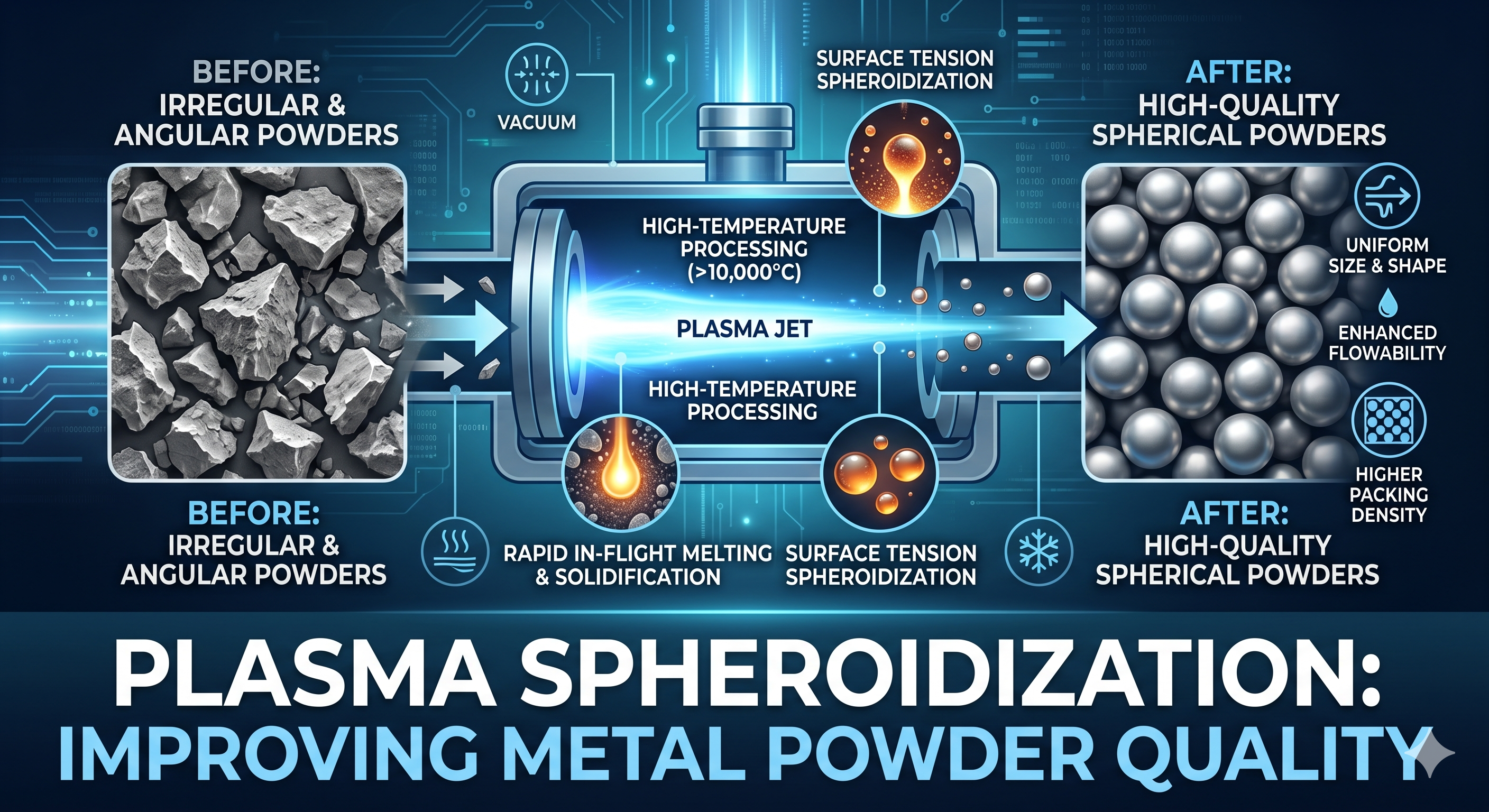
The modern manufacturing landscape, particularly the burgeoning field of metal additive manufacturing (3D printing), is only as good as the raw materials it uses. Metal powders are the lifeblood of these processes, and their quality directly dictates the strength, integrity, and finish of the final component. However, many standard techniques for producing metal powders yield irregular, angular, and porous particles. Enter plasma spheroidization—a revolutionary thermal processing technique that reshapes and densifies these powders, unlocking their full potential. This article provides a detailed exploration of plasma spheroidization, its scientific foundations, its role in improving metal powder quality, current research, and a balanced assessment of its advantages and risks.
1. Introduction: The Powder Problem in Advanced Manufacturing
The demand for high-performance metal components in aerospace, medical, automotive, and energy sectors has skyrocketed. Traditional manufacturing methods are increasingly being complemented or replaced by additive manufacturing (AM), which offers unprecedented design freedom and material efficiency. However, the efficacy of AM technologies, such as Laser Powder Bed Fusion (L-PBF) and Electron Beam Melting (EBM), hinges upon the feedstock material: metal powder.
Ideal metal powders for these applications must possess specific characteristics: they should be spherical, dense, free from internal porosity, have a smooth surface, and exhibit consistent flowability. Unfortunately, common powder production methods often fall short:
-
Water Atomization: Produces irregular, somewhat angular powders.
-
Crushing/Grinding: Results in highly irregular and angular particles.
-
Sponge Iron Process: Creates porous, irregular sponge-like particles.
These irregular powders lead to problems like poor flowability, low packing density, inconsistent layer deposition in AM machines, and final parts with structural defects. To bridge this gap, plasma spheroidization has emerged as the premier technology for “upcycling” these lower-grade powders into high-quality feedstock.
2. The Science Behind Plasma Spheroidization: How It Works
Plasma spheroidization is a rapid thermal process that uses a high-temperature plasma jet to melt and shape metal particles in mid-air. The entire process occurs within microseconds to milliseconds.
The Plasma Medium
At the heart of the system is a plasma torch, which generates a plasma jet using gases like Argon (Ar), Hydrogen (H₂), Nitrogen (N₂), or Helium (He). Plasma, often called the fourth state of matter, consists of a gas of ions and free electrons. It can reach extremely high temperatures, typically ranging from 8,000 to 15,000°C (or even higher in specialized systems), significantly above the melting and even boiling points of all known metals.
The Mechanism of Spheroidization
The transformation occurs in four key stages:
-
Injection: The irregular feedstock powder is introduced into the high-velocity, high-temperature plasma jet using a carrier gas.
-
In-flight Melting: As the particles travel through the plasma zone, they absorb heat rapidly due to convection and radiation. The high enthalpy of the plasma ensures that the entire volume of each particle melts completely.
-
Spheroidization by Surface Tension: Once in a molten state, the fluid particles are no longer constrained by their previous solid shape. The predominant force acting upon them is surface tension. To minimize its surface-free energy, a liquid droplet naturally assumes a spherical shape, which has the lowest surface area-to-volume ratio.
-
Rapid Solidification: The molten spherical droplets exit the plasma zone and enter a cooling chamber filled with inert gas. They cool down rapidly through radiation and convection, solidifying into perfect spheres before they make contact with any surface or each other.
3. How Plasma Spheroidization Improves Metal Powder Quality
The application of plasma spheroidization offers a multifaceted improvement in the physical and technological properties of metal powders.
3.1 Morphological Transformation
The most obvious change is the shift from irregular, angular shapes to nearly perfect sphericity (with a circularity index close to 1). This change has several crucial knock-on effects.
3.2 Enhanced Flowability
Powder flowability refers to the ease with which a powder flows. It is a critical parameter for AM systems that rely on a recoater blade or roller to spread a thin, uniform layer of powder. Irregular particles tend to interlock, causing erratic flow and uneven layers. Spherical particles act like tiny ball bearings, reducing internal friction and ensuring smooth, consistent, and predictable flow. This improves process stability and reduces downtime in AM machines.
3.3 Increased Packing and Bulk Density
Spherical particles pack more efficiently than irregular ones. Imagine filling a bucket with jagged rocks versus marbles; the marbles will leave far fewer gaps. In AM, higher packing density means more metal is present in each powder bed layer, leading to better thermal conductivity, more uniform melting, and fewer voids in the solidified part. Plasma spheroidization can significantly increase tap density (the density after tapping the container).
3.4 Elimination of Internal Porosity and Satellites
Many raw powders have internal pores or smaller particles (“satellites”) attached to their surface. Plasma spheroidization eliminates both defects. As the particle melts completely, any internal gas bubbles are forced out by buoyancy and the contracting forces of surface tension. Satellites are absorbed into the main body of the molten drop. This creates “dense” or “satellite-free” powders, which are essential for manufacturing dense, fatigue-resistant parts.
3.5 Surface Purification and Alloying
The high temperature of the plasma can cause volatile impurities (like oxygen or carbon) on the particle surface to vaporize. Furthermore, the reducing environment within the cooling chamber (if hydrogen is used) can help reduce oxide layers. Additionally, plasma processing can be used for in-flight alloying or modifying the particle surface chemistry.
4. Current Research Trends and Clinical/Industrial Studies
The field of plasma spheroidization is dynamic, with ongoing research focusing on optimization, processing of novel materials, and understanding the process mechanics at a fundamental level.
Current Research Areas
-
Numerical Modeling and Simulation: Researchers use Computational Fluid Dynamics (CFD) and Discrete Phase Modeling (DPM) to simulate particle-plasma interactions. This helps optimize torch design, gas flow rates, power input, and feeding rates to achieve maximum spheroidization efficiency.
-
Refractory Metals processing: Extensive research is dedicated to spheroidizing difficult metals like Tungsten (W), Tantalum (Ta), Molybdenum (Mo), and Niobium (Nb) for aerospace and high-temperature applications.
-
Alloy Development: In-flight alloying is being explored, where mixed raw powders are fed into the plasma to create homogeneous alloy spheres directly.
-
Surface Modification for Bio-compatibility: Research is ongoing to use plasma spheroidization to create powders of biometals (like Ti alloys) with specific surface properties or textures to enhance bone ingrowth (osseointegration) for medical implants.
Studies and Case Examples
In the industrial realm, numerous case studies demonstrate the impact of plasma spheroidization. Companies like Carpenter Additive have published data showing significant improvements in properties for materials like Ti6Al4V Grade 23 (commonly used for medical implants), Tungsten, and Tantalum. For example, HDH Ti6Al4V (irregular) saw its flow time improve twofold and its tap density increase to ~60% of theoretical bulk density after plasma spheroidization.
While “clinical studies” do not apply directly to the powder process itself, the resulting spherical powders are widely used in “clinical applications” by manufacturing patient-specific medical implants (hip joints, cranial plates, spinal cages) via AM. The high quality and purity of these powders are vital for ensuring the long-term safety and performance of these life-critical devices.
5. Advantage and Risk Assessment
While plasma spheroidization is a powerful technology, it must be evaluated alongside its associated challenges.
Advantages
-
Unmatched Sphericity: Achieves circularity levels that are superior to almost any other method.
-
Versatility: Can process virtually any metallic material, including refractory metals and superalloys, provided a feedstock powder exists.
-
Enhanced Flow and Packing: Dramatically improves technological properties that are vital for additive manufacturing.
-
Elimination of Defects: Effectively removes satellites and internal porosity, creating highly dense particles.
-
Surface Purification: Reduces surface oxygen and other volatile impurities.
Risks and Challenges
-
High Operational Costs: Plasma torches are energy-intensive, and the inert gases (Argon, Helium) used are expensive, making the process costly.
-
Small Production Scale: Traditionally, plasma spheroidization systems have been smaller-scale batch processors compared to massive atomization towers.
-
Feeding Difficulties: Very fine powders can be challenging to feed consistently into the plasma jet without agglomeration.
-
Yield Issues: Evaporation of material at extreme temperatures can lead to material loss and lower yield of the desired particle size fraction.
-
Health and Safety: Handling fine metal powders (especially reactive metals) poses explosion and inhalation risks.
6. Conclusion: A Key Enabler for High-Performance Metallurgy
Plasma spheroidization has transitioned from a specialized research tool to a critical industrial technology for high-value metal powder production. By transforming irregular, porous, or angular particles into dense, perfect spheres, it unlocks the potential of additive manufacturing for critical applications in medicine, aerospace, and beyond. Despite its high costs, the benefits in terms of improved flowability, packing density, and particle integrity make it an invaluable “upcycling” step for materials where performance cannot be compromised. As research continues to optimize efficiency and scale, plasma spheroidization is poised to play an even larger role in the future of advanced manufacturing feedstock metallurgy.