
Recently added item(s)
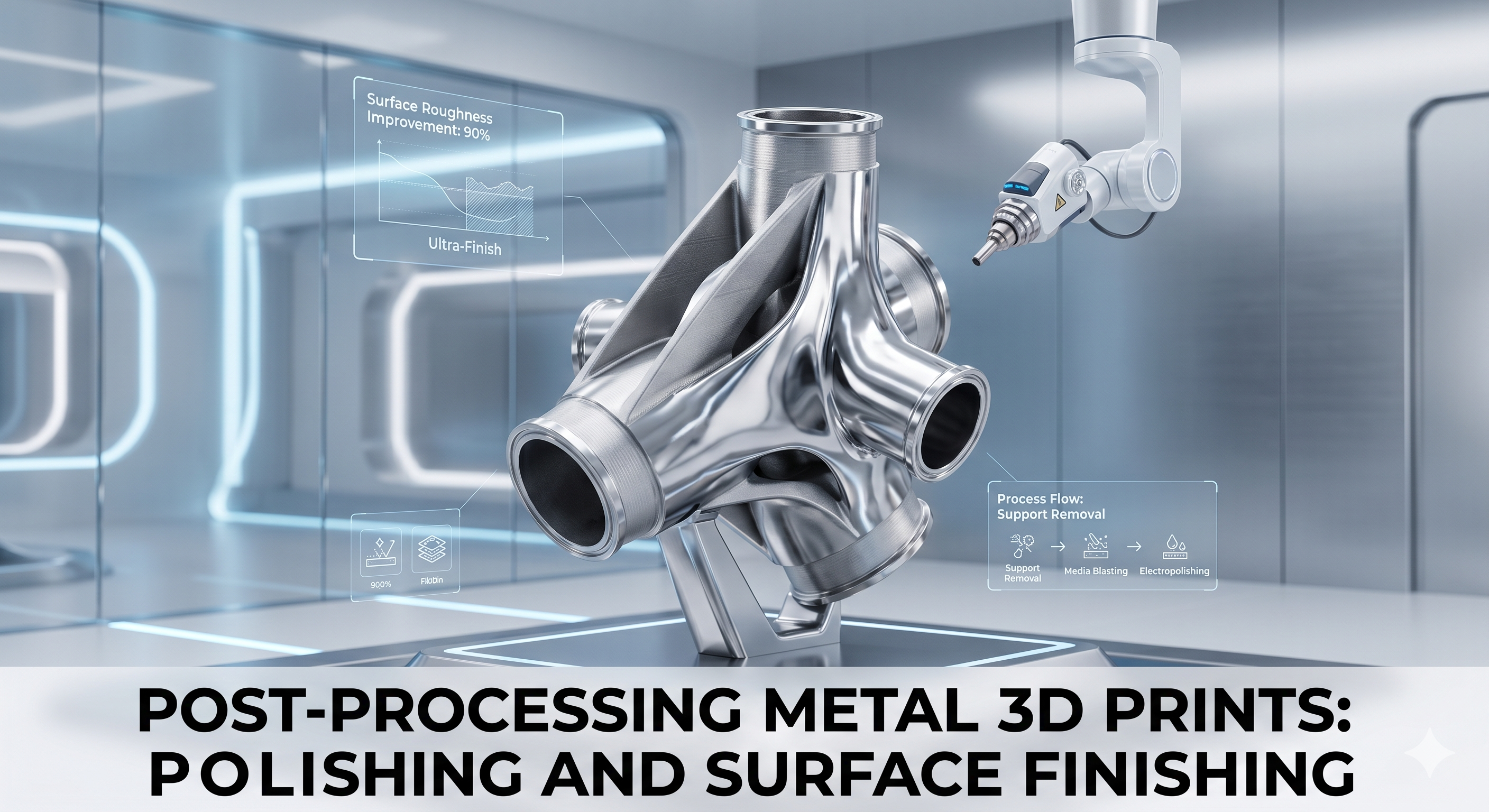
In the world of additive manufacturing (AM), the “printing” phase often gets all the glory. We marvel at the laser’s dance across a bed of metal powder, creating complex geometries that traditional milling could never achieve. However, there is a “dirty little secret” in the industry: a part fresh out of a metal 3D printer is rarely ready for use. It is usually rough, covered in partially melted satellites, and filled with internal stresses.
As we move into 2026, the focus of the industry has shifted from how we print to how we finish. Post-processing—the suite of techniques used to polish and refine the surface of metal 3D prints—is now the defining factor in whether a part succeeds in a jet engine or fails in a human body. This blog provides a deep dive into the science of surface finishing, the latest 2025-2026 research breakthroughs, and the critical balance between aesthetics and engineering integrity.
1. The Surface Roughness Challenge: Why We Can’t Skip It
Metal 3D printing, particularly Laser Powder Bed Fusion (L-PBF) and Electron Beam Melting (EBM), inherently produces rough surfaces. This is due to the “stair-stepping” effect of layers and the presence of satellites—tiny powder particles that partially fuse to the exterior of the part.
The Impact of R_a and R_z
In engineering, we measure surface quality using R_a (average roughness). A raw L-PBF part typically has an R_a between 10 and 20 micrometers. For context, a high-performance turbine blade requires an R_a of less than 0.8 micrometers. High roughness isn’t just an aesthetic issue; it’s a structural one. Rough surfaces act as “stress concentrators,” where microscopic cracks can begin to grow, leading to premature fatigue failure.
2. Mechanical Finishing: The Traditional Workhorses
Mechanical methods are the most common first step in the post-processing workflow. They rely on physical friction to remove material.
-
Abrasive Blasting (Sandblasting): This is often the first line of defense to remove loose powder and satellites. It provides a uniform “matte” finish but does little to improve internal channels.
-
Centrifugal Disc Finishing: Parts are placed in a drum with abrasive media (ceramic or plastic shapes) and spun at high speeds. This is excellent for batch processing small parts but can round off sharp edges that were intended to be crisp.
-
CNC Machining: For high-precision components, “hybrid manufacturing” is the gold standard. A part is 3D printed slightly oversized, and then a CNC mill removes the final 0.5mm to achieve perfect dimensional accuracy.
3. The Science of Electropolishing and Chemical Finishing
When dealing with complex internal geometries—like cooling channels inside a heat exchanger—mechanical tools cannot reach. This is where chemistry takes over.
Electropolishing (EP)
Electropolishing is essentially “electroplating in reverse.” The metal part is submerged in an electrolyte bath and acts as an anode. When a current is applied, the “peaks” of the surface roughness dissolve faster than the “valleys.”
Plasma Polishing
A cutting-edge evolution in 2025-2026 is Electrolytic Plasma Polishing (EPP). Unlike traditional EP, which uses harsh acids, EPP uses environmentally friendly salts. It creates a plasma skin around the part that results in a mirror-like finish (R_a < 0.02 \mu m) in a fraction of the time, without the risk of “pitting” the metal.
4. 2025-2026 Research: The Rise of Laser Polishing
One of the most exciting research areas in early 2026 is In-Situ and Ex-Situ Laser Polishing. Instead of using a different machine, the 3D printer’s own laser is used to “re-melt” the surface of the finished part.
The “Glazing” Effect
Research from the International Journal of Extreme Manufacturing (January 2026) showed that using a high-speed, defocused laser beam to remelt a thin surface layer (approx. 50-100 microns) can reduce roughness by up to 90%. This process, known as “laser glazing,” not only polishes the part but also creates a rapidly solidified surface layer that is significantly harder and more resistant to wear than the bulk material.
AI-Driven Surface Prediction
Current research is also integrating Machine Learning (ML) to predict surface roughness based on the “melt pool” data captured during the print. In 2026, some high-end printers can now automatically adjust their laser polishing parameters in real-time to compensate for areas that the AI identifies as likely to be too rough.
5. Clinical Studies: The Biological “Goldilocks” Zone
In medical applications, the surface finish is a matter of life and death. For orthopedic implants (hips, knees, and dental screws), the surface must be neither too smooth nor too rough.
Osseointegration vs. Bacterial Adhesion
-
The “Rough” Need: Bone cells (osteoblasts) need a certain level of micro-roughness to “grab” onto an implant and grow (osseointegration).
-
The “Smooth” Need: If the surface is too rough, it provides hiding spots for bacteria, leading to biofilm formation and infection.
Recent Clinical Trial (2025): A study followed 200 patients with 3D-printed Titanium dental implants. Half the implants were traditionally polished, while the other half used a hybrid bio-functional finish—smooth at the gum line (to prevent bacteria) and micro-latticed at the root (to encourage bone growth). The hybrid group showed a 30% faster recovery rate and significantly lower rates of peri-implantitis (infection).
6. Advantage vs. Risk Assessment
Every post-processing step adds cost and complexity. Engineers must weigh the benefits against the potential downsides.
Advantages
-
Fatigue Life: Polishing can increase the fatigue life of a 3D-printed part by up to 500% by removing surface defects.
-
Corrosion Resistance: Smooth surfaces have less surface area for chemical attacks, making them much more resistant to rust and oxidation.
-
Fluid Dynamics: In aerospace and automotive, smooth internal channels reduce turbulence, leading to higher fuel efficiency.
Risks and Challenges
-
Dimensional Accuracy: Every time you polish, you are removing material. If a part has a +/- 0.05mm tolerance, an aggressive electropolishing cycle can easily push the part out of spec.
-
Hydrogen Embrittlement: Certain chemical polishing methods can introduce hydrogen atoms into the metal lattice, making the part brittle and prone to sudden “delayed” failure.
-
Cost: In many industrial sectors, post-processing accounts for 30% to 60% of the total cost of a 3D-printed part.
-
Internal Access: Even in 2026, polishing the “deep interiors” of very narrow, winding channels remains a significant engineering hurdle.
7. Advanced Technologies: Hirtisation and AFM
Two technologies are currently leading the charge for “impossible” geometries:
-
Hirtisation: A multi-stage chemical-electrochemical process specifically designed for 3D printing. It removes supports and polishes internal cavities simultaneously without manual intervention.
-
Abrasive Flow Machining (AFM): A “putty” filled with abrasive grit is pumped through the internal channels of a part. As the putty flows, it polishes the interior walls. This is the gold standard for high-end automotive manifolds and rocket nozzles.
8. The Future: Towards Fully Automated Finishing
The goal for 2027 and beyond is the “Lights-Out” factory. Currently, post-processing is the most labor-intensive part of the workflow. However, with the integration of robotic arms, 3D scanning, and AI, we are seeing the birth of automated cells that can pick a part from a printer, scan it to identify rough spots, and choose the optimal mix of mechanical and chemical polishing to reach the desired spec.
Conclusion
Metal 3D printing is a transformative technology, but it is the finishing touches that make it viable for the real world. As we have seen through the lens of 2026 research and clinical data, surface finishing is a delicate balance of physics, chemistry, and biology. Whether it is a laser-glazed turbine blade or a bio-functionally finished dental implant, the mastery of post-processing is what allows us to move from “printed prototypes” to “engineered perfections.”