
Recently added item(s)
Corrosion is often called the “silent killer” of global infrastructure. From the massive hulls of cargo ships to the intricate pipelines snaking across continents and the structural steel of our bridges, the slow, relentless oxidation of metal costs the global economy an estimated 2.5 trillion USD annually. For decades, the industry has relied on heavy-duty epoxies, zinc-rich primers, and toxic chromate-based conversions. However, as environmental regulations tighten and the demand for longer-lasting materials grows, the industrial world is turning to nanotechnology—specifically, the “wonder material” known as graphene.
Graphene-based industrial coatings represent a paradigm shift in material science. By leveraging the unique physical and chemical properties of a single layer of carbon atoms, engineers are developing coatings that are thinner, stronger, and significantly more impermeable than anything previously imagined.
Understanding the Graphene Advantage
Graphene is a two-dimensional honeycomb lattice of carbon atoms. Despite being only one atom thick, it is roughly 200 times stronger than steel and possesses extraordinary electrical and thermal conductivity. But for the world of anti-corrosion, its most vital trait is its impermeability.
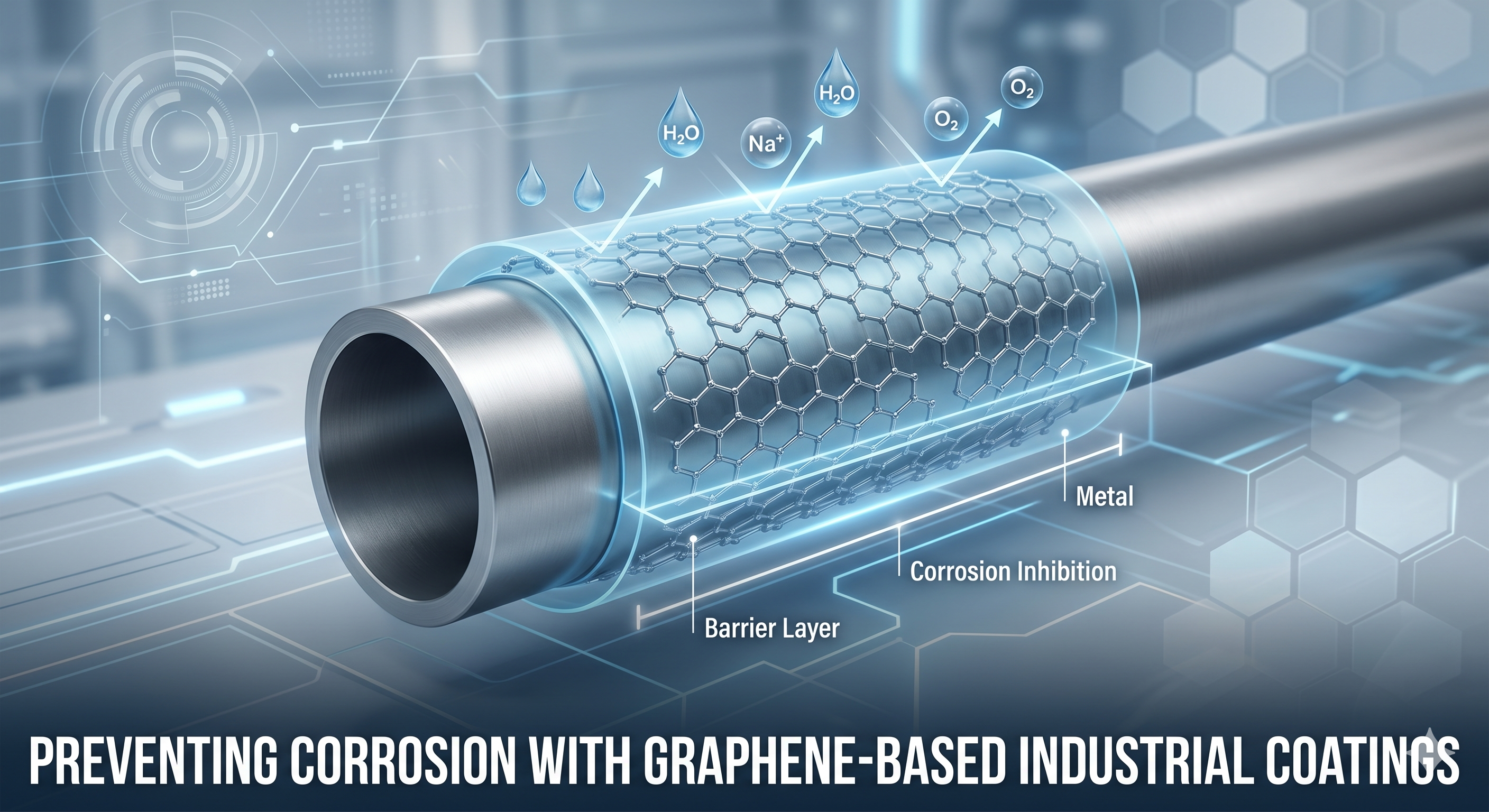
A perfect sheet of graphene is so dense that even a helium atom—the smallest atomic element—cannot pass through it. When integrated into industrial coatings, graphene acts as a physical wall, preventing corrosive agents like water, oxygen, and salt ions from reaching the metal substrate.
The “Tortuous Path” Mechanism
In traditional coatings, moisture eventually finds its way through microscopic pores or defects in the polymer matrix. Graphene changes this dynamic through what scientists call the “tortuous path” effect.
When graphene nanoplatelets (GNPs) are dispersed into a resin or epoxy, they align themselves like shingles on a roof. Because the corrosive molecules cannot pass through the graphene flakes, they are forced to travel around them. This creates a long, winding, and difficult journey for moisture and oxygen. By the time these elements reach the metal surface, the rate of corrosion has been slowed by orders of magnitude compared to standard coatings.
Current Research and Breakthroughs (2024–2026)
The transition of graphene from a laboratory curiosity to an industrial staple has been accelerated by recent breakthroughs in chemical functionalization and mass production.
1. Functionalized Graphene Oxide (GO)
One of the primary challenges in early graphene coatings was “agglomeration”—the tendency of graphene flakes to clump together because they are naturally hydrophobic (water-repellent). Recent research has focused on Graphene Oxide (GO), which contains oxygen-bearing functional groups. These groups allow the graphene to disperse more evenly in water-based or solvent-based resins.
Studies published in 2025 have demonstrated that by “tuning” these oxygen groups, scientists can create a more cohesive bond between the graphene and the epoxy matrix, effectively sealing the coating at a molecular level and eliminating the microscopic gaps where corrosion typically begins.
2. Self-Healing Hybrid Coatings
A significant area of active research involves “smart” coatings. In these systems, graphene is combined with micro-capsules containing corrosion inhibitors. When the coating is scratched or damaged, the capsules break, releasing chemicals that react with the graphene and the metal to form a new protective layer instantly.
Recent lab trials have shown that these hybrid graphene-epoxy systems can maintain 95% of their protective efficiency even after being deliberately scored with a blade, a feat traditional zinc primers cannot match.
3. AI-Driven Dispersion Models
With the rise of industrial AI, companies are now using machine learning algorithms to determine the exact concentration and orientation of graphene flakes required for specific environments. Whether it is the high-salinity splash zone of an offshore oil rig or the high-heat environment of a chemical processing plant, AI models are helping formulators optimize the “aspect ratio” of graphene to ensure maximum protection with minimum material usage.
Advantage-Risk Assessment: A Balanced View
While graphene is revolutionary, it is not a “magic dust” that can be thrown into any paint without consequences. A professional evaluation requires looking at both the immense benefits and the technical hurdles.
The Advantages
-
Superior Barrier Properties: As mentioned, the physical barrier provided by graphene is unmatched. It significantly extends the service life of assets in “C5” (highly corrosive) environments.
-
Reduced Coating Thickness: Because graphene is so effective, industrial users can often achieve better protection with thinner layers. This reduces the overall weight of the coating—a critical factor in the aerospace and automotive industries—and lowers the total volume of chemicals used.
-
Enhanced Mechanical Durability: Graphene doesn’t just stop rust; it makes the coating harder and more resistant to abrasion, impact, and UV degradation. This means fewer touch-ups and less maintenance over time.
-
Environmental Sustainability: By extending the life of steel and reducing the need for toxic additives like hexavalent chromium, graphene coatings contribute to a more sustainable industrial ecosystem.
The Risks and Challenges
-
The Galvanic Corrosion Paradox: This is the most significant risk. Graphene is highly conductive. If a graphene coating is formulated incorrectly and the graphene flakes come into direct, continuous contact with the metal substrate, they can actually accelerate corrosion through a process called galvanic action. The graphene acts as a cathode, and the metal becomes an anode, leading to rapid pitting.
-
Solution: Proper insulation of the flakes within the resin and using non-conductive “buffer” layers are essential.
-
-
Dispersion Issues: If the graphene is not perfectly dispersed, “clumps” can create weak spots or even pathways for water to bypass the barrier. High-shear mixing and chemical stabilizers are required, which can increase production costs.
-
Cost of Raw Materials: While the price of high-quality graphene has dropped significantly in the last five years, it remains more expensive than traditional fillers like talc or calcium carbonate. The ROI must be calculated based on “total life cycle” rather than “initial gallon cost.”
Case Studies and Laboratory Insights
Recent clinical and laboratory evaluations provide concrete evidence of graphene’s efficacy. In a standard Salt Spray Test (ASTM B117), which simulates years of maritime exposure in a matter of weeks, graphene-enhanced epoxies consistently outperform standard marine-grade coatings.
In one 2025 industrial trial involving structural steel in a coastal chemical plant, a 1% graphene-to-resin ratio resulted in a 400% increase in corrosion resistance compared to the control group. Furthermore, electrochemical impedance spectroscopy (EIS) tests—a scientific method used to measure how well a coating “resists” electrical flow—showed that graphene coatings maintain their integrity for nearly twice as long as traditional polyurethane finishes when submerged in acidic solutions.
The Road Ahead: Scaling and Standardization
The future of graphene in industrial coatings lies in standardization. For large-scale adoption, the industry needs clear “Graphene Content” certifications. We are moving toward a world where “Graphene-Inside” becomes a standard label for high-performance protection.
We are also seeing the emergence of Graphene-Zinc Hybrids. Rather than replacing zinc entirely, small amounts of graphene are being used to “bridge” the zinc particles. This creates a more conductive path for the sacrificial protection of the zinc while providing the physical barrier of the graphene, offering a double-layered defense mechanism.
Conclusion
Preventing corrosion is no longer just about “painting” a surface; it is about engineering a molecular shield. Graphene-based coatings offer a sophisticated, high-performance solution to one of the world’s oldest engineering problems. While challenges regarding dispersion and galvanic risks remain, the advancements in functionalization and smart-additive technology are rapidly overcoming these hurdles.
For industries ranging from shipping and energy to infrastructure and automotive, the adoption of graphene is not just an upgrade—it is an investment in longevity and sustainability. As we move further into the 2020s, graphene is set to move from a “premium additive” to the fundamental backbone of the global anti-corrosion industry.