
Recently added item(s)
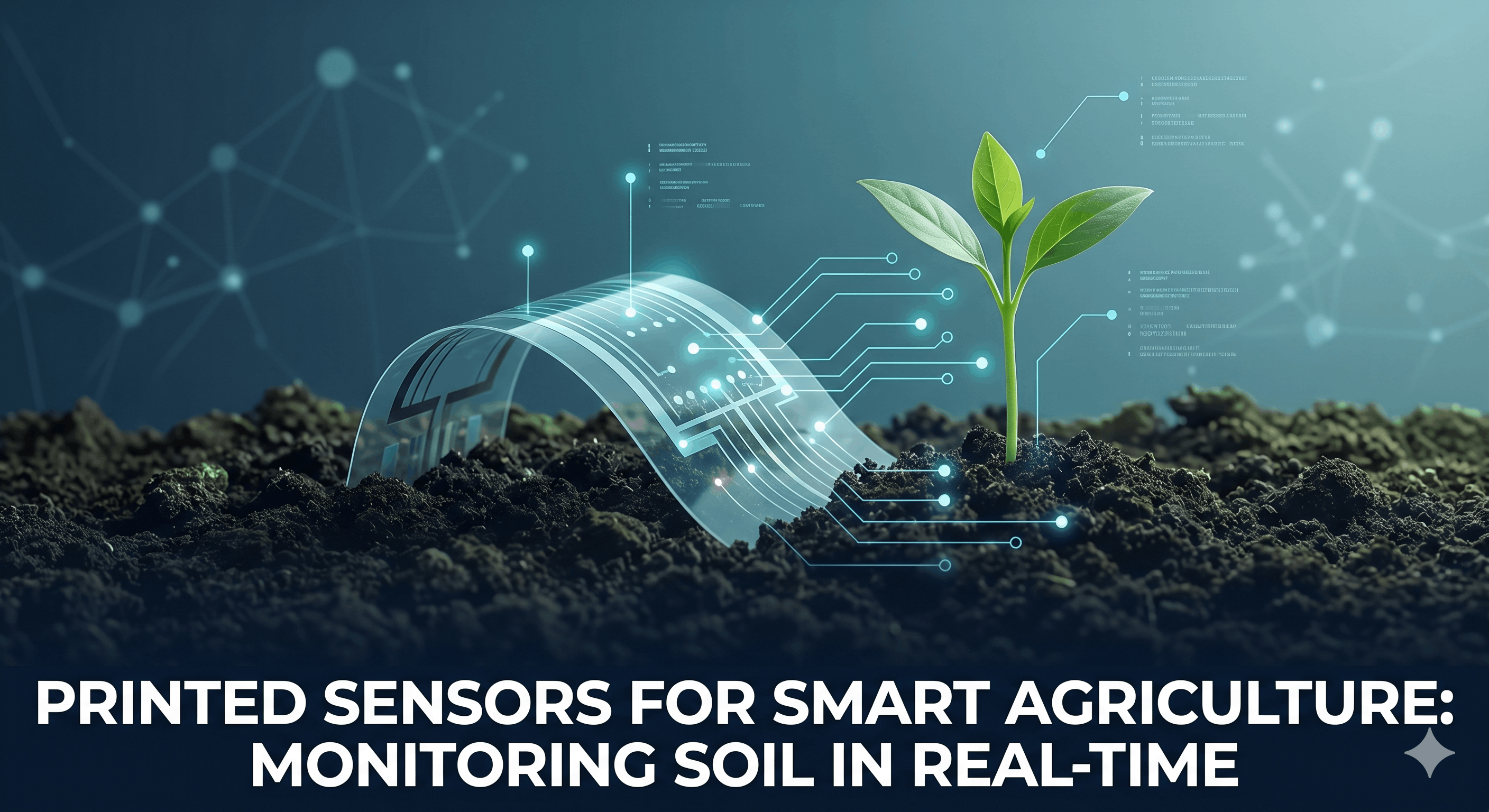
The global population is projected to reach nearly 10 billion by 2050. To feed this many people, global food production must increase by approximately 70%. However, we are facing this challenge in the midst of a climate crisis, shrinking arable land, and a desperate need to reduce the environmental footprint of industrial farming. The answer to this paradox lies in “Smart Agriculture”—a data-driven approach where every drop of water and every gram of fertilizer is optimized.
At the heart of this revolution are printed sensors. These paper-thin, flexible, and low-cost devices are transforming the soil itself into a source of real-time data, allowing farmers to “listen” to their land like never before.
1. From “Gut Feeling” to Data-Driven Farming
For centuries, farming was guided by experience and seasonal intuition. If the leaves looked yellow, you added nitrogen. If the soil felt dry, you irrigated. While effective for small plots, this “reactive” approach leads to massive waste on an industrial scale. Over-fertilization runs off into groundwater, causing toxic algal blooms, while over-irrigation depletes precious freshwater resources.
Printed sensors shift the paradigm from reactive to proactive. By embedding electronic sensors directly into the soil across hundreds of acres, farmers receive a continuous stream of data on their smartphones. They no longer guess what the crop needs; they know.
2. What are Printed Sensors?
Traditional electronic sensors are often bulky, expensive, and made of rigid silicon and metal. They are difficult to deploy in large numbers and often need to be manually collected to avoid contaminating the field.
Printed sensors are different. They are manufactured using techniques similar to how newspapers are printed. “Functional inks”—made from conductive materials like graphene, carbon nanotubes, or metallic nanoparticles—are deposited onto flexible substrates like plastic films, paper, or even biodegradable polymers.
How They Are Made:
-
Inkjet Printing: Precision droplets of conductive ink are “sprayed” onto a surface to create complex circuits.
-
Screen Printing: A stencil-like process used for high-volume production, ideal for creating large arrays of soil moisture or pH sensors.
-
Roll-to-Roll Manufacturing: This is the same process used for food packaging, allowing miles of sensors to be produced in a single run, bringing the cost per sensor down to pennies.
3. The Big Five: What are We Monitoring?
To understand soil health, printed sensors focus on five critical parameters:
A. Volumetric Water Content (Moisture)
Water is the most critical input. Printed capacitive sensors measure the soil’s “dielectric constant,” which changes based on how much water is present. Real-time moisture data allows for “Variable Rate Irrigation,” where water is only applied to specific zones that are actually thirsty.
B. Nitrogen, Phosphorus, and Potassium (NPK)
These are the “Big Three” nutrients. Historically, testing for NPK required taking soil samples to a lab—a process that takes days. New printed electrochemical sensors use ion-selective membranes to detect NPK levels in the soil’s pore water instantly.
C. Soil pH
The acidity or alkalinity of soil determines how well plants can absorb nutrients. Printed pH sensors use metal-oxide layers (like Ruthenium or Iridium oxide) to monitor these shifts, which can occur rapidly after rain or fertilization.
D. Temperature
Soil temperature affects seed germination and the activity of beneficial microbes. Printed thermistors are incredibly cheap and can be integrated into the same strip as the moisture sensor.
E. Salinity (Electrical Conductivity)
High salt content can “burn” crops. Monitoring conductivity helps farmers manage the quality of their irrigation water, especially in arid regions where salt buildup is a major risk.
4. Current Research and “Field Trials”
While we don’t call them “clinical trials” in agriculture, the rigorous field-testing of these sensors mirrors the scientific depth of medical studies. Current research is focusing on the intersection of materials science and the Internet of Things (IoT).
Biodegradability: The “Plant and Forget” Model
A major area of research (published in journals like Nature Communications) involves sensors made from cellulose or silk-based substrates. The goal is a sensor that functions for one growing season and then safely biodegrades into the soil, leaving no electronic waste behind.
Self-Powered Sensors
Researchers are exploring “soil microbial fuel cells” to power these sensors. Instead of using a battery, the sensor draws a tiny amount of electricity from the metabolic activity of bacteria naturally present in the soil. This would allow sensors to remain active for years without maintenance.
Accuracy in Diverse Soil Types
A recent study involving large-scale pilot projects in the American Midwest and the European Union tested printed sensors across clay, sand, and loamy soils. The challenge is “sensor drift”—where the chemicals in the soil eventually degrade the sensor’s accuracy. Research into protective nano-coatings is currently the leading solution to extend the life of these devices in harsh environments.
5. Advantage–Risk Assessment
The Advantages
-
Cost-Effectiveness: Traditional soil probes cost 100-500 USD each. A printed sensor can cost less than 1 USD, allowing for high-density deployment (e.g., one sensor every 10 meters).
-
Precision: By identifying “micro-climates” within a single field, farmers can reduce fertilizer use by up to 30% and water use by 40-50%.
-
Sustainability: Reducing chemical runoff protects local ecosystems and reduces the carbon footprint associated with fertilizer production.
-
Real-Time Alerts: Integration with 5G and LoRaWAN (Long Range Wide Area Network) means a farmer gets a notification the moment a “dry patch” or “nutrient dip” is detected.
The Risks and Challenges
-
Durability: Soil is a chemically aggressive environment. Moisture, microbes, and fluctuating temperatures can cause printed inks to peel or oxidize.
-
Data Security: As farms become “connected,” they become targets for cyber-attacks. Protecting the data flow from the field to the cloud is a growing concern.
-
E-Waste: If the sensors are not biodegradable, deploying thousands of them per hectare could lead to micro-plastic or heavy-metal accumulation over decades.
-
Calibration: Every soil type is different. A sensor calibrated for the sandy soil of Southern Turkey may give “false” readings in the heavy clay of Northern Europe without local calibration.
6. The Role of AI and 5G/6G
Printed sensors are the “eyes” of the farm, but Artificial Intelligence is the “brain.” When thousands of sensors feed data into an AI model, the system can predict problems before they happen. For example, by combining soil moisture data with localized weather forecasts, an AI can decide not to irrigate today because it knows it will rain in exactly four hours.
With the rollout of 5G (and the future 6G), the “Massive Machine Type Communication” (mMTC) feature will allow millions of these tiny sensors to stay connected simultaneously without slowing down the network. This is the backbone of the “Internet of Everything” (IoE) in agriculture.
7. Conclusion: The Green Recovery
We are at the dawn of the “Second Green Revolution.” The first revolution was about chemistry and machinery; the second is about information. Printed sensors represent the most scalable and affordable way to digitize the Earth’s surface.
For the entrepreneur, these sensors represent a massive market in “AgTech” (Agricultural Technology). For the scientist, they are a playground for nanomaterials and electrochemical research. And for the planet, they are a vital tool to ensure that our future food supply is grown in harmony with the environment, rather than at its expense.