
Recently added item(s)
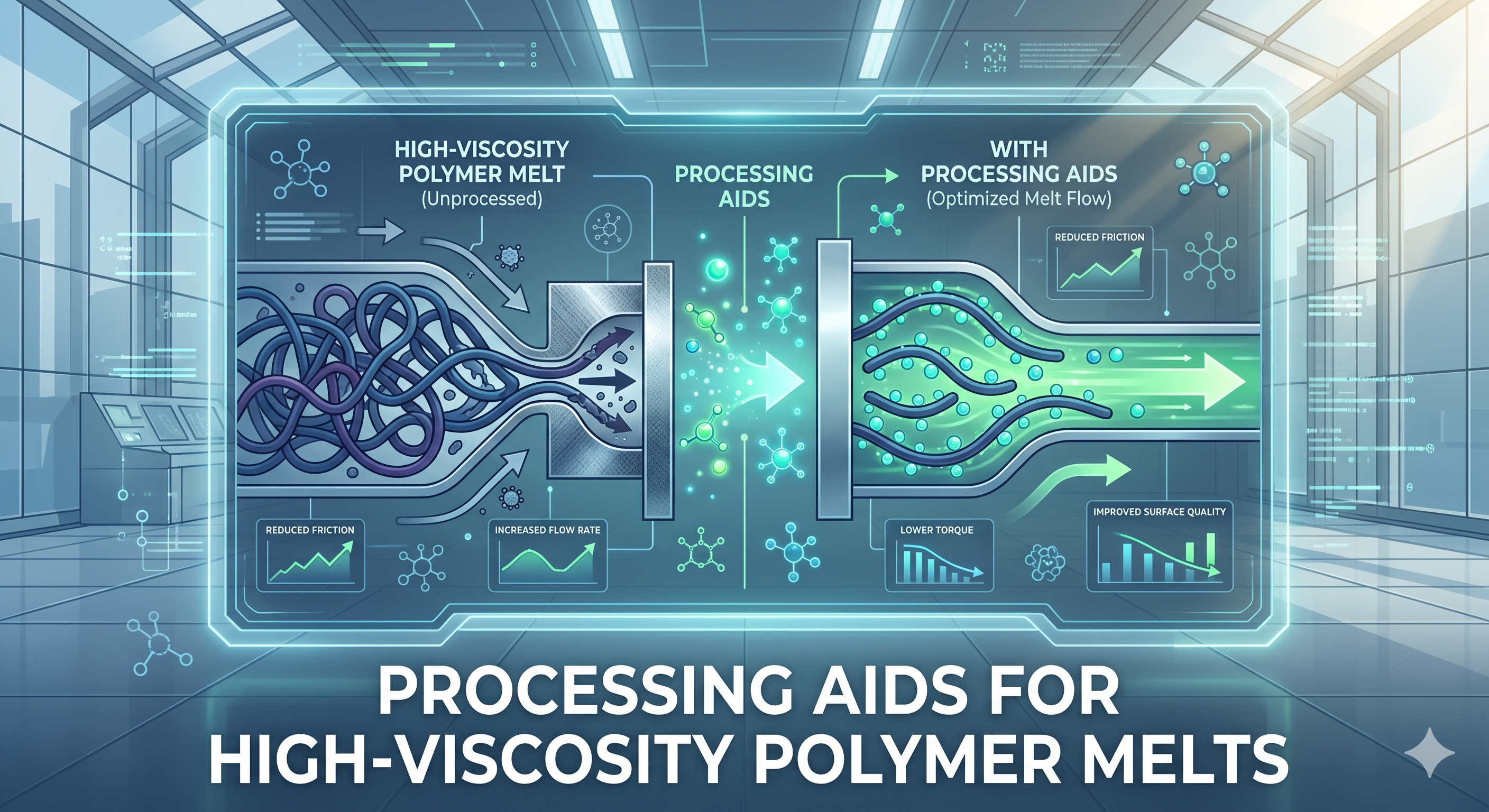
In the world of industrial manufacturing, polymers are the undisputed heavyweight champions. From the ultra-durable pipes buried beneath our cities to the high-performance components in electric vehicle batteries, high-molecular-weight polymers are the backbone of modern infrastructure. However, these materials come with a significant catch: they are incredibly difficult to move.
When a polymer has high viscosity, it behaves less like water and more like cold molasses—or worse, like wet clay. For manufacturers, this “thickness” is a double-edged sword. While it provides the final product with superior strength, impact resistance, and durability, it creates a nightmare during the extrusion and molding processes. This is where Polymer Processing Aids (PPAs) step in. They are the “industrial lubricants” that allow us to shape the unshapeable, turning stubborn, high-viscosity melts into precise, high-quality products.
The Physics of Friction: Why High Viscosity is a Problem
To understand the role of processing aids, we first have to look at what happens inside an extruder. As a polymer melt is pushed through a metal die, the layers of plastic closest to the metal walls move slower than the layers in the center. This is known as the “velocity profile.”
In high-viscosity melts, the friction between the polymer and the metal wall becomes so intense that the polymer actually “sticks” to the surface. When the pressure finally forces the melt forward, it doesn’t flow smoothly; it tears and snaps. This leads to several critical industrial failures:
-
Melt Fracture (Sharkskin): The surface of the extruded product becomes rough and ridged, resembling the skin of a shark. This isn’t just an aesthetic issue; it weakens the structural integrity of the material.
-
Die Drool: Material builds up at the exit of the die, eventually breaking off and contaminating the product.
-
High Energy Consumption: The extruder motor has to work significantly harder to overcome the internal friction (viscosity) and external friction (wall stick), leading to massive electricity costs and equipment wear.
The Invisible Shield: How Processing Aids Work
Processing aids are typically added to the polymer resin in very small amounts—often between 200 to 1,000 parts per million (ppm). Despite their low concentration, their impact is transformative. They operate primarily through two mechanisms: Internal Lubrication and External Lubrication.
1. External Lubrication (The “Wall-Slip” Effect)
Most modern PPAs are designed to be “incompatible” with the host polymer at processing temperatures. As the melt moves through the extruder, the PPA molecules migrate to the surface. They coat the metal walls of the die with a microscopic, low-energy layer.
Imagine trying to slide a heavy box across a dry concrete floor versus a floor covered in ice. The PPA acts as the “ice,” allowing the polymer melt to slip past the metal wall without sticking. This eliminates melt fracture and allows for much higher production speeds.
2. Internal Lubrication
Some aids work by getting between the long, tangled polymer chains. They reduce the “molecular friction” within the melt itself, making it easier for the chains to slide past one another. This lowers the overall viscosity and reduces the torque required by the extruder motor.
The Evolution of Chemistry: From Fluoropolymers to Green Alternatives
For the last few decades, the gold standard for processing aids has been Fluoropolymer-based PPAs. These materials are exceptionally effective because nothing sticks to them—much like the coating on a non-stick frying pan.
However, as we move through 2025 and 2026, the regulatory landscape is shifting. The focus on PFAS (Per- and Polyfluoroalkyl Substances) has forced the industry to look for “Fluorine-Free” alternatives.
Current Research Frontiers (2025-2026)
-
Silicone-Based Technologies: High-molecular-weight siloxanes are emerging as the primary successor to fluoropolymers. They offer excellent thermal stability and provide the necessary “slip” without the environmental baggage of PFAS.
-
Bio-Based Fatty Acid Esters: Derived from vegetable oils, these are being optimized for food-grade packaging. While historically less stable than synthetics, new “nanostructured” bio-aids are showing remarkable resilience at high temperatures.
-
Nanofillers and Graphene: Recent studies are exploring the use of functionalized graphene and carbon nanotubes as processing aids. Because of their incredible surface area and “slick” atomic structure, they can reduce viscosity while simultaneously increasing the strength of the final plastic—a “two-for-one” benefit that was previously impossible.
Clinical and Safety Perspectives: Occupational and Consumer Health
When we discuss chemical additives in plastics, we must address health. Processing aids are generally considered “locked” within the polymer matrix, but their safety is evaluated through two main lenses:
1. Occupational Safety (The Factory Floor)
In a manufacturing environment, processing aids are handled in concentrated masterbatch forms. Clinical studies on factory workers have historically focused on the inhalation of vapors during high-temperature processing. With the shift toward fluorine-free aids, the risk of “polymer fume fever”—a flu-like condition caused by the breakdown of fluoropolymers at extreme heats—is being significantly reduced.
2. Food Contact and Migration
For polymers used in food packaging, the migration of the processing aid into the food is a critical safety metric. Current clinical data suggests that because PPAs are used in such minute quantities and have high molecular weights, their migration levels are well below the thresholds set by the FDA and EFSA. In fact, by preventing “die drool” and degradation, these aids actually make packaging safer by ensuring the plastic doesn’t contain burnt or oxidized particles.
Advantage-Risk Assessment: The Manufacturer’s Dilemma
Implementing a processing aid is a strategic decision. It requires balancing the cost of the additive against the gains in efficiency.
The Advantages:
-
Increased Throughput: Manufacturers can often increase production speeds by 20% to 50% without losing surface quality.
-
Lower Processing Temperatures: By reducing friction, you can run the machines at lower heats, which prevents the “thermal degradation” of the polymer.
-
Improved Surface Finish: Essential for high-end consumer goods where “look and feel” dictate market value.
-
Recycling Optimization: One of the biggest roles for PPAs in 2026 is in the recycling sector. Recycled plastics often have inconsistent viscosities; PPAs help “level the playing field,” making recycled material behave more like virgin resin.
The Risks and Challenges:
-
Interaction with Other Additives: PPAs can sometimes “compete” for the surface of the plastic. If you are using an anti-fog or anti-static coating, the processing aid might prevent those from working correctly.
-
Printability and Adhesion: Because PPAs create a “slick” surface, they can sometimes make it difficult for inks or glues to stick to the finished product. This requires careful calibration of the PPA concentration.
-
Cost Sensitivity: While they save money in the long run, the upfront cost of high-performance, fluorine-free masterbatches is higher than traditional aids.
The Future: Smart Processing for a Circular Economy
As we look toward the end of the decade, the role of processing aids is evolving from “lubrication” to “intelligence.” We are seeing the development of Stimuli-Responsive Aids. These are molecules that remain dormant during the initial mixing phase but “activate” only when they reach the high-shear environment of the die. This prevents the additive from interfering with the bulk properties of the plastic while still providing the necessary flow at the exit point.
Furthermore, as the world moves toward a circular economy, processing aids will be the key to unlocking the potential of “difficult” waste streams. Mixed plastic waste is notoriously high-viscosity and prone to tearing. Specialized aids are being developed specifically to act as “compatibilizers,” smoothing the flow of diverse plastic blends and turning trash into high-performance treasure.
Conclusion
Processing aids for high-viscosity melts are the unsung heroes of the material science world. They represent the bridge between a theoretical material and a practical product. By mastering the interface between the polymer and the machine, these additives allow us to push the boundaries of what plastic can do—making it stronger, thinner, and more sustainable.
Whether it is the shift away from PFAS or the integration of nanotechnology, the science of “making things flow” is more vital than ever. In an age of high energy costs and environmental scrutiny, the ability to process stubborn materials with less heat and more speed isn’t just a technical advantage; it is a competitive necessity.