Recently added item(s)
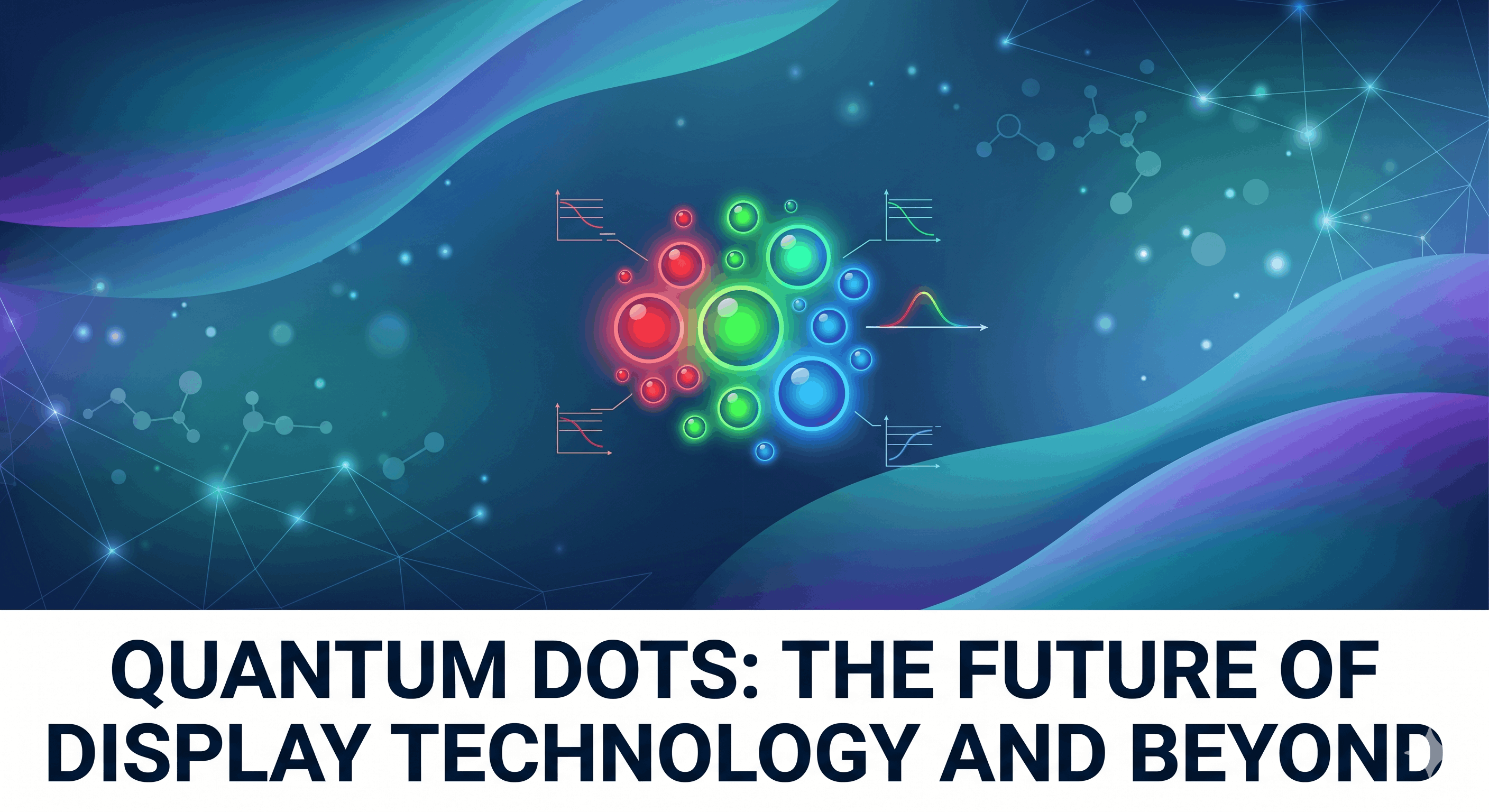
In the realm of nanotechnology, few discoveries have captured the imagination of scientists and industry leaders quite like Quantum Dots (QDs). These microscopic semiconductor particles, often referred to as “man-made atoms,” are so small that their optical and electronic properties differ significantly from those of larger particles. While they might sound like something out of a science fiction novel, they are already powering the screens in our living rooms and are poised to revolutionize everything from cancer surgery to renewable energy.
The significance of this field was cemented on the global stage when the 2023 Nobel Prize in Chemistry was awarded to Moungi Bawendi, Louis Brus, and Alexei Ekimov for the discovery and synthesis of quantum dots. This recognition underscores a journey from theoretical physics to a practical technology that is changing how we interact with the world.
What Exactly Are Quantum Dots?
At their core, quantum dots are semiconductor crystals measuring only a few nanometers in diameter—roughly 10,000 times thinner than a human hair. To understand why they are special, we have to look at the “quantum” part of their name.
In traditional materials, the way electrons behave is determined by the chemical composition. However, when a material is shrunk down to the nanoscale, a phenomenon called quantum confinement takes over. In this state, the electronic properties of the particle become dependent on its physical size.
Imagine a guitar string. When you shorten the string, the pitch gets higher. Quantum dots work similarly with light. By precisely controlling the size of the dot during manufacturing, scientists can “tune” the color of light it emits when excited by an external energy source (like blue LED light or electricity).
-
Large dots (approx. 5-6 nm) emit longer wavelengths, appearing Red.
-
Small dots (approx. 2-3 nm) emit shorter wavelengths, appearing Blue.
-
Mid-sized dots emit Green.
Revolutionizing the Display Industry: QLED and Beyond
The most visible application of QDs today is in the premium television market. If you’ve seen a “QLED” or “QD-OLED” display, you’ve witnessed quantum dots in action.
Why QDs Beat Traditional LCD and OLED
Standard LCD screens use a white backlight filtered through color filters to create red, green, and blue pixels. These filters are inefficient and often produce “muddy” colors. Quantum dots, however, offer unprecedented color purity.
-
Vibrant Color Gamut: Because QDs emit light in very narrow, specific wavelengths, they can reproduce a wider range of colors than any other technology. This allows for lifelike images that match the “DCI-P3” cinematic color standards.
-
Peak Brightness: QDs are inorganic and highly stable, meaning they can be driven at high brightness levels without the “burn-in” risks associated with organic LEDs (OLED).
-
Energy Efficiency: Instead of filtering out light (and wasting energy), QD layers convert blue light into red and green with near 100% efficiency. This leads to brighter screens that consume less power.
Current research is moving toward Electroluminescent Quantum Dots (ELQD). Unlike current QLED TVs, which use QDs as a conversion layer for a backlight, ELQD displays would allow each individual quantum dot to be powered by electricity. This would combine the perfect blacks of OLED with the brightness and color of Quantum Dots, creating the “holy grail” of display technology.
Beyond the Screen: Energy and Photovoltaics
Quantum dots are not just for looking at; they are also being used to harvest energy. Traditional silicon solar panels have a theoretical efficiency limit (the Shockley-Queisser limit) of about 33%. Quantum dot solar cells (QDSCs) aim to shatter this ceiling.
The Multi-Exciton Advantage
In a standard solar cell, one photon of light usually knocks one electron loose to create current. Any excess energy from high-energy photons is lost as heat. Quantum dots can exhibit Multiple Exciton Generation (MEG), where a single high-energy photon can kick off two or more electrons.
Furthermore, because QDs can be tuned to “see” different parts of the light spectrum, researchers are developing “tandem” solar cells. These involve layers of quantum dots tuned to capture infrared light—energy that currently passes straight through silicon panels and goes to waste.
Quantum Dots in Medicine: From Bio-Imaging to Clinical Trials
The “Beyond” in the title of this article is perhaps most exciting in the field of nanomedicine. Quantum dots are proving to be the most powerful biological “beacons” ever created.
Superior Bio-imaging
In cancer research, doctors need to see exactly where a tumor ends and healthy tissue begins. Traditional fluorescent dyes fade quickly (photobleaching) and have broad emission spectra. Quantum dots are thousands of times brighter and extremely resistant to fading.
By coating QDs with specific proteins that “stick” only to cancer cells, researchers can make tumors glow under specialized cameras. This allows surgeons to perform “image-guided surgery,” ensuring they remove all cancerous cells while sparing healthy nerves and blood vessels.
Clinical Studies and Current Research
While many QD applications are still in the lab, clinical movement is accelerating:
-
Sentinel Lymph Node Mapping: Research studies have used Near-Infrared (NIR) Quantum Dots to map lymph nodes in breast cancer patients. Since NIR light can penetrate deep into human tissue, these QDs allow doctors to see deep structures without invasive procedures.
-
Drug Delivery Tracking: Clinical research is investigating “theranostic” QDs—particles that both diagnose a condition through imaging and deliver a drug payload simultaneously. By watching the QD glow, doctors can confirm exactly when a drug has reached its target.
-
In-Vitro Diagnostics: QDs are already used in highly sensitive “lab-on-a-chip” devices to detect biomarkers for diseases like Alzheimer’s or HIV much earlier than traditional blood tests.
Advantage vs. Risk: The Sustainability Challenge
No technology is without its hurdles. The primary debate surrounding quantum dots involves their chemical composition and environmental impact.
The Advantages
-
Tunability: Unmatched control over optical properties.
-
Durability: Inorganic nature leads to long lifespans.
-
Scalability: QDs can be manufactured using “wet chemistry” (solution-processing), which is much cheaper than the vacuum-chamber processes required for silicon chips.
The Risks and Toxicity
Historically, the highest-performing quantum dots were made of Cadmium Selenide (CdSe). Cadmium is a heavy metal and a known carcinogen. This has raised concerns regarding:
-
End-of-Life Disposal: What happens to QLED TVs when they are thrown away?
-
Biological Toxicity: If used in the human body, can the body safely clear the heavy metals?
The Solution: Lead-Free and Cadmium-Free QDs
Current research is heavily focused on Indium Phosphide (InP) and Perovskite quantum dots. These materials offer similar performance without the toxic heavy metals. Most consumer electronics brands have already shifted to cadmium-free technology to comply with environmental regulations like RoHS.
In the medical world, “Carbon Dots” (C-dots) are gaining traction. Made from organic waste, these are non-toxic, biocompatible, and provide a sustainable path forward for clinical applications.
The Road Ahead: What’s Next?
We are entering the “Golden Age” of nanotechnology. In the next decade, we can expect:
-
Smart Windows: Windows coated with transparent quantum dots that harvest solar energy during the day without blocking the view.
-
Visible Light Communication (Li-Fi): Using QD-LEDs to transmit high-speed data through room lighting.
-
Point-of-Care Testing: Instant, hyper-accurate medical testing kits for homes, powered by QD sensors.
Quantum dots have moved from being a laboratory curiosity to a cornerstone of modern materials science. By bridging the gap between the macro world we see and the quantum world we are just beginning to master, these tiny particles are set to illuminate our future—quite literally.