
Recently added item(s)
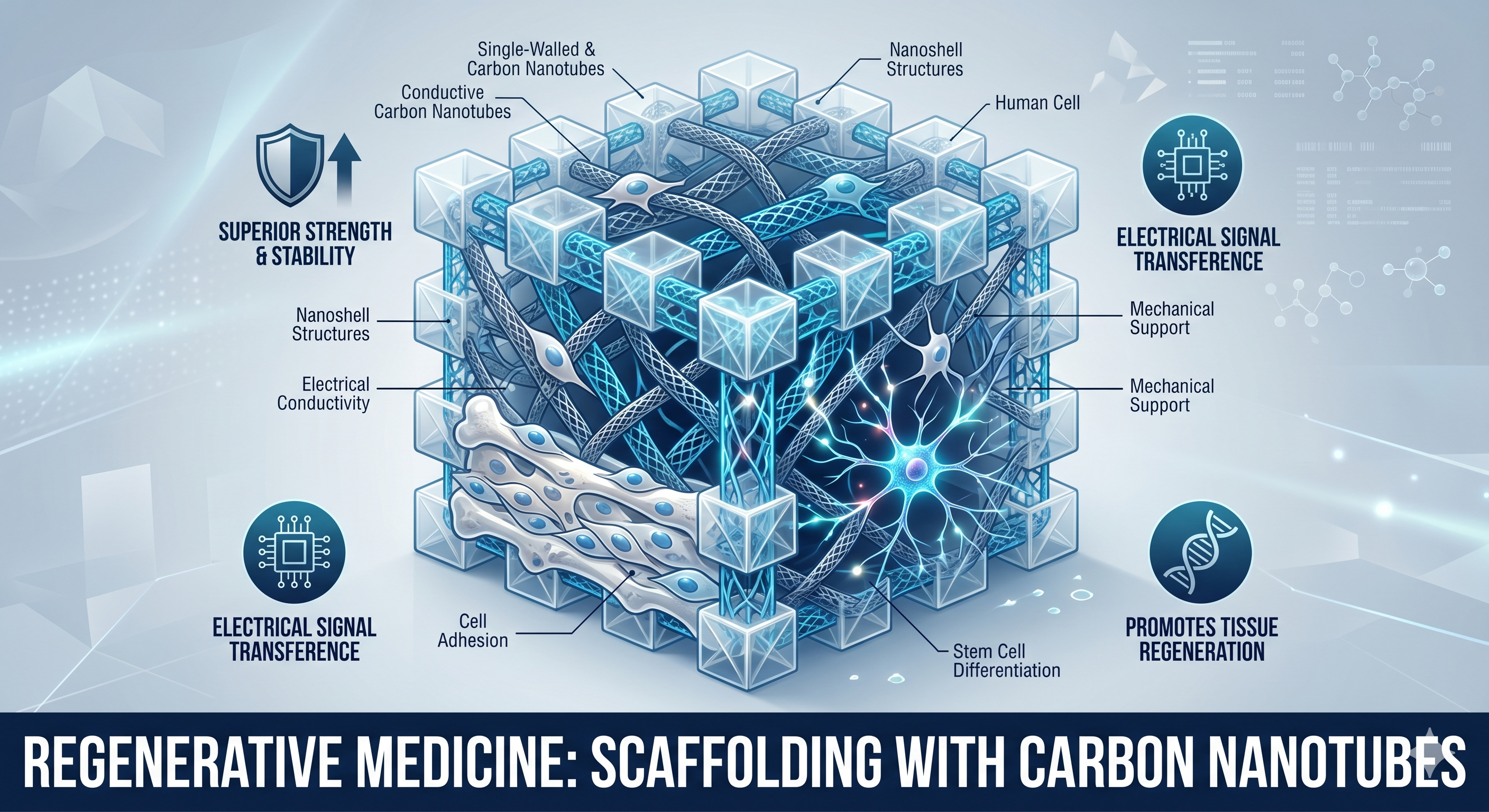
Regenerative medicine is no longer a concept confined to science fiction. The ability to regrow damaged organs, repair severed spinal cords, and restore bone density is becoming a reality thanks to the convergence of biology and nanotechnology. At the heart of this revolution lies the concept of “scaffolding.”
In tissue engineering, a scaffold is a three-dimensional structure that provides mechanical support and a template for cell attachment and growth. While traditional scaffolds made of collagen or synthetic polymers have been used for years, they often lack the mechanical strength or electrical conductivity required for complex tissues. Enter Carbon Nanotubes (CNTs)—cylindrical molecules made of carbon atoms that are reshaping how we build the foundations of human life.
2. What are Carbon Nanotubes (CNTs)?
Carbon Nanotubes are allotropes of carbon with a nanostructure that can have a length-to-diameter ratio greater than 1,000,000. To visualize them, imagine a sheet of graphene (a single layer of carbon atoms in a honeycomb lattice) rolled into a perfect cylinder.
There are two main types used in regenerative medicine:
-
Single-Walled Carbon Nanotubes (SWCNTs): A single cylinder of graphene.
-
Multi-Walled Carbon Nanotubes (MWCNTs): Multiple nested cylinders of graphene.
These structures are incredibly light, stronger than steel, and can conduct electricity as efficiently as copper. These unique physical properties make them the ideal “rebar” for biological scaffolding.
3. The Role of CNTs in Tissue Scaffolding
A successful scaffold must mimic the Extracellular Matrix (ECM)—the natural “glue” that holds our cells together. CNTs are uniquely suited for this because their dimensions are on the same scale as natural ECM components like collagen fibers.
A. Mechanical Reinforcement
Most biological hydrogels (the soft materials used to house cells) are too weak to be used in load-bearing areas like bone or cartilage. By weaving CNTs into these gels, researchers can create composites that have high tensile strength and flexibility, allowing the scaffold to withstand the physical stresses of the human body.
B. Electrical Stimulation for Nerve and Heart Repair
Perhaps the most exciting application of CNTs is in “excitable” tissues—those that rely on electrical signals, such as the brain, spinal cord, and heart. Because CNTs are highly conductive, they can act as a bridge for electrical impulses, encouraging neurons to fire across a gap in a damaged spinal cord or helping heart cells beat in synchrony after a heart attack.
C. Surface Functionalization
In their raw state, CNTs are hydrophobic (they repel water), which isn’t great for cells. However, scientists can “functionalize” them by attaching chemical groups like carboxyl or hydroxyl to their surface. This makes them “cell-friendly,” allowing proteins and cells to stick to the scaffold and begin the regeneration process.
4. Current Research and Clinical Frontiers
Research into CNT-based scaffolds is moving rapidly from the lab bench toward clinical considerations.
Bone Regeneration
Recent studies have shown that CNT-reinforced scaffolds can promote osteogenesis (the formation of new bone). The nanotubes provide a textured surface that encourages calcium hydroxyapatite—the mineral that makes bone hard—to crystallize. Researchers are currently testing these scaffolds in complex fractures that would otherwise require bone grafts.
Neural Interfaces and Spinal Cord Repair
In neural engineering, CNT scaffolds are being used to create “neural bridges.” When a spinal cord is severed, scar tissue usually prevents nerves from regrowing. CNT-based scaffolds provide a path for axons to grow through the injury site, potentially restoring movement to paralyzed limbs.
Cardiac Patch Technology
Following a myocardial infarction (heart attack), the heart develops non-conductive scar tissue. Clinical research is exploring “cardiac patches” infused with CNTs. These patches are placed over the damaged area to restore electrical rhythm and provide a framework for new heart muscle cells to grow.
5. Advantage vs. Risk Assessment
As with any disruptive technology, the use of Carbon Nanotubes in the human body requires a rigorous evaluation of the pros and cons.
| Advantage | Description | Risk / Challenge | Description |
| High Conductivity | Ideal for nerve and cardiac tissue signaling. | Cytotoxicity | Pure CNTs can sometimes trigger oxidative stress in cells if not properly treated. |
| Exceptional Strength | Provides durability to soft scaffolds in bone repair. | Biodegradability | CNTs are very stable; the body struggles to break them down naturally over time. |
| Nanoscale Biomimicry | Mimics the natural structure of collagen and fibers. | Long-term Biocompatibility | There are concerns about chronic inflammation if nanotubes migrate to other organs. |
| Drug Delivery | Can be loaded with growth factors to “seed” regeneration. | Manufacturing Purity | Metal catalysts used to grow CNTs must be 100% removed to prevent toxicity. |
6. Overcoming the Toxicity Hurdle
The biggest “if” in CNT research is safety. Early studies suggested that CNTs could behave like asbestos if inhaled. However, in the context of regenerative medicine, the nanotubes are usually embedded within a solid scaffold or chemically modified to be water-soluble.
Current research focuses on “Green CNTs”—nanotubes that are functionalized with biodegradable molecules that allow the body’s enzymes to eventually break the carbon bonds, mitigating the risk of long-term accumulation in the liver or spleen.
7. The Future: 3D Bioprinting and Personalized Scaffolds
The next frontier is the integration of CNTs into 3D Bioprinting. Imagine a surgeon taking a 3D scan of a patient’s injury and printing a custom scaffold made of the patient’s own cells mixed with a CNT-reinforced bio-ink. This would allow for perfectly fitted replacements for everything from jawbones to sections of the esophagus.
Furthermore, “smart scaffolds” are being developed that can be triggered by external magnetic or electrical fields to release specific growth factors exactly when the body needs them during the healing timeline.
8. Conclusion: A Carbon-Based Solution for Biological Problems
Regenerative medicine is entering a phase where we no longer just treat symptoms; we rebuild the body. Carbon Nanotubes provide the mechanical, electrical, and structural missing links that traditional materials could not offer. While clinical trials must continue to address long-term safety and degradation, the potential for CNTs to heal the “unhealable” makes them one of the most promising tools in the 21st-century medical arsenal.
The journey from a carbon cylinder to a functioning human organ is complex, but the path is now clearer than ever. As we master the art of scaffolding with carbon nanotubes, we move closer to a world where organ failure and permanent nerve damage are things of the past.