
Recently added item(s)
The nanotechnology revolution has transitioned from a futuristic concept to a cornerstone of modern industrial and medical progress. From high-performance electronics and aerospace components to targeted drug delivery systems, the manipulation of matter at the atomic and molecular scale—typically between 1 and 100 nanometers—is reshaping our world. However, this “small” revolution carries substantial “large” responsibilities.
As we move deeper into 2026, the volume of engineered nanoparticles (ENPs) produced globally has reached unprecedented levels. While their unique physical and chemical properties drive innovation, these same characteristics pose unique challenges to human health and environmental safety. This is particularly true for airborne nanoparticles, which can bypass traditional biological barriers and lab safety measures if not handled with rigorous, evidence-based protocols.
Understanding the Nature of the Invisible Hazard
Nanoparticles are not simply smaller versions of bulk materials; they behave according to different physical laws. At the nanoscale, the surface-area-to-volume ratio increases dramatically. This makes them highly reactive and prone to aerosolization.
Airborne nanoparticles behave like gases in some respects and like particles in others. They are governed by Brownian motion, meaning they do not settle out of the air quickly like larger dust particles. Instead, they remain suspended for long periods, drifting with the slightest air currents. This makes inhalation the primary route of exposure in laboratory settings, followed by dermal absorption and accidental ingestion.
The Mechanism of Toxicity
Recent research highlights that the toxicity of a nanoparticle is often determined more by its surface area and chemistry than by its mass. When inhaled, these particles can reach the deep alveolar regions of the lungs. Because they are so small, they can undergo translocation—moving from the respiratory system into the bloodstream and eventually reaching secondary organs like the liver, heart, and even crossing the blood-brain barrier.
Clinical Insights: What the Research Tells Us in 2026
Clinical and toxicological studies over the past few years have provided a clearer picture of how specific nanoparticles interact with human physiology.
-
Carbon Nanotubes (CNTs) and Fibrous Nanomaterials:
Studies have drawn parallels between certain multi-walled carbon nanotubes (MWCNTs) and asbestos fibers. Clinical observations in animal models have shown that long, needle-like nanotubes can cause pleural inflammation and granuloma formation, potentially leading to mesothelioma if exposure is chronic and unregulated.
-
Metal Oxide Nanoparticles (TiO2, ZnO, CuO):
Research published in late 2025 indicated that metal oxide nanoparticles can induce significant oxidative stress. When these particles interact with cellular environments, they trigger the production of reactive oxygen species (ROS), leading to DNA damage and chronic inflammation. Specifically, Copper Oxide (CuO) nanoparticles have shown high levels of cytotoxicity in lung epithelial cells.
-
The “Trojan Horse” Effect:
A fascinating clinical discovery involves the ability of nanoparticles to carry other toxins. Because of their high surface reactivity, they can “adsorb” heavy metals or organic pollutants from the lab environment and deliver them directly into cells, acting as a delivery vehicle for substances that would otherwise be filtered out by the body’s natural defenses.
The Advantage-Risk Evaluation
To manage a lab effectively, one must balance the undeniable benefits of nanomaterials against the inherent risks.
Advantages of Working with Nanoparticles
-
Enhanced Material Properties: Materials like graphene and tungsten carbide offer superior strength, conductivity, and thermal stability.
-
Medical Breakthroughs: Nanoparticles allow for “smart” medicine that targets tumors without harming healthy tissue.
-
Environmental Solutions: Nanofiltration and nanocatalysts are essential for modern water purification and carbon capture technologies.
Risks and Challenges
-
Detection Difficulty: Airborne nanoparticles are invisible to the naked eye and often require specialized, expensive equipment (like condensation particle counters) to detect in real-time.
-
Unknown Long-term Effects: While acute toxicity is becoming better understood, the long-term “latency period” for nano-related diseases is still a subject of ongoing longitudinal studies.
-
Regulatory Lag: Scientific innovation often moves faster than government safety regulations, leaving lab managers to establish their own high-standard “best practices.”
Primary Safety Protocols: Engineering Controls
The most effective way to handle airborne nanoparticles is to remove the hazard at the source. Reliance on masks alone is insufficient; a multi-layered approach is required.
1. Containment and Ventilation
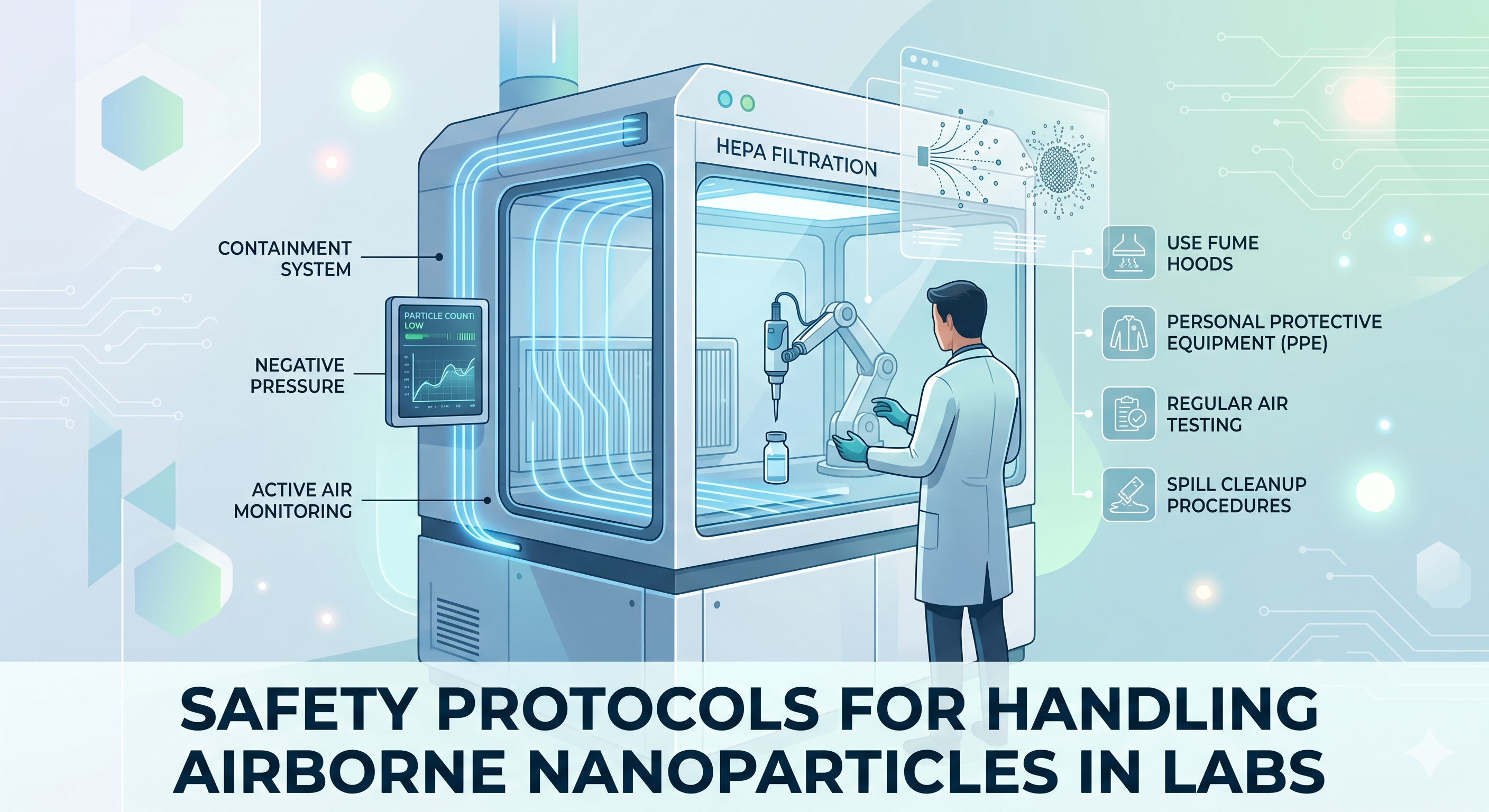
All weighing, mixing, and transferring of dry nanopowders must occur within a Class II Biosafety Cabinet or a dedicated Nano-Enclosure.
-
HEPA Filtration: High-Efficiency Particulate Air (HEPA) filters are rated to capture 99.97% of particles at 0.3 microns. Interestingly, they are actually more efficient at capturing nanoparticles (below 0.1 microns) due to the diffusion caused by Brownian motion.
-
Local Exhaust Ventilation (LEV): Capture hoods should be positioned as close to the source as possible.
2. Standardized Wet Handling
Whenever possible, nanoparticles should be handled in a liquid medium (suspensions or pastes). This drastically reduces the risk of particles becoming airborne. If a dry powder must be used, “glove box” environments are the gold standard for preventing environmental contamination.
Personal Protective Equipment (PPE) for the Nano-Era
When engineering controls cannot fully eliminate the risk, PPE becomes the final line of defense. Standard lab coats and surgical masks are generally inadequate for nanomaterial handling.
| Equipment Type | Specification | Purpose |
| Respirators | N95, N100, or P100 (NIOSH approved) | Filters out fine aerosols and suspended nanoparticles. |
| Gloves | Double-gloving with Nitrile | Provides a redundant barrier; nitrile is more resistant to penetration than latex. |
| Clothing | Non-woven lab coats (Tyvek) | Prevents particles from getting trapped in fabric fibers and being carried home. |
| Eye Protection | Non-vented safety goggles | Protects the mucous membranes of the eyes from accidental splashes or dust. |
The Role of AI and Automation in Lab Safety
In 2026, the “Smart Lab” is no longer a luxury—it is a safety necessity. AI-driven systems are now being integrated into laboratory workflows to monitor airborne concentrations in real-time.
-
Automated Sensors: Low-cost, high-sensitivity sensors can now be linked to an office’s central automation system. If particle counts spike above a certain threshold, the system can automatically increase ventilation rates and send alerts to all personnel via mobile apps.
-
Robotic Handling: For high-risk materials like certain carbon nanotubes or radioactive nanoparticles, robotic arms within sealed enclosures can perform the “heavy lifting,” keeping human intervention to a minimum.
-
Predictive Modeling: AI models can now predict the dispersion patterns of a spill based on the lab’s specific HVAC layout, allowing for faster and more precise evacuation and cleanup protocols.
Administrative Protocols and Waste Management
Safety is as much about culture and record-keeping as it is about equipment.
-
The “Nano-Log”: Every lab should maintain a detailed log of which nanomaterials are used, by whom, and in what quantities. This is vital for long-term health monitoring.
-
Specialized Spill Kits: A standard paper towel is not enough for a nano-spill. Specialized kits containing HEPA-filtered vacuums, damp wiping cloths, and specific surfactants are necessary to neutralize the surface charge of the particles.
-
Waste Disposal: Nanoparticle waste must be treated as hazardous chemical waste. It should be double-bagged in puncture-resistant containers and clearly labeled “Contains Engineered Nanomaterials.”
Conclusion: Balancing Innovation with Vigilance
The potential for nanotechnology to solve the world’s most pressing problems—from energy storage to cancer treatment—is boundless. However, the workers at the forefront of this research must be protected by the most advanced safety protocols available. By combining robust engineering controls, specialized PPE, and modern AI-driven monitoring, we can ensure that the “invisible” world remains a source of progress rather than a source of peril.
As we continue to refine our understanding of the nano-bio interface, our safety protocols must remain dynamic. Staying informed on the latest clinical findings and technological safeguards is the hallmark of a responsible, world-class laboratory.