
Recently added item(s)
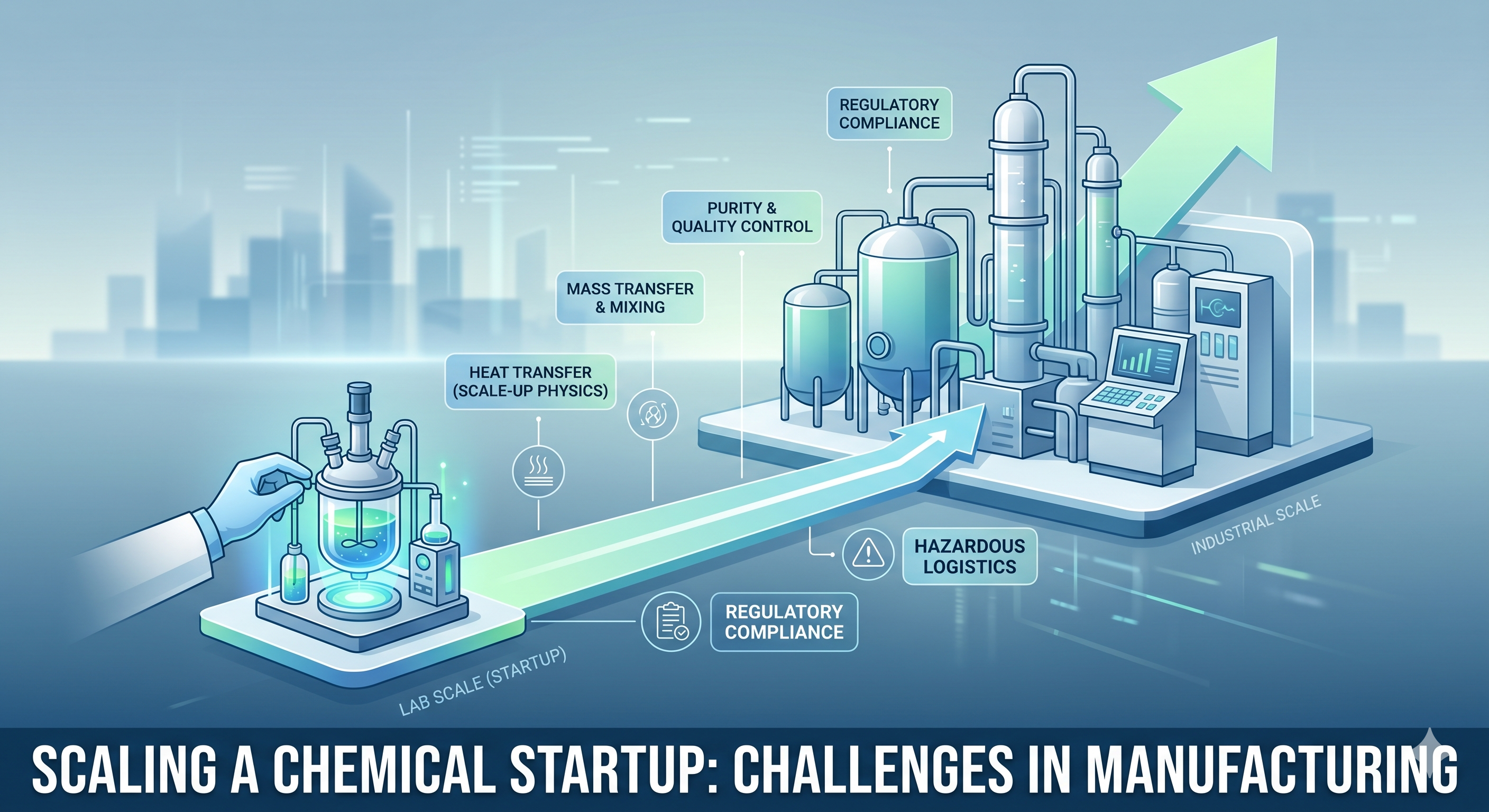
The journey of a chemical startup from a laboratory bench to a commercial-scale manufacturing facility is often described as crossing the “Valley of Death.” While a scientist might successfully synthesize a few milligrams of a “wonder material” in a controlled environment, producing that same material by the ton—with identical purity, structure, and performance—is a monumental engineering challenge.
In the modern industrial landscape, where nanotechnology and advanced materials like graphene and carbon nanotubes (CNTs) are at the forefront, the stakes of scaling are higher than ever. For an entrepreneur, scaling is not just about “buying bigger equipment”; it is about re-engineering the very physics and chemistry of the production process while navigating a minefield of regulatory and logistical hurdles.
1. The Physics of Scale: Why “Bigger” Isn’t Always Better
In the laboratory, mixing is instantaneous, and temperature is easily controlled with a simple water bath. However, as the volume of a chemical reactor increases, the physics of the process changes fundamentally due to the square-cube law.
-
Heat Transfer: As a reactor grows, its volume (where heat is generated in exothermic reactions) increases much faster than its surface area (where heat is dissipated). This creates “hotspots” that can lead to thermal runaway, inconsistent batch quality, or even explosions.
-
Mass Transfer and Mixing: Achieving a homogenous mixture in a 5,000-liter tank is vastly different from a 500-milliliter flask. Inconsistent mixing can lead to “dead zones” where reactions are incomplete, which is particularly problematic for materials like carbon nanotubes where structural uniformity is the primary value proposition.
-
Reaction Kinetics: Changes in pressure and concentration at scale can shift the equilibrium of a reaction, leading to the formation of unwanted byproducts that were never seen during the R&D phase.
2. The Nanotechnology Hurdle: Scaling the Ultra-Small
Scaling the production of nanomaterials introduces unique complexities. When dealing with materials like graphene or micronized metal powders (such as tungsten or nickel), the goal is often to maintain specific thicknesses or surface functionalizations.
Graphene and 2D Materials
Producing high-quality graphene at scale often requires a transition from laboratory vacuum filtration to industrial “Doctor Blade” or Chemical Vapor Deposition (CVD) techniques. The challenge lies in ensuring that the graphene sheets—perhaps as thin as 35 µm—remain consistent across large surface areas without stacking back into graphite.
Carbon Nanotubes and Metal Powders
For startups focused on metal powders like tungsten or nickel for enhanced conductivity and impact resistance, the challenge is maintaining particle size distribution (PSD). At a large scale, particles tend to agglomerate (clump together), which ruins the material’s ability to be functionalized or integrated into composites.
3. The Purity Paradox and Quality Control
In a startup’s early days, a scientist can manually verify the quality of every gram produced. At scale, manual inspection is impossible.
-
Sourcing Consistency: Sourcing raw materials (precursors) becomes a vulnerability. A slight change in the impurity profile of a bulk-sourced solvent can poison a catalyst or alter the electronic properties of a nanomaterial.
-
Analytical Throughput: Industrial manufacturing requires real-time quality monitoring. Waiting 24 hours for a Raman spectroscopy or Scanning Electron Microscopy (SEM) result can lead to an entire day’s worth of wasted “off-spec” production.
-
The Cost of Purity: Increasing purity from 98% to 99.9% does not just increase costs linearly; it often increases them exponentially due to the need for more complex purification stages like fractional distillation or specialized centrifugation.
4. Digital Transformation: AI and Automation in Scale-Up
One of the most significant advantages for modern chemical startups is the integration of Artificial Intelligence and automated workflows. By using platforms like n8n to create modular, cloud-based assistants, founders can automate the monitoring of manufacturing data and customer feedback loops.
“Jarvis” in the Factory
An AI-driven assistant can monitor sensor data (temperature, pressure, flow rates) from the factory floor in real-time. If a deviation occurs, the system can automatically adjust the feed rates or alert an engineer via WhatsApp or email, preventing a batch failure before it happens. This level of “autonomous manufacturing” reduces the human error that typically plagues the scale-up process.
Data-Driven Optimization
Machine learning models can analyze thousands of batches to find the “Goldilocks zone” of production parameters that maximize yield while minimizing energy consumption. This digital layer allows a startup to scale “intellectually” rather than just “physically.”
5. Regulatory, Safety, and Hazardous Logistics
As a startup moves from “grams” to “tons,” it enters a new world of legal and safety requirements.
-
REACH and GHS: Compliance with the Globally Harmonized System (GHS) and regulations like REACH in the EU becomes mandatory. Every chemical must have a detailed Safety Data Sheet (SDS) and proper labeling.
-
Hazardous Logistics: Transporting advanced materials—especially powders that may be flammable or reactive—requires specialized hazardous materials (Hazmat) logistics. This involves UN-certified packaging, specific route planning, and strict driver certifications.
-
Environmental Impact: Large-scale chemical manufacturing produces significant waste. Startups must invest in wastewater treatment and emission scrubbing systems to meet environmental standards, which can be a massive capital expenditure (CapEx).
6. Advantage vs. Risk Assessment: The Scale-Up Decision
Every founder must decide when—and if—to scale. Scaling too early can lead to “premature scaling,” where the company burns through capital before the process is stable. Scaling too late allows competitors to capture the market.
| Feature | Advantage of Scaling | Risk Factor |
| Cost per Unit | Drastic reduction through economies of scale. | High initial CapEx and debt burden. |
| Market Share | Ability to serve large industrial clients (e.g., automotive, aerospace). | Quality dilution and batch inconsistency. |
| Innovation | Moving from a “lab project” to a real-world industrial solution. | Regulatory scrutiny and potential for environmental accidents. |
| Efficiency | Opportunities for automation and AI integration. | Technological lock-in to potentially obsolete equipment. |
7. Clinical and Safety Research: The Toxicological Frontier
In the context of advanced materials, “clinical” concerns often center on toxicology and environmental safety. Recent research into carbon nanotubes and metal nanoparticles has highlighted the need for rigorous exposure monitoring for workers. Because these materials are small enough to cross biological membranes, scaling up production means scaling up the potential for inhalation or skin contact.
Modern manufacturing facilities now employ “closed-loop” systems where the material is never exposed to the open air. This protects the workers and ensures the material remains uncontaminated—a win-win for safety and quality.
Conclusion: The Future of Chemical Entrepreneurship
Scaling a chemical startup is an act of balancing the precision of science with the brute force of engineering. The founders who succeed are those who treat the manufacturing process as a product in itself. By leveraging nanotechnology, maintaining a fanatical focus on purity, and embracing digital automation through tools like n8n, a startup can transform from a laboratory success story into an industrial powerhouse.
The future of the chemical industry lies in these “smart,” scaled-up startups that can produce the advanced materials—like graphene and functionalized nanotubes—that the world’s transition to green energy and high-tech manufacturing demands.