Recently added item(s)
In the high-stakes world of industrial 3D printing, we are witnessing a fundamental divergence. While the early days of additive manufacturing were dominated by simple plastic filaments, today’s engineers are looking at “powder bed” technologies to achieve professional-grade results. Two titans stand at the center of this arena: Selective Laser Sintering (SLS) and Binder Jetting.
At first glance, they look remarkably similar. Both involve a box of fine powder and a recoater blade that spreads a new layer for every “slice” of the object. However, beneath the surface, they are as different as fire and ice. One uses a high-powered laser to fuse particles together through heat; the other uses a precision inkjet to “glue” them together with a chemical binder.
For the modern engineer, the choice between these two isn’t just about speed or cost—it is fundamentally about Material Science. The physics of how these particles bond dictates the strength, texture, and ultimate utility of the final part.
1. The Core Mechanics: Fire vs. Glue
To understand the material choice, we must first understand the “handshake” between the technology and the powder.
Selective Laser Sintering (SLS): The Thermal Workhorse
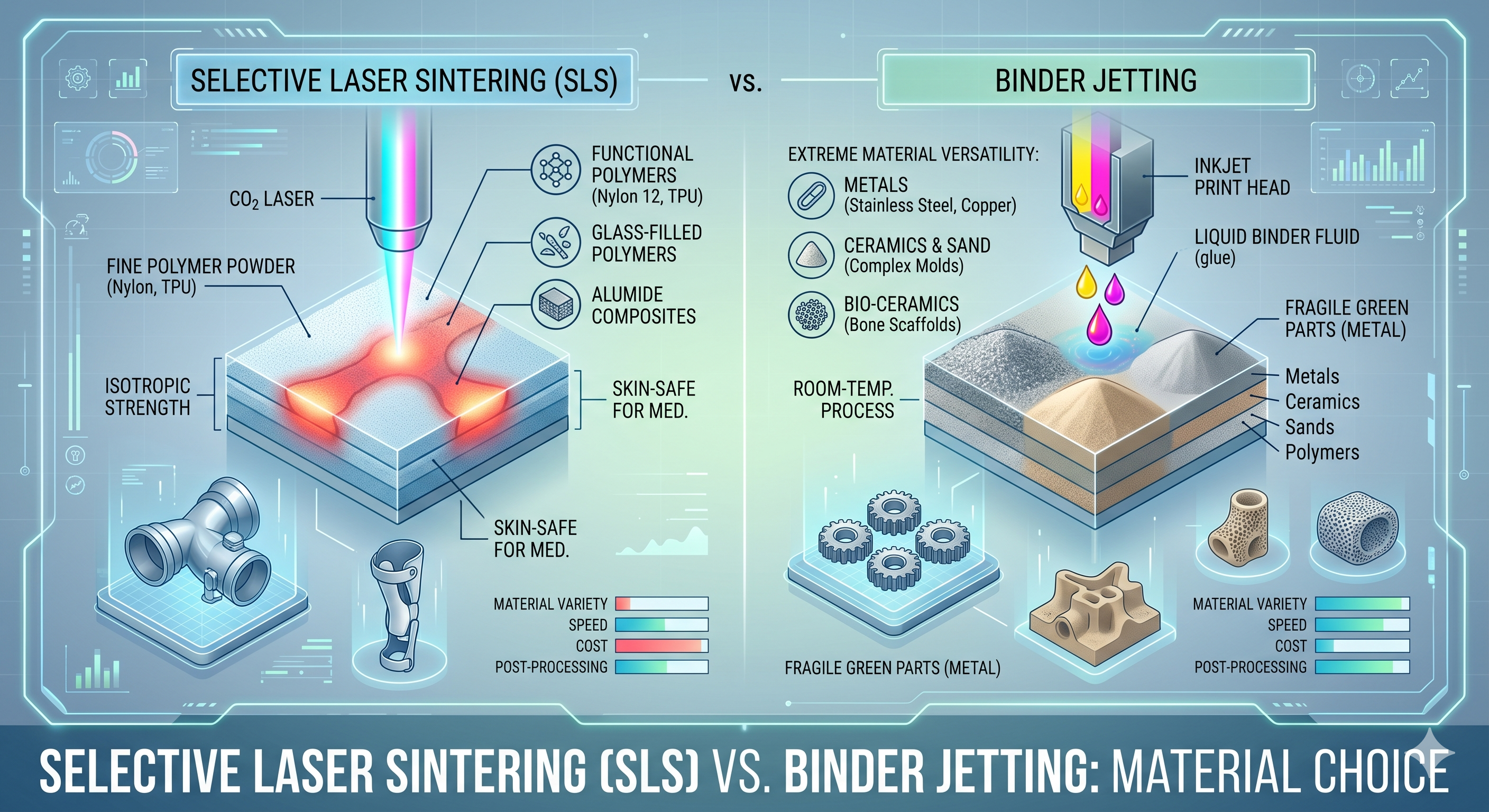
In an SLS machine, the build chamber is heated to just below the melting point of the powder. A CO2 laser then traces the cross-section of the part, providing that final burst of energy needed to “sinter” (fuse) the particles together.
-
The Bond: Atomic diffusion. The particles partially melt and flow into one another, creating a near-isotropic solid.
-
The Environment: An inert gas (Nitrogen) chamber to prevent the hot plastic from catching fire or oxidizing.
Binder Jetting: The Chemical Architect
Binder Jetting doesn’t use heat during the printing process. Instead, an inkjet print head moves across the powder bed, depositing tiny droplets of a liquid binding agent (an adhesive).
-
The Bond: Chemical adhesion. The binder acts as a bridge between particles.
-
The Environment: Room temperature. This eliminates the “warping” issues caused by the rapid heating and cooling seen in SLS.
2. Selective Laser Sintering (SLS): Why Polymers Reign Supreme
SLS is the undisputed king of Functional Polymers. Because the process relies on thermal fusion, it requires materials with a specific “thermal window”—a range where the powder can be hot without melting, but fused easily with a laser.
-
Polyamides (Nylon 11 & 12): This is the “gold standard” for SLS. Nylon 12 offers incredible toughness and chemical resistance. It is the material of choice for “living hinges,” complex ducting, and industrial housings.
-
TPU (Thermoplastic Polyurethane): For parts that need to stretch and bounce. SLS-printed TPU is used for high-performance footwear and flexible gaskets.
-
Reinforced Composites: Materials like “Alumide” (Nylon mixed with aluminum dust) or Glass-Filled Nylon provide extra stiffness and a metallic aesthetic, though they remain polymer-based at their core.
The SLS Advantage: The unsintered powder acts as a natural support structure. You can print “impossible” geometries, like a ship in a bottle or complex interlocking gears, without needing to snap off support pieces later.
3. Binder Jetting: The Material Chameleon
While SLS is mostly restricted to plastics, Binder Jetting has an almost limitless material palette. If you can turn a material into a powder and find a glue that sticks to it, you can “jet” it.
-
Metals (Stainless Steel, Copper, Tungsten): This is where Binder Jetting shines. It is significantly faster and cheaper than laser-based metal printing. However, the part comes out as a “Green Part”—a fragile mix of metal and glue that must be placed in a furnace to be “sintered” into a solid metal object.
-
Ceramics and Sand: Used heavily in the foundry industry. Binder Jetting can create complex sand-casting molds for engine blocks in hours rather than weeks.
-
Polymers (PMMA): While not as strong as SLS Nylon, binder-jetted polymers are excellent for full-color architectural models and casting patterns.
The Binder Jetting Advantage: Speed and Scale. Because it uses an inkjet head with thousands of nozzles, it can print much faster than a single laser point. It is the primary technology for “Mass Production” in 3D printing.
4. Current Research (2025–2026): The Quest for Density and Sustainability
The research landscape for 2026 is focused on overcoming the “porosity” of Binder Jetting and the “waste” of SLS.
AI-Optimized Powder Sphericality
Recent studies published in the Journal of Additive Manufacturing have shown that using AI to design the “sphericity” of powder particles can increase the density of Binder Jetted metal parts by up to 15%. Smoother, more perfectly round particles pack tighter, leaving less room for air and glue.
Bio-Based Polyamides for SLS
Sustainability is a major driver this year. Researchers have successfully stabilized Nylon 11 derived from castor oil for high-heat SLS applications. This reduces the carbon footprint of industrial prototypes and moves the industry away from petroleum-based feedstocks.
Multi-Material Binder Jetting
In the lab, we are seeing the first “Multi-Binder” systems. Imagine a single part where some areas are bound with a rigid glue and others with a flexible one, or a metal part with “built-in” ceramic insulation. This remains the frontier of 3D printing research.
5. Clinical and Medical Perspectives: Prosthetics vs. Implants
The choice between SLS and Binder Jetting in the medical field is a matter of “external vs. internal” application.
SLS: The King of Orthotics
Clinical studies have lauded SLS for its role in Patient-Specific Orthotics. Because Nylon 12 is biocompatible (safe for skin contact) and has a high fatigue life, it is perfect for leg braces and prosthetic sockets. A printed socket can be “tuned” to have different thicknesses—stiff in the areas that support weight and flexible in areas that protect sensitive nerves.
Binder Jetting: Complex Bone Scaffolds
In the world of Hard Tissue Engineering, Binder Jetting is the lead player. Researchers use it to print “Bioceramics” like Hydroxyapatite (the primary mineral in human bone). These printed scaffolds are porous by design, allowing the patient’s actual bone cells to grow through the implant.
Clinical trials in early 2026 have demonstrated that these “resorbable” scaffolds can provide a temporary structure that eventually disappears as the body replaces the printed ceramic with natural bone tissue.
6. Advantage-Risk Evaluation: The Engineering Trade-off
| Feature | Selective Laser Sintering (SLS) | Binder Jetting |
| Structural Integrity | High (Near-solid parts out of the box). | Moderate (Requires furnace sintering for metal). |
| Surface Finish | Slightly grainy (matte). | Often porous or “stepped” (requires infiltration). |
| Material Variety | Limited (Mostly Polyamides/TPU). | Extreme (Metals, Ceramics, Sand, Polymers). |
| Cost for Small Batches | Moderate (High energy/gas costs). | Low (Standard inkjet technology). |
| Post-Processing | Minimal (De-powdering and media blasting). | Significant (Sintering, Infiltration, Curing). |
| Thermal Stress | High (Parts can warp if cooling is uneven). | None during printing (No heat used). |
7. The Sustainability Paradox: Powder Waste
Both technologies face a “recycling” problem. In SLS, the high heat of the chamber causes the unused powder to undergo “thermal aging.” You can usually only reuse about 50% to 70% of the powder before the quality of the parts starts to degrade (leading to an “orange peel” texture).
In Binder Jetting, since there is no heat, the powder is theoretically 100% recyclable. However, any stray binder droplets can contaminate the bed. In 2026, the industry is moving toward Closed-Loop Powder Management, where machines automatically sieve, test, and refresh the powder with zero human intervention.
8. Which One Should You Choose?
The decision boils down to the End-Use Case:
-
Choose SLS if: You need a functional, durable plastic part that will be used in a car, an airplane, or a medical brace. If “Strength-to-Weight” is your primary metric, SLS Nylon is the answer.
-
Choose Binder Jetting if: You need to produce hundreds of metal parts at a low cost, or if you are creating large-scale sand molds for metal casting. It is also the winner for high-fidelity, full-color visual models.
Conclusion
Selective Laser Sintering and Binder Jetting are no longer “emerging” technologies; they are the pillars of the modern factory. SLS provides the mechanical muscle for polymers, while Binder Jetting provides the material versatility for everything from stainless steel to bone-mimicking ceramics.
As we look toward 2030, the “winners” will be the engineers who stop viewing these as competing tools and start viewing them as complementary. In a world where we can “grow” a hip joint or “print” a rocket engine, the only true constraint is our understanding of the powders beneath our feet.