
Recently added item(s)
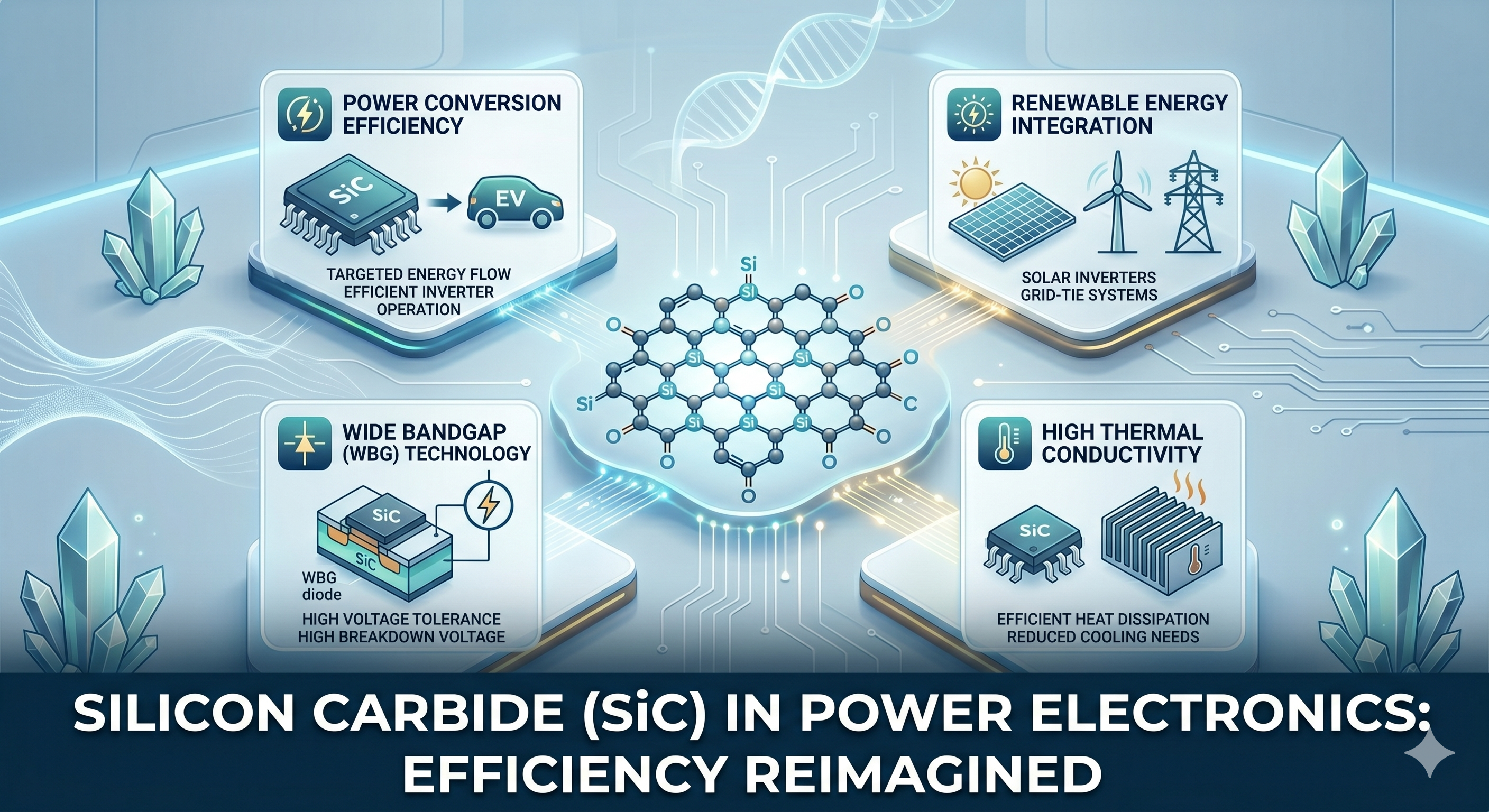
For over half a century, Silicon (Si) has been the undisputed king of the semiconductor world. It powered the computer revolution, gave us the internet, and managed the electricity in our homes. But as we transition into an era defined by electric vehicles (EVs), massive AI data centers, and renewable energy grids, Silicon is hitting a physical wall. It simply cannot handle the heat or the high voltages required by the next generation of technology without becoming bulky and inefficient.
Enter Silicon Carbide (SiC). Often hailed as a “miracle material,” Silicon Carbide is a wide-bandgap (WBG) semiconductor that is fundamentally reimagining how we convert and control power. It isn’t just an incremental upgrade; it is a paradigm shift that allows electronics to be smaller, faster, cooler, and significantly more efficient.
1. The End of the Silicon Age?
To understand why SiC is essential, we must understand the limitations of standard Silicon. Silicon is a “narrow-bandgap” material. In simple terms, this means it takes relatively little energy to knock an electron loose so it can conduct electricity. While this is great for low-power computer chips, it is a liability in power electronics.
When Silicon is subjected to high voltages or high temperatures, those electrons start moving when they shouldn’t, leading to leakage, inefficiency, and eventually, the total failure of the component. Silicon Carbide, a synthetic compound of silicon and carbon, possesses a “wide bandgap” (approximately 3.2 electron volts, compared to Silicon’s 1.1 eV). This allows SiC to withstand electric fields ten times stronger than Silicon can.
2. The Science of the Gap: Why 3.2 eV Changes Everything
The physical properties of SiC translate into three massive engineering advantages:
-
High Breakdown Voltage: Because of its wide bandgap, a SiC layer can be much thinner than a Silicon layer while still blocking the same high voltage. This reduces the “on-resistance” (the internal friction electricity faces), which means less energy is wasted as heat.
-
Superior Thermal Conductivity: SiC moves heat three times better than Silicon. In practical terms, this means you can often eliminate heavy, expensive cooling fans and bulky copper heat sinks.
-
High Switching Frequency: Power electronics work by turning “on” and “off” thousands of times per second. SiC can switch much faster than Silicon with almost zero “switching loss.” This allows for the use of smaller capacitors and inductors, shrinking the overall size of the power system.
3. Revolutionizing the Road: SiC in the Electric Vehicle Era
The most visible “clinical trial” for Silicon Carbide has been the global automotive market. As manufacturers move from 400V to 800V battery architectures to enable “ultra-fast charging,” Silicon Carbide has become the mandatory choice for the traction inverter—the brain that converts DC battery power into AC power for the motor.
Longer Range and Faster Charging
Recent industrial data from 2025 and early 2026 indicates that switching from Silicon-based IGBTs to SiC MOSFETs increases EV range by 5% to 10% simply by reducing energy loss. While 10% might sound small, it allows manufacturers to use a smaller, lighter battery pack to achieve the same range, saving thousands of dollars in raw material costs.
Bidirectional Charging (V2G)
SiC is also the enabling technology for Vehicle-to-Grid (V2G) systems. Because SiC converters are so efficient, they allow your car to send power back to your house or the grid during peak hours with minimal energy loss, turning every EV into a mobile power plant.
4. Green Energy and the Grid: Solar Inverters Refined
Renewable energy is inherently intermittent and often generated far from where it is used. Converting DC power from solar panels into AC power for the grid requires heavy-duty inverters.
In 2026, the push for “Micro-grids” has made SiC essential. Traditional Silicon inverters are roughly 96% to 97% efficient. SiC inverters are pushing 99% efficiency. In a massive solar farm, that 2% difference represents gigawatts of energy—enough to power a small city—that would otherwise be lost as wasted heat. Furthermore, because SiC inverters are 50% smaller and lighter, they are significantly easier and cheaper to install on rooftops or in remote locations.
5. Current Research (2024–2026): The 200mm Transition and Trench Technology
The SiC industry is currently undergoing a massive technological evolution.
The 200mm Wafer Milestone
For years, SiC was produced on 150mm (6-inch) wafers, which made the chips expensive. As of 2025, major semiconductor foundries have successfully transitioned to 200mm (8-inch) wafers. This shift increases the number of chips per wafer and is expected to drive down the cost of SiC components by nearly 30% by the end of 2026.
Trench MOSFET Architecture
New research into “Trench” structures—where the gate of the transistor is etched vertically into the material—is allowing for even higher power density. By moving from planar (flat) designs to trench designs, engineers can pack more power-switching capability into a smaller footprint, further reducing the size of chargers and industrial drives.
6. Industrial Case Studies: Real-World Performance Data
Industrial “field tests” conducted by industry leaders like Tesla, Wolfspeed, and STMicroelectronics have provided concrete evidence of SiC’s superiority:
-
Data Centers: In a study involving AI server power supplies, SiC-based units reduced power consumption by 15%. Given that data centers now consume nearly 2% of global electricity, widespread SiC adoption could save billions of kilowatt-hours annually.
-
Heavy Machinery: In electric mining trucks and high-speed rail, SiC has demonstrated the ability to operate reliably in environments exceeding 175°C, where Silicon components would have required massive, complex liquid cooling systems.
7. The Double-Edged Sword: Advantages vs. Manufacturing Risks
Despite its dominance, Silicon Carbide is not a “magic bullet” without its own set of challenges.
The Advantages (The Pros)
-
System-Level Cost Savings: While a SiC chip is more expensive than a Silicon chip, the entire system (smaller battery, smaller cooling, smaller housing) ends up being cheaper.
-
High-Temperature Operation: SiC thrives where Silicon fails, making it ideal for aerospace and deep-well drilling.
-
Sustainability: By reducing energy loss across the board, SiC is one of the most effective tools we have for reducing global CO2 emissions.
The Risks and Challenges (The Cons)
-
Substrate Defects: Growing SiC crystals is incredibly difficult. “Basal plane dislocations” or tiny “micropipes” in the crystal can cause a chip to fail. High-quality yield is still a challenge for many manufacturers.
-
Supply Chain Concentration: Much of the high-purity Silicon Carbide powder and substrate production is concentrated in a few geographic regions, making the supply chain vulnerable to geopolitical shifts.
-
High Initial Investment: Building a SiC fabrication plant (Fab) is significantly more expensive than a traditional Silicon Fab due to the specialized high-temperature equipment required.
8. Conclusion: Powering a Sustainable Future
Silicon Carbide is no longer a “future” technology; it is the heartbeat of the modern energy economy. As we move closer to 2030, the “Efficiency Reimagined” by SiC will be the standard, not the exception.
From the car in your driveway to the satellite orbiting Earth, SiC is the silent partner ensuring that we use our energy as wisely as possible. For companies involved in advanced materials and electronics, the transition to SiC is the single most important strategic move of the decade. The Silicon age isn’t over, but for high-power, high-efficiency applications, Silicon Carbide has officially taken the throne.