
Recently added item(s)
The global transition to electric vehicles (EVs) is undeniable. Driven by climate goals and advances in technology, traditional internal combustion engines are being replaced by sleek, electric alternatives. However, despite the surge in popularity, a persistent challenge remains: range anxiety. While current lithium-ion (Li-ion) batteries are impressive, they are pushing their theoretical limits.
The holy grail of EV manufacturing is a battery that offers double the range, charges in minutes rather than hours, and lasts for the lifetime of the vehicle. To achieve this, the industry is looking beyond standard materials to a chemical element that promises to revolutionize energy storage: Silicon. Specifically, Silicon Nanoparticles.
The Bottleneck in Current Batteries: Graphite’s Limit
To understand why silicon nanoparticles are the “secret” ingredient, we must first look at how the anode (the negative electrode) of a modern EV battery works. For decades, graphite has been the dominant anode material.
Inside a Li-ion battery, lithium ions shuttle back and forth between the cathode (positive electrode) and the anode. When you charge your EV, the ions embed themselves within the graphite structure. This process is called intercalation. Think of graphite as a well-organized parking garage for lithium ions.
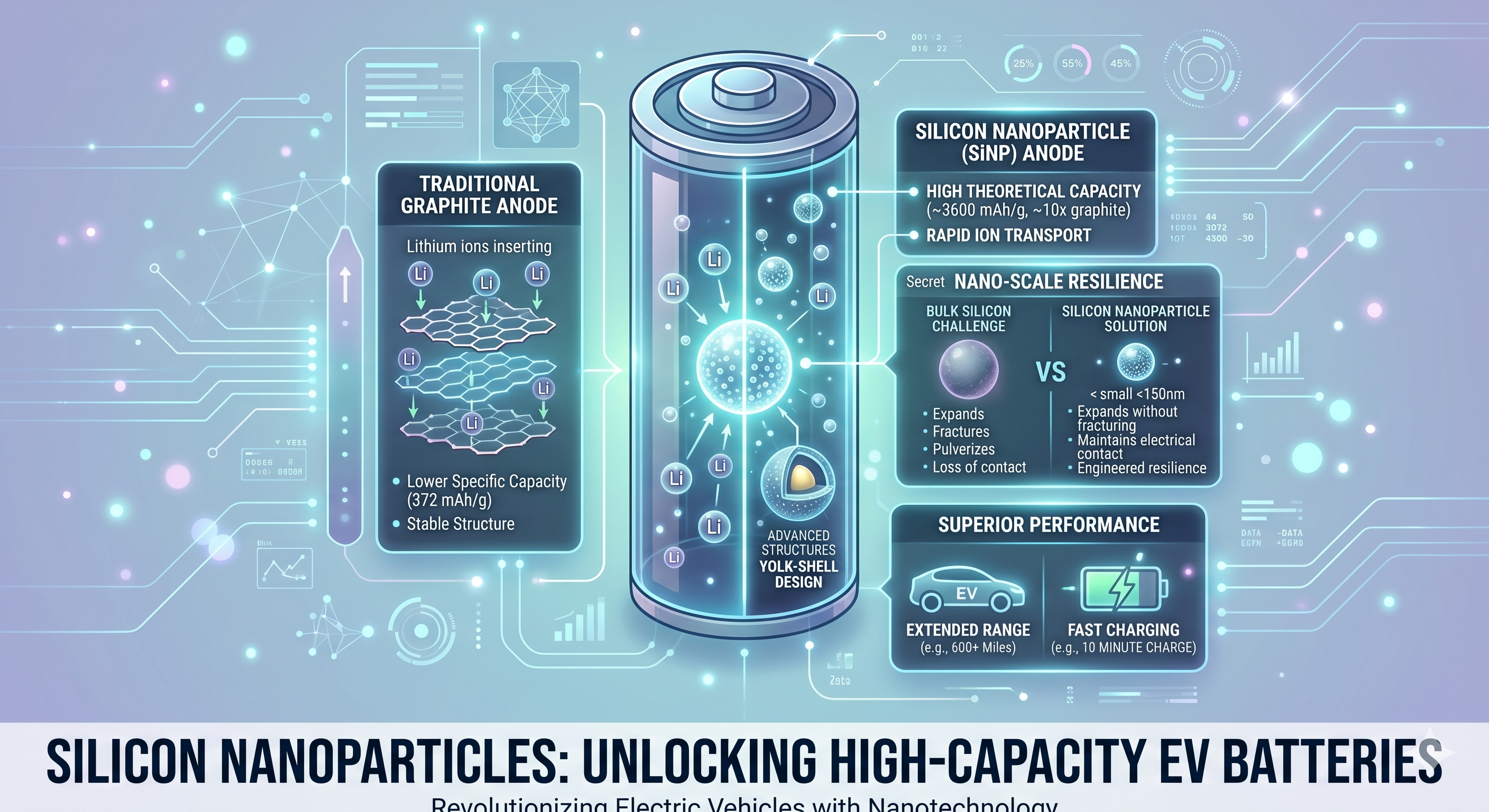
Graphite is used because it is stable, abundant, and reliable. However, its “parking capacity” is limited. Scientifically, graphite has a theoretical specific capacity of 372 milliampere-hours per gram (mAh/g). At this level, current EV batteries are hitting a performance ceiling. To pack more energy into the same space—increasing energy density—we need a better parking garage. We need Silicon.
The Silicon Promise: Ten Times the Capacity
Silicon is widely recognized as the most promising next-generation anode material. Where graphite merely “parks” the lithium ions, silicon actively reacts with them, forming a new alloy.
The difference in capacity is staggering. While graphite stops at 372 mAh/g, silicon has a theoretical specific capacity of approximately 3,600 mAh/g—roughly ten times greater than graphite.
By replacing the graphite anode with a silicon-dominant one, automakers could drastically increase the energy density of EV packs. This means cars could travel 600 miles or more on a single charge without requiring a heavier or larger battery, or vehicles could become lighter while maintaining their current range, improving overall efficiency.
The Silicon Problem: The Expansion Crisis
If silicon is ten times better than graphite, why isn’t every EV already using it? The challenge lies in the mechanics of alloying.
When graphite hosts lithium ions, its volume barely changes (around 10%). However, when silicon forms an alloy with lithium during charging, it swells dramatically. A pure silicon anode expands by over 300%.
Imagine a sponge absorbing water and swelling to three times its size. In a rigid battery cell, this expansion is catastrophic. It leads to several critical points of failure:
-
Pulverization: The repeated expansion (during charging) and contraction (during discharging) causes the silicon structure to crack and shatter, turning the electrode into powder.
-
Loss of Conductivity: Pulverized particles lose electrical contact with the rest of the electrode, rendering them useless for storing energy.
-
SEI Layer Destruction: Batteries form a protective layer called the Solid Electrolyte Interphase (SEI) on the anode. Silicon’s massive volume changes continually break this layer. The battery then wastes lithium trying to re-form the SEI, leading to a rapid loss of capacity and poor cycle life.
Silicon Nanoparticles: The “Secret” Solution
This is where advanced nanotechnology steps in. Researchers discovered that shrinking the silicon down to the nanoscale—creating Silicon Nanoparticles (SiNPs)—fundamentally changes its behavior.
The revolution hinges on scale. When silicon particles are microscopic (micrometers), they pulverize under strain. However, when researchers engineered silicon particles smaller than approximately 150 nanometers (nm), they observed a crucial phenomenon: the particles became resilient enough to swell and shrink without fracturing.
Furthermore, silicon nanoparticles offer a massive surface-area-to-volume ratio. This allows for extremely rapid lithium-ion exchange. For EV owners, this means faster charging times. A nanostructured silicon anode could potentially charge an EV battery to 80% capacity in 10 minutes or less.
Engineering Beyond the Nanoparticle
While using nanoparticles prevents fracturing, it does not stop the overall electrode from expanding, nor does it completely stabilize the problematic SEI layer. To address these lingering issues, scientists and startups are integrating silicon nanoparticles into complex, engineered structures:
-
Silicon-Graphite Composites: Small amounts of silicon nanoparticles (5-10%) are mixed into graphite anodes. This provides a modest, stable increase in capacity without overwhelmed the system with expansion. (This approach is already being deployed in some commercial cells).
-
Carbon Coatings and Yolk-Shell Structures: Nanoparticles are coated in carbon or encased within a hollow carbon “shell.” The shell provides a stable surface for the SEI layer and contains conductive pathways, while the hollow space gives the silicon nanoparticle room to expand without applying pressure to the overall battery cell.
Current Research, Pilots, and “Clinical” Validation
While battery technology doesn’t undergo “clinical trials” in the medical sense, it goes through a rigorous process of pilot testing, validation by third-party labs, and integration into “pre-production” or prototype vehicles. This process is the industry equivalent of advanced clinical phases.
Currently, the industry is transitioning from laboratory benchmarks to real-world pilot applications.
Leading Innovations:
-
Silicon Nanowires: Companies like Amprius are manufacturing batteries using anodes composed of pure silicon nanowires. These nano-structures provide an easy pathway for electricity and ions, and their vertical alignment accommodates expansion. These are currently used in high-performance applications (like aerospace and drones) and are being validated for EVs.
-
Carbon-Silicon Yolk-Shell (Titan Silicon): Major battery startups such as Sila Nanotechnologies are producing composite materials where silicon is engineered at the nanoscale and encased in a durable material. Sila’s material, Titan Silicon, is already utilized in consumer electronics and is scheduled for integration in upcoming electric vehicles, such as the Mercedes-Benz EQG, providing a definitive real-world “clinical” proof-of-concept.
Safety Testing: Advanced validation phases involve extreme “clinical” stress tests. These include thermal stability tests (heating the cells past their operational limits), overcharge testing, and nail penetration tests (physically damaging the cell). Engineered silicon anodes must prove they are safer or equal to current graphite cells before being approved for road use. Recent results show that nanostructured silicon composite anodes improve thermal stability by reducing the chance of thermal runaway (battery fires) compared to pure silicon alternatives.
Advantage–Risk Assessment
The move to silicon nanoparticles is not without hurdles. A balanced view reveals both the immense potential and the significant engineering risks.
Advantages
-
Dramatic Energy Density Increase: Silicon nanoparticles enable cells with energy densities approaching 500 Wh/kg, up from the ~280 Wh/kg available today. This means EVs with significantly longer ranges.
-
Ultra-Fast Charging: High surface area allows for massive lithium flow, drastically reducing the time spent at charging stations.
-
Reduced Cost Potential: While processing is expensive now, silicon is the second most abundant element on Earth (found in sand). Graphite, by contrast, is often sourced through more geographically constrained mining.
-
Reduced Geographical Dependence: Large-scale silicon production can be localized more easily than graphite mining and refining, stabilizing the supply chain.
Risks
-
Lifespan and Degradation: Even with nanoparticles, stabilizing the anode for 10+ years of EV use (1,000+ charge cycles) remains difficult. Current advanced silicon anodes are targeting 500-800 cycles, while the target is usually >1,000.
-
Cost and Scalability: Synthesizing silicon nanoparticles (particularly uniform, high-quality ones or structures like nanowires) is significantly more complex and expensive than milling graphite. Scaling production from the lab to metric tons while keeping the cost low is a massive manufacturing challenge.
-
SEI Layer Instability: While pulverized particles are solved, the continuous formation and destruction of the SEI layer on the high surface area of nanoparticles can still consume lithium, shortening the battery’s calendar life.
The Road Ahead: 2025 and Beyond
Silicon nanoparticles are no longer theoretical. We are currently in the early commercial deployment phase. In the immediate future (the next 2-3 years), we will see “silicon-dominant” anodes gradually replacing graphite in premium electric vehicles, first as composite materials and later as pure nanostructured electrodes.
The EV revolution is a race for better chemistry. By conquering the atomic constraints of standard materials, silicon nanoparticles hold the secret to making EVs not just alternatives to gas-powered cars, but definitively superior machines, marking the true end of range anxiety.