Recently added item(s)
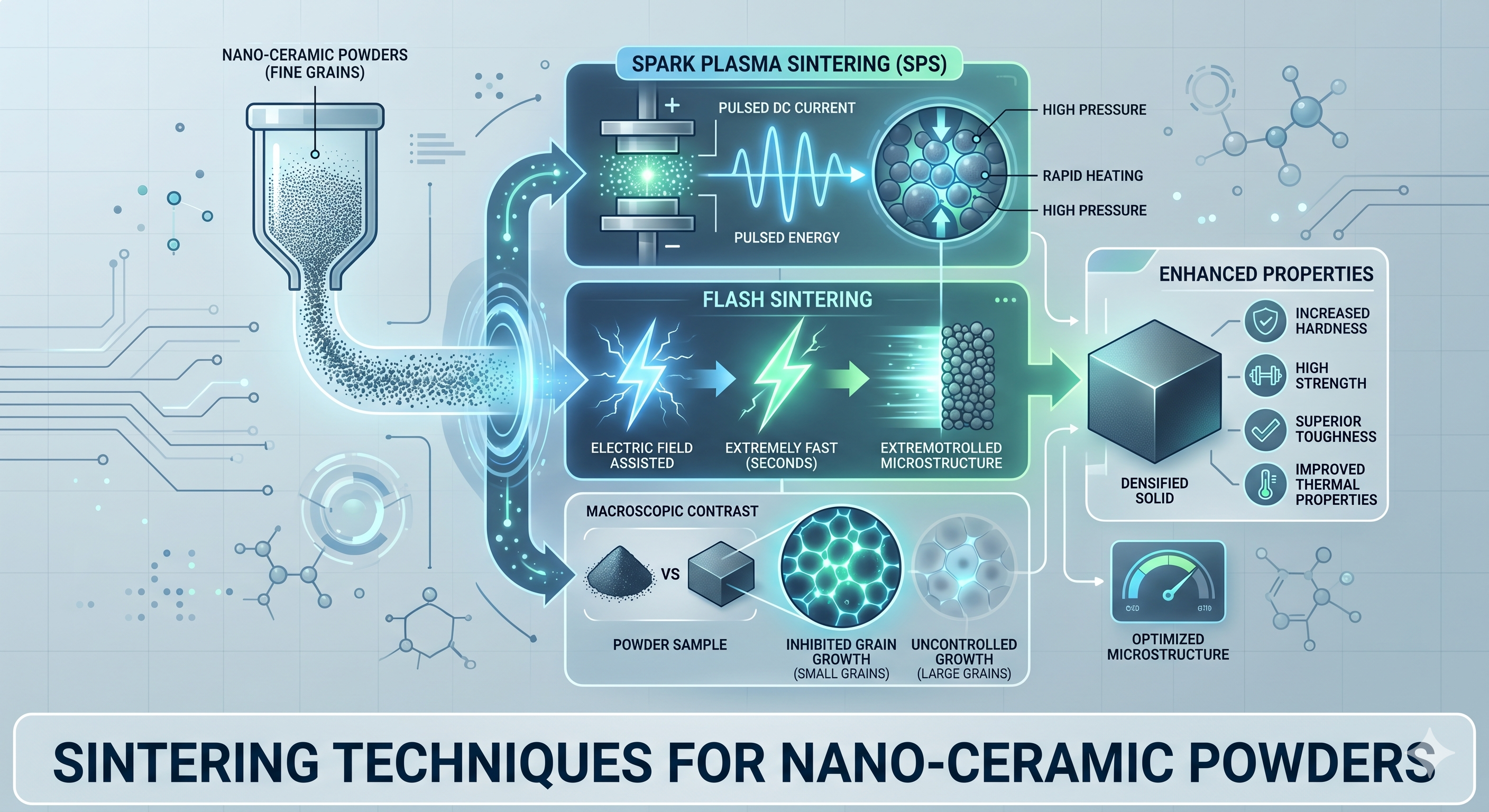
In the world of advanced materials, there is a profound difference between a pile of powder and a finished, high-performance component. That bridge—the process that turns billions of individual particles into a solid, impenetrable structure—is known as sintering.
For centuries, sintering was a slow, “brute force” method involving massive kilns and days of heat. But as we enter the era of nanotechnology, the rules have changed. When dealing with nano-ceramic powders, traditional sintering is no longer enough. If you cook these particles for too long, they grow, merge, and lose the very “nano-properties” that make them valuable.
Today, the challenge for advanced manufacturing is “densification without grain growth.” We need to fuse the particles together without letting them get big. This article explores the cutting-edge sintering techniques that are making the impossible possible in 2026, from the lab bench to the industrial floor of nanotechnology hubs.
1. The Nano-Sintering Dilemma: The Race Against Grain Growth
To understand why specialized techniques are necessary, we have to look at the physics of the nanoscale. Nano-ceramic powders have an incredibly high surface-to-volume ratio. This makes them highly reactive and “eager” to bond.
In traditional sintering, the material is heated to roughly 70% to 90% of its melting point. At these temperatures, atoms begin to diffuse across particle boundaries. However, in a standard furnace, this process takes hours. During that time, a phenomenon called Ostwald Ripening occurs: smaller particles are “eaten” by larger ones.
By the time the material is solid, your 50-nanometer powder has grown into 5-micrometer grains. You have lost the hardness, the transparency, and the unique electrical properties of the nanomaterial. To solve this, modern metallurgy has developed “Fast Sintering” methods.
2. Spark Plasma Sintering (SPS): The Current Gold Standard
If there is a “hero” in the world of nano-ceramics, it is Spark Plasma Sintering (SPS), also known as Field Assisted Sintering Technology (FAST).
How it Works:
Unlike a traditional oven that heats the air around the part, SPS passes a high-amperage, pulsed direct current (DC) directly through the graphite mold and, if the ceramic is conductive, through the material itself. This creates “internal heating.”
The Nano Advantage:
-
Speed: SPS can reach sintering temperatures in minutes. Total cycle times are often under an hour.
-
Pressure: It applies high mechanical pressure simultaneously with the heat, forcing the particles together before they have a chance to grow.
-
Purity: The vacuum environment and rapid cycle prevent oxidation and contamination.
In 2026, SPS is the primary method for producing ultra-hard Boron Carbide armor and high-transparency Alumina for specialized optics.
3. Microwave Sintering: Volumetric Efficiency
While SPS uses electricity, Microwave Sintering uses electromagnetic waves to excite the molecules within the ceramic.
The Science of “Deep Heat”:
In a traditional furnace, heat moves from the outside in (conduction). In microwave sintering, the heating is volumetric. The entire part heats up at the same time. For nano-ceramics, this uniform temperature gradient is crucial. It prevents internal stresses and “warping” that can lead to microscopic cracks in the final product.
Why it Matters:
Microwave sintering is significantly more energy-efficient than traditional methods. For companies focusing on green manufacturing and “clean” chemical procurement, reducing the energy footprint of a 1,600°C process by 50% is a massive strategic win.
4. Flash Sintering: The 2026 Frontier
Perhaps the most “futuristic” technique currently being scaled for industrial use is Flash Sintering.
The “Flash” Phenomenon:
Discovered relatively recently, Flash Sintering involves applying an electric field to a ceramic specimen while it is being heated. Once the material reaches a “critical temperature,” its electrical resistance suddenly drops, a burst of current flows through it, and the material densifies—often in less than 10 seconds.
Industrial Impact:
Flash Sintering is the ultimate weapon against grain growth. Because the process is so fast, there is virtually zero time for the nano-grains to enlarge. Researchers are currently using Flash Sintering to create next-generation solid-state batteries, where nano-ceramic electrolytes must be perfectly dense to allow for rapid ion transport without short-circuiting.
5. Cold Sintering (CSP): Breaking the Heat Barrier
For decades, the word “sintering” was synonymous with “heat.” Cold Sintering is changing that definition. Developed to handle hybrid materials (like ceramic-polymer composites), CSP uses a transient liquid phase and high pressure to densify powders at temperatures below 300°C.
By using a small amount of water or an acidic solution to partially dissolve the surface of the nano-particles, the material can be “pressed” into a solid state. This is essential for electronics where you might want to embed sensitive sensors or conductive polymers directly into a ceramic housing without melting them.
6. Case Studies and “Field” Research (2025–2026)
Recent industrial applications have proven that these techniques are no longer just for university labs.
-
Medical: Nano-Zirconia Dental Implants: Using SPS, manufacturers are producing nano-crystalline Zirconia. These implants are not only stronger than titanium but have a “bio-mimetic” surface that helps human bone cells attach faster, reducing recovery time by 30%.
-
Defense: Multi-Hit Silicon Carbide Armor: By using Flash Sintering, defense contractors have created SiC plates with a grain size of 150nm. These plates can absorb multiple hits from armor-piercing rounds because the nano-structure prevents “crack propagation” across the entire plate.
-
Energy: Nano-Ceramic Thermal Barriers: In jet engines, nano-ceramic coatings applied via rapid sintering allow engines to run 200°C hotter than before, drastically increasing fuel efficiency and reducing CO2 emissions.
7. Advantage vs. Risk Assessment
Every high-tech solution comes with a set of trade-offs.
The Advantages (The Pros):
-
Superior Mechanical Properties: Nano-grain ceramics are harder, tougher, and more wear-resistant.
-
Energy Savings: Methods like Microwave and Flash sintering drastically reduce the “kilowatt-per-part” cost.
-
New Material Combinations: Cold sintering allows us to mix ceramics with plastics and metals in ways never before possible.
-
Precision: These techniques allow for “near-net-shape” manufacturing, meaning less grinding and waste after the sintering is done.
The Risks and Challenges (The Cons):
-
High Capital Expenditure: An SPS or Flash Sintering setup is significantly more expensive than a traditional vacuum furnace.
-
Size Limitations: Currently, it is difficult to use SPS for very large, complex parts (like a full engine block); it is best suited for tiles, inserts, and smaller components.
-
Safety of Nano-Powders: Sintering involves handling fine powders. At the nanoscale, these can be inhaled or even become explosive (pyrophoric). Specialized “glove-box” handling and inert gas environments are mandatory.
-
Process Sensitivity: Flash sintering, in particular, is highly sensitive to the chemistry of the powder. A 1% change in purity can cause the “flash” to fail or the part to explode.
8. The AI Integration: “Smart” Sintering
As we move toward modular, cloud-based industrial automation, the future of sintering lies in Digital Twins. By using AI models to monitor the sintering process in real-time, we can adjust the voltage or pressure millisecond-by-millisecond.
Imagine a system where the “Jarvis” of the factory monitors the thermal expansion of a Boron Carbide plate. If the AI detects a localized “hot spot” that could cause a crack, it instantly re-routes the electrical pulses in the SPS unit to compensate. This level of “Smart Sintering” is what will allow Turkey and the global market to reach 99.9% yields in advanced ceramic production.
9. Conclusion: The Foundation of the Nano-Age
Sintering is the silent engine of the nanotechnology revolution. By mastering the art of heat, pressure, and electricity, we are unlocking the full potential of nano-ceramic powders. We are moving away from “bulk” materials and toward “engineered” structures where every nanometer is designed for a purpose.
For leaders in the chemical and nanotechnology sectors, the message is clear: The powder is only the beginning. The real value—the real “Black Diamond” performance—is created in the furnace. As we refine these techniques, we aren’t just making better parts; we are building the indestructible foundation of the future.