
Recently added item(s)
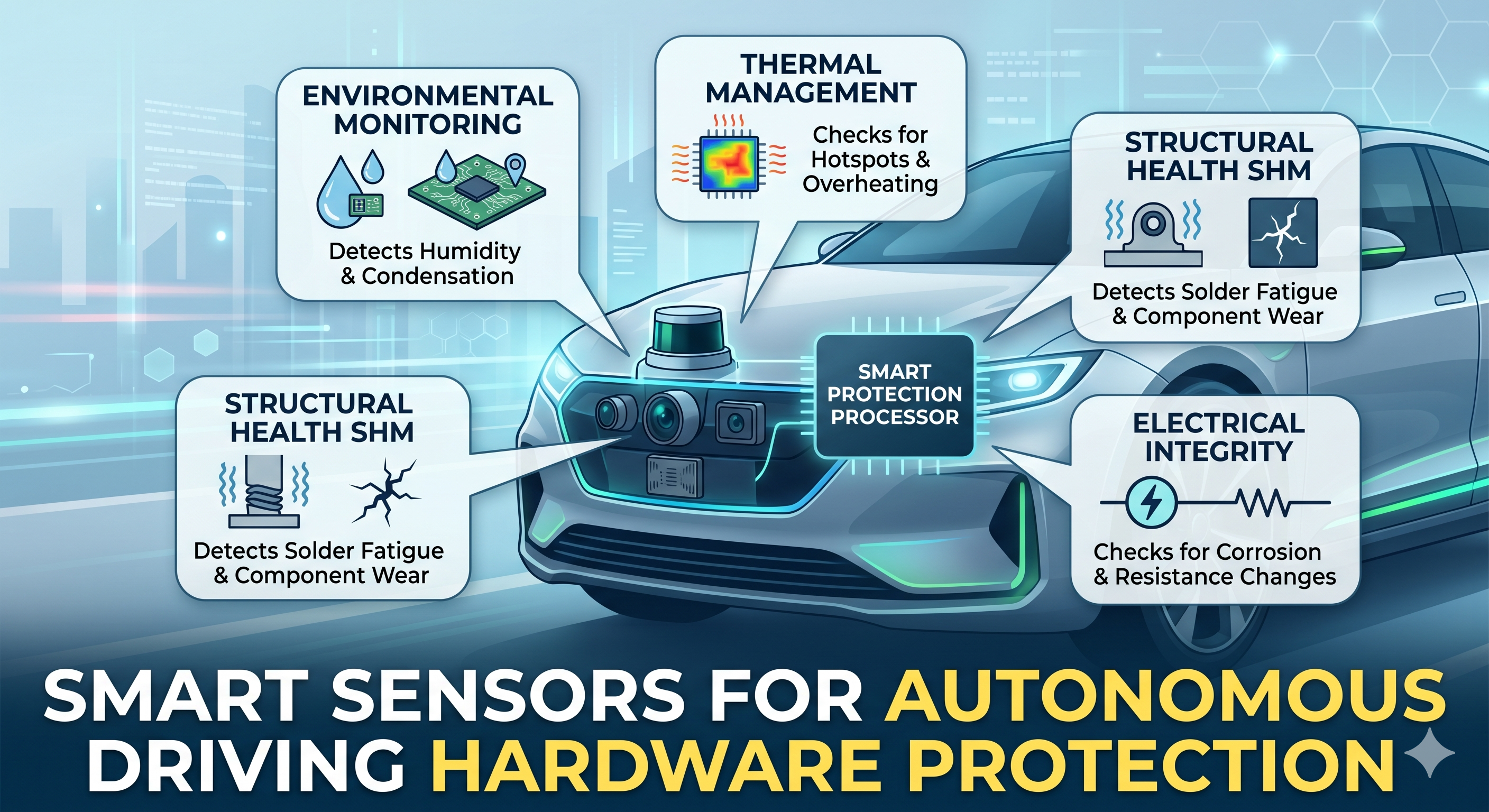
The “eyes” of an autonomous vehicle (AV)—its LiDAR, cameras, and Radar—get all the glamour. We marvel at their ability to see in the dark, distinguish a pedestrian from a lamppost, and map a three-dimensional world in real-time. But these perception systems are not indestructible superheroes; they are incredibly delicate, computationally dense, and expensive instruments exposed to the harshest of environments. They are the car’s sensory nervous system, and currently, that system is vulnerable.
If a single LiDAR unit malfunctions due to internal overheating or vibration damage, the entire safety architecture of the vehicle can be compromised, leading to a catastrophic disengagement—or worse. To move from experimental robotaxis to ubiquitous consumer autonomy, we must shift our focus from just making AVs “see” better to making them “survive” longer.
This is where the new frontier of Smart Sensors for Autonomous Driving Hardware Protection emerges. This is not about the sensors that monitor the external road; it is about a secondary, “proprioceptive” sensory system—an internal network of “bodyguard” sensors whose sole job is to monitor the structural, thermal, environmental, and electrical health of the primary driving hardware itself.
The Hidden Enemy: Why Primary AV Hardware Fails Internally
Before we meet the protectors, we must understand the threats. An AV’s primary perception stack faces a daily bombardment from stressors that traditional automotive components are not designed to handle at such high fidelity.
1. The Silent Killer: Moisture Ingress and Condensation Primary sensors must be hermetically sealed. However, over thousands of thermal cycles (the heating up from computation and cooling down from the environment), seals can degrade. Minute amounts of moisture ingress. Even worse, if the temperature drops rapidly below the dew point, hidden condensation can form directly on critical Printed Circuit Boards (PCBs) or optical lenses within the housing. This causes corrosion, short circuits, or optical obstruction that software can’t fix.
2. The Incessant Vibration Automotive electronics are built to withstand standard road vibration. AV sensors, however, must maintain precise optical alignments within micrometers over their entire lifespan. High-frequency vibrations from standard road use, or the sudden, intense shock of a pothole, can lead to mechanical fatigue in component solder joints, the micro-cracking of PCBs, or the drifting of laser alignment in LiDAR.
3. The Extreme Thermal Gauntlet The computational power required by perception systems generates immense localized heat. Simultaneously, the vehicle might be operating in the blistering heat of Arizona or the freezing cold of Michigan. The primary hardware is perpetually caught in extreme temperature gradients. Excessive heat degrades semiconductor performance and shortens lifespan; freezing temperatures can embrittle materials and compromise seals.
Enter the Smart Bodyguards: Meet the Hardware Protection Sensors
The traditional approach to this problem has been reactive (fixing a failed sensor) or preventative (replacing a sensor based on a rigid, conservative schedule). Smart sensors are enabling a paradigm shift toward Condition-Based Maintenance and Predictive Diagnostics. They are the “wearable health trackers” for the vehicle’s brains.
Here are the key categories of smart protection sensors currently being integrated into AV hardware design:
1. Dew Point and Moisture Sensors (ENCAPSULATION HEALTH)
The latest generation of protectant sensors doesn’t just measure general humidity. They are placed directly onto critical internal PCBs within the perception unit’s housing to measure the surface temperature of the board and the localized dew point. If the surface temperature approaches the dew point—threatening condensation before it forms—the sensor triggers an alert to activate internal micro-heaters or manage computational load to raise the internal temperature. These smart sensors use techniques like capacitive polymer impedance monitoring to detect moisture traces at a micro-level.
2. Advanced Vibration & Structural Health Monitoring (SHM) Sensors
Forget simple accelerometers. Smart protection utilizes specialized piezoelectric sensors or fiber optic Bragg grating sensors to perform on-board Structural Health Monitoring (SHM) on primary sensor mounts and housings. These sensors capture high-fidelity vibration profiles. The embedded smart chip doesn’t just transmit raw noise; it performs real-time Fast Fourier Transform (FFT) analysis to transform vibration data from the time domain to the frequency domain. By identifying changes in the specific harmonic frequencies of the component (its unique “vibration signature”), the sensor can detect impending mechanical failures—like a loose screw or a solder joint crack—long before a human could hear or see it.
3. Real-Time Micro-Thermal Sensors
Primary perception chips have internal temperature sensors, but smart protection goes further. Multi-point micro-thermistor arrays are embedded across the entire surface of sensor interfaces and optical alignment points. This creates a high-definition internal thermal map. The smart element analyzes thermal gradients (how quickly heat is moving between components), not just peak temperatures. This can identify localized hotspots caused by abnormal electrical resistance (corrosion) or failed internal cooling paths, preventing catastrophic chip burnouts.
4. Electrical Health and Resistance Monitors
Smart shunt resistors and integrated current/voltage monitors are becoming standard within the power delivery paths of perception hardware. They continuously monitor the dynamic electrical impedance of primary circuits. An unexplained, subtle rise in electrical resistance in a power line often signals the beginning of electrochemical corrosion or a weakening connector, acting as an early warning for total power failure.
From Checkups to Predictive Diagnostics: The Role of Machine Learning and IoT
The data generated by these “bodyguard” sensors would be overwhelming if treated traditionally. The true intelligence comes from the coupling of Smart Sensors with Edge Machine Learning (Edge ML) and the Industrial Internet of Things (IIoT).
Primary perception units now have secondary, dedicated microcontrollers (acting as “medical advisors”) that run lightweight ML algorithms trained on health data. Instead of transmitting all health data to a central computer, the smart sensor or its local advisor processes the streams of temperature, vibration signatures, and resistance values at the “edge”—within the component itself.
These ML algorithms are trained to calculate the component’s Remaining Useful Life (RUL). They answer the critical question: “Given the environmental stress this specific LiDAR unit has faced today, how many hours of life does it have left before it fails internally?”
This health data is then synchronized via IIoT to the fleet operator’s digital twin models. When a smart sensor predicts an impending failure within the next 48 hours, the fleet operator can proactively swap that vehicle out for maintenance before it has a safe-stop incident on the highway.
Current Research, Trials, and the Real-World Bottleneck
While Level 5 autonomy is still elusive, the need for robust hardware is apparent in current Level 4 trials (like those by Waymo and Cruise). While incident data from organizations like the NHTSA focuses primarily on collision statistics and software recalls, the sheer number of incidents in highly controlled deployments highlights that any disengagement—even those triggered by hardware warnings—is a roadblock to commercialization.
Current automotive tier-1 suppliers, such as Bosch, Continental, and Denso, are heavily researching diagnostic integration.
-
Integrated Self-Diagnostics in Digital LiDAR: Tier-1 suppliers are developing “digital LiDAR” that abandons complex rotating mirrors for solid-state technology. A key feature of these digital units is the integration of ASIL-B (Automotive Safety Integrity Level B) capabilities and internal self-diagnostics that continuously monitor alignment, laser health, and internal temperature in real-time, feeding this data directly to the vehicle’s master safety computer.
-
Predictive Diagnostics for Fleet Operators: Research projects in 2024 and 2025 have focused on integrating vibration and environmental sensors with cloud-based ML dashboards to automate maintenance scheduling for entire autonomous truck fleets, proving that predictive maintenance can extend component lifespan by up to 25% compared to conservative time-based schedules.
Advantage–Risk Evaluation of Smart Protection Sensors
The integration of a secondary, proprioceptive sensory system is not a simple decision. It requires a strict evaluation of its benefits versus its added complexities.
Advantages
1. Dramatic Increase in Vehicle Uptime and Reliability This is the primary commercial driver. By predicting failures before they occur, fleet operators can switch from reactive, chaotic maintenance to scheduled, proactive maintenance. Vehicles are always available when needed, improving fleet efficiency.
2. Enhanced Public Safety Through Redundancy Smart protection creates a health redundancy layer. If a primary sensor begins to fail during a trip, the protection system can provide a 30-second warning, allowing the car to perform a smooth, controlled safe-stop maneuver on the shoulder, rather than a sudden, jarring emergency brake that could cause a pileup.
3. Reduced Long-Term Total Cost of Ownership (TCO) While adding these sensors increases the upfront cost of the vehicle, the long-term savings are substantial. Sensors are not replaced prematurely based on conservative estimations. Conversely, expensive perception chips are not “run to failure” and burned out catastrophically.
Risks and Challenges
1. System Complexity and Added Single Points of Failure Adding more sensors to monitor existing sensors increases the overall complexity of the vehicle’s nervous system. It introduces a paradoxical question: “Who watches the watchman?” What if the smart dew point sensor malfunctions and shuts down the LiDAR stack on a perfectly sunny day, misinterpreting the environmental condition? This is known as a False Positive Failure, and it can be just as costly to uptime.
2. Weight, Space, and Cost Constraints Even smart, micro-level sensors consume space, weight, and computational resources. Within the intensely packed housing of a LiDAR unit, finding the optimal location for a multi-point thermal array or an SHM sensor is a significant engineering challenge.
3. Cybersecurity and Health Data Privacy Health data (RUL estimates, thermal signatures) is highly sensitive competitive intelligence. Fleet operators use this data to prove their vehicles are “safer.” This makes the health communication architecture a target for cyberattacks. A malicious actor might inject false health data to trick a fleet into grounding all its vehicles simultaneously, causing a logistical shutdown.
Conclusion: Smart Hardware Protection is the Foundation, Not an Accessory
The era of merely making autonomous cars “see” is closing. We are entering the era of making them “survive.” We can no longer afford to treat AV perception hardware as expendable computing components. The commercial reality of Level 5 autonomy depends on creating vehicles that can operate robustly for years, not months, in the harsh chaos of the real world.
Smart sensors for hardware protection represent the necessary evolution of the automotive body. By equipping these advanced computing brains with their own proprioceptive nervous system—their own sense of heat, stress, and internal environment—we are not just adding an accessory. We are building the indispensable foundation of a safe, reliable, and commercially viable autonomous future. Without smart hardware protection, Level 5 autonomy is merely a vision; with it, it becomes a reality that can withstand the storm.