
Recently added item(s)
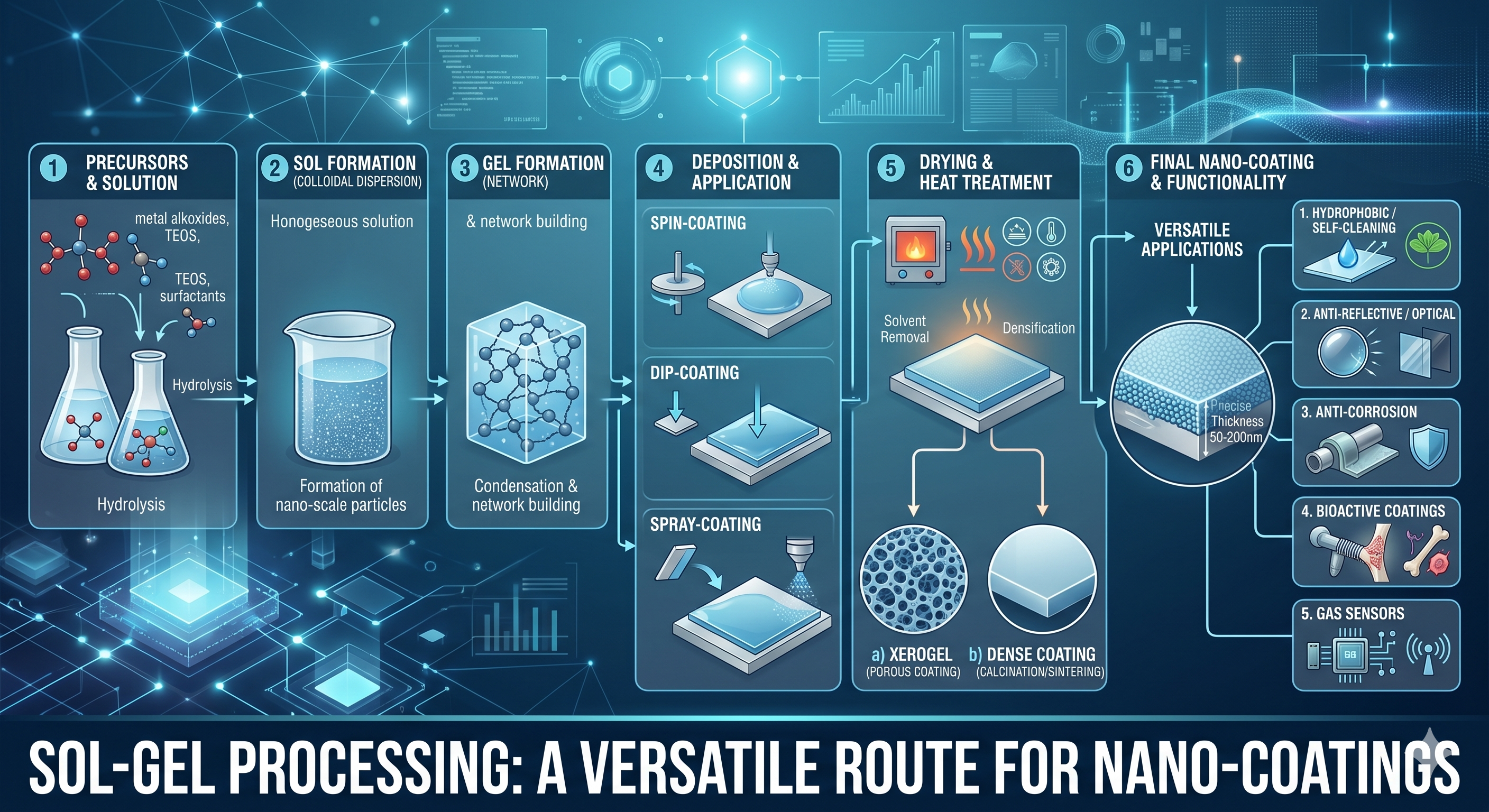
In the realm of advanced materials science, few techniques can match the elegant flexibility of sol-gel processing. While it may sound like something from a culinary class, “sol-gel” is actually a wet-chemical procedure—a molecular-scale technique used to fabricate solid materials, particularly high-purity ceramic and glass materials. This seemingly simple approach has evolved into the definitive method for creating nano-coatings—layers of material so thin that their thickness is measured in billionths of a meter.
These nano-coatings are quietly revolutionizing our world, making our electronics smaller, our medical implants safer, and our energy production more sustainable. This blog post will take a deep dive into the fascinating world of sol-gel processing, explaining how it works, showcasing cutting-edge research and clinical trials, and performing a balanced assessment of its advantages and potential risks.
What is Sol-Gel Processing? The “Recipe” for Nano-Coatings
At its core, sol-gel processing is a process of changing states, moving from a liquid “solution” to a solid “network.” It allows scientists to build a solid material from the atoms up, analogous to assembling a complex jigsaw puzzle, where every piece is placed exactly where it needs to go.
Here is the basic, step-by-step “recipe” for creating a sol-gel material:
1. Preparation of the “Sol”
The process begins with a liquid solution called a “sol” (a stable colloidal solution). This sol contains a precursor molecule, which is the essential building block of the final coating. For metal oxide coatings (like silica, TiO₂, or zirconia), the precursors are usually metal-organic compounds called metal alkoxides. These alkoxides are ideal because they react readily with water.
2. Hydrolysis and Gelation
In this crucial phase, water and a catalyst are added to the sol. This triggers two fundamental chemical reactions: hydrolysis and polycondensation. The water breaks the bonds in the precursor molecule (hydrolysis), creating active species that begin to chain together, forming microscopic ceramic particles. As these particles cross-link with each other, they transform the liquid sol into a diphasic system called a “gel”. Think of this transition like a “jelly” setting; the material still contains liquid, but it has developed a solid network that prevents it from flowing.
3. Application to a Substrate
To create a nano-coating, this “gel” is applied to the surface of a substrate (the material to be coated, which could be anything from glass to metal, plastic, or even a medical implant). Techniques such as dip-coating (dipping the object and withdrawing it slowly), spin-coating (spinning the object to spread the sol evenly), or spray-coating are commonly used.
4. Drying and Densification
The applied layer is then dried to remove the liquid phase (solvent) trapped within the gel network. If dried carefully, it forms a low-density solid known as a xerogel, or if the solvent is removed under special conditions, a incredibly light aerogel. The final step is densification, usually achieved by heating the xerogel layer. This “baking” process causes the organic residues to decompose, and the network particles to fuse together (sinter), forming a dense, crystalline, or glassy nano-coating. The high-tech, precise environment ensures that the chemical composition can be tuned with unmatched precision, allowing for the addition of dopants to introduce specific functional properties.
Cutting-Edge Applications: A Spectrum of Sol-Gel Nano-Coatings
The true magic of sol-gel processing lies in its versatility. Because it is a liquid process, it can coat complex, three-dimensional shapes evenly. This has opened the door to applications across a multitude of industries.
1. Energy: Enhancing Solar Power and Batteries
Energy storage and production are prime fields for sol-gel innovations.
-
Solar Plants: Recent research (2025) has shown that sol-gel-derived zirconia (YSZ) coatings doped with alumina can effectively protect the metallic components of Concentrated Solar Power (CSP) plants. These plants use molten salt mixtures to transfer heat, an incredibly corrosive environment. Sol-gel nano-coatings provide a robust barrier, extending the lifespan of the equipment and lowering the cost of energy.
-
Next-Generation Batteries: Researchers are actively using sol-gel to create cathode materials witholivine-type or perovskite structures for supercapacitors and batteries, aiming to improve charging speeds and overall stability.
2. Smart and Self-Healing Coatings
Anti-corrosion coatings are a multi-billion dollar industry. Traditionally, these are “passive,” merely providing a barrier. Sol-gel allows the creation of “smart” coatings.
-
Active Defense: Imagine a coating that can heal itself. Scientists have created hybrid sol-gel films doped with nanocontainers. These nanocontainers hold a corrosion inhibitor (like benzotriazole). When corrosion begins, it often causes a localized change in pH. The pH-responsive containers sense this shift and release the inhibitor only where needed, actively stopping the corrosion process.
3. Electronics and Sensors
Sol-gel coatings are used to create sensitive layers for sensors, especially gas sensors. The inherent molecular-level control allows for the creation of high-surface-area, porous films that are extremely sensitive to trace amounts of gases.
Biomedical and Clinical Studies: A Game Changer in Medicine
Perhaps the most exciting developments are in the field of medicine. Sol-gel silica nanoparticles are “FDA recognized as safe,” allowing them to be widely used in cosmetics, food, and oral drugs. But their potential goes much deeper.
1. Reprogramming the Cancer Landscape: Cornell Dots
The most high-impact sol-gel biomedical breakthrough involves fluorescent silica nanoparticles, often called Cornell prime dots or C’dots.
-
Clinical Relevance: C’dots are not a theoretical concept; they have already been tested in human clinical trials as a cancer diagnostic and drug delivery system.
-
Ferroptosis and Immunotherapy (2026 Results): In a groundbreaking 2026 study published in Nature Nanotechnology, researchers made an entirely unexpected discovery. The silica nanoparticles themselves can reprogram the tumor microenvironment (TME). Aggressive, immunotherapy-resistant tumors are often “cold,” meaning they do not trigger a strong immune response. C’dots, without any attached drug, activate innate immune responses through pattern-recognition receptors and halt cancer cell proliferation. This transforms “cold” tumors into “hot,” inflammatory environments that allow existing immunotherapies to work far more effectively. This synergistic “one-two punch” has led to a significant survival advantage in mouse models for melanoma, prostate, and ovarian cancers, opening a powerful new frontier in cancer therapy.
2. Smarter Implants: Bioceramic Nano-Coatings
In orthopedic and dental surgery, implants (often made of titanium alloy) must integrate seamlessly with the patient’s bone. Sol-gel derived nano-coatings of bioceramics like Hydroxyapatite (HAp) can be applied to the implant surface. This bioactive coating encourages faster bone formation (osteogenesis) and stronger integration, enhancing the durability and longevity of the joint prosthesis or dental implant.
3. Nasal Drug Delivery for Brain Disorders
Drug delivery to the brain is notoriously difficult due to the Blood-Brain Barrier (BBB). Sol-gel technology offers a solution. Companies are developing nasal sol-gel delivery platforms (preclinical or transitioning to clinical stages). These are liquid at room temperature but instantly gel upon contact with body temperature inside the nasal cavity, allowing a drug (like a cannabinoid or dopamine) to slow-release directly into the brain, bypassing the BBB.
Advantage-Risk Assessment of Sol-Gel Processing
While a versatile route, sol-gel processing is not a universally perfect tool. We must perform a detailed advantage-risk assessment.
| Advantages | Risks and Disadvantages |
| Versatility: Can coat complex, large, and three-dimensional shapes evenly due to its liquid precursor state. | Shrinkage and Cracking: The major challenge. During drying, the gel network can shrink dramatically (up to 90%), leading to high capillary stresses and crack formation, which is difficult to control for large, monolithic pieces. |
| Low-Temperature Processing: Often requires temperatures much lower than traditional ceramic methods, allowing for coating heat-sensitive materials. | Organic Residues: The complete removal of organic groups from metal alkoxide precursors can be difficult, leaving impurities that may affect the properties of the final coating. |
| Unmatched Chemical Control: Allows for precise, molecular-level composition control, allowing researchers to incorporate small amounts of dopants (like organic dyes or functional groups) uniformly. | Residual Porosity: The final coating may retain residual porosity or OH groups if the densification process is not complete. |
| Hybrid Materials: Easily creates hybrid organic-inorganic materials (like organically modified silicates—ORMOSILS), combining the toughness of polymers with the hardness of ceramics. | Precursor Reactivity: Different precursors (e.g., non-silicate metal alkoxides) react at vastly different rates, making multi-component coatings difficult to synthesize evenly without stabilizers. |
The Future of Sol-Gel Processing
The path forward for sol-gel is clear: moving from a powerful lab technique to a robust industrial process. The future will focus on overcoming the “shrinkage problem,” perhaps by using non-hydrolytic sol-gel methods or advanced additive manufacturing. We will also see further development of “active” and “autonomous” hybrid materials that can adapt their optical, electrical, or biological properties on demand.
The sol-gel journey, moving from liquid solution to a nano-engineered future, is a testament to the power of precise, atomic-scale molecular design. It is a versatile route that is quietly reshaping industries, one nanometer-thin layer at a time.