
Recently added item(s)
The global energy transition is no longer a future concept; it is an urgent, present reality. As we strive to decouple our economies from fossil fuels, one molecule has taken center stage in the race for decarbonization: Hydrogen. However, not all hydrogen is created equal. Currently, over 95% of the world’s hydrogen is “grey hydrogen,” produced from natural gas through steam methane reforming—a process that releases massive amounts of carbon dioxide.
The ultimate goal is “green hydrogen,” produced using renewable energy. The conventional method for making green hydrogen involves using renewable electricity (from solar panels or wind turbines) to power an electrolyzer that splits water ($H_2O$) into hydrogen and oxygen. While viable, this multi-step process involves energy losses at every stage.
What if we could cut out the middleman? What if we could use sunlight directly to split water, without converting it to electricity first? This is the promise of direct solar-to-hydrogen conversion, also known as Artificial Photosynthesis. The key to unlocking this revolutionary technology lies in the field of nanotechnology, specifically through the development of nano-photocatalysts.
Understanding the Basics: Artificial Photosynthesis and Photocatalysis
In nature, plants use photosynthesis to convert sunlight, water, and carbon dioxide into energy (sugars). Artificial photosynthesis aims to mimic this process, but instead of producing sugar, it aims to produce hydrogen gas ($H_2$).
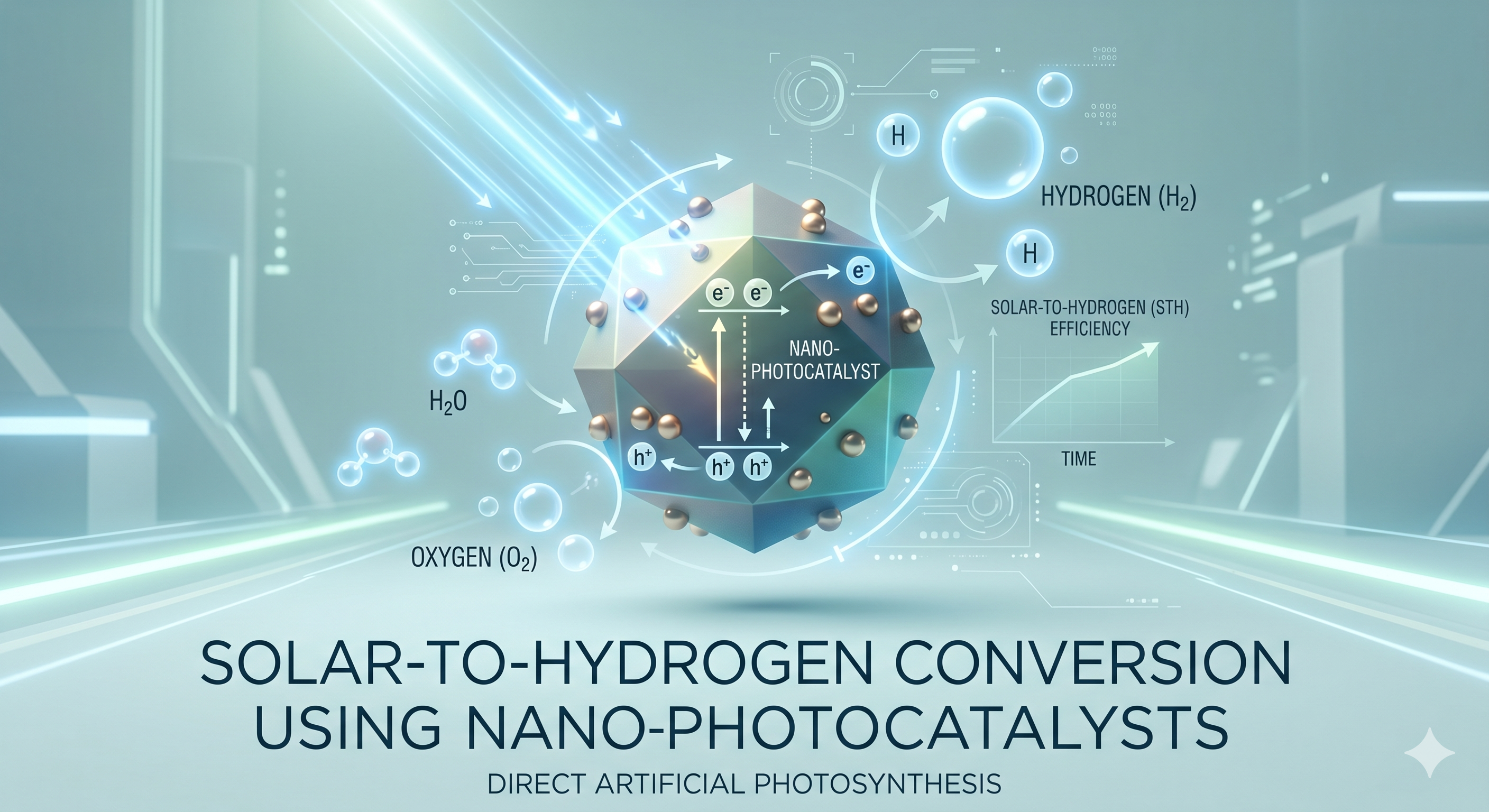
The engine of this process is a photocatalyst. This is typically a semiconductor material that, when exposed to light, can absorb photons (light energy). When a photon is absorbed, it excites an electron ($e^-$) within the material, leaving behind a positively charged “hole” ($h^+$). Think of this as creating tiny molecular batteries within the material.
To split water, these generated electrons and holes must migrate to the surface of the catalyst and participate in two distinct chemical reactions:
-
Reduction Reaction: The excited electrons ($e^-$) react with protons ($H^+$) in the water to form hydrogen gas ($H_2$).
-
Oxidation Reaction: The positive holes ($h^+$) react with water molecules to form oxygen gas ($O_2$).
For this to work effectively, the material must have very specific properties. It needs a suitable “bandgap” to capture enough energy from sunlight (especially visible light, which makes up most of solar radiation), and it must resist breaking down in water while efficiently separating the generated charges. This is where bulk materials fail and nanotechnology shines.
The ‘Nano’ Advantage: Why Size Matters
Standard photocatalysts, like bulk Titanium Dioxide ($TiO_2$), have been studied for decades. However, they suffer from extremely low efficiencies, typically well below 1%. The problem is twofold: they often only absorb UV light (a small fraction of sunlight), and the excited electrons and holes frequently recombine (canceling each other out) before they can reach the surface to react.
Nanotechnology changes the game. By engineering catalysts at the nanoscale (one-billionth of a meter), scientists can fundamentally alter their physical and chemical properties. Here is why nano-photocatalysts are essential for making this technology viable:
1. Massive Surface Area
Reducing a particle’s size increases its surface-area-to-volume ratio exponentially. A small amount of nanomaterial can provide a gigantic “workshop” space for chemical reactions. More surface area means more reaction sites, significantly speeding up the production of hydrogen.
2. Enhanced Charge Migration
In a large particle, an electron excited at the center has a long, difficult journey to reach the surface, increasing the chance of recombination. In a nanoparticle, the distance to the surface is mere nanometers. The generated “molecular batteries” can deploy their energy almost instantly, dramatically improving efficiency.
3. Quantum Confinement: Tuning for Sunlight
At the nanoscale, the “bandgap” of a material—the energy barrier the electron must jump when hit by light—becomes tunable. By changing the size and shape of the nanoparticle, scientists can “tune” the material to absorb visible light rather than just UV. This allows the catalyst to harvest a much larger percentage of the sun’s available energy.
4. Engineering Heterojunctions: The Relay Race
Nanotechnology allows for the creation of composite materials. Scientists can create “core-shell” particles or decorate a semiconductor nanoparticle with other materials (like “co-catalysts” such as Platinum or Nickel). These structures, known as heterojunctions, create energy “slides” that force the electrons and holes to move in opposite directions, almost completely eliminating charge recombination. It is like a moleclular relay race where the electron gets passed instantly to the finish line (the $H_2$ creation site).
Frontline Research: The New Generation of Nano-Catalysts
The current landscape of nano-photocatalyst research is incredibly dynamic. While Titanium Dioxide remains a benchmark, the field is moving rapidly towards advanced materials that can capture visible light.
1. Beyond Metal Oxides: Sulfides and Nitrides
Materials like Cadmium Sulfide (CdS) and g-C3N4 (Graphitic Carbon Nitride) have shown immense potential. g-C3N4 is particularly exciting because it is metal-free, relatively inexpensive, and easily synthesized. It has a bandgap perfectly suited for visible light absorption. However, g-C3N4 on its own has modest efficiency, so current research focuses on loading it with other nanomaterials to create highly efficient heterojunctions.
2. MXenes: The 2D Material Revolution
A recent, highly promising entrant to the field is the family of 2D nanomaterials known as MXenes (pronounced “Max-eens”). These are atomically thin layers of transition metal carbides or nitrides. MXenes possess excellent electrical conductivity and, critically, have surfaces that can be easily modified to act as highly active co-catalysts. Recent studies have decorated standard photocatalysts with MXene nanosheets, resulting in a dramatic, multi-fold increase in hydrogen production rates.
3. Defect Engineering
Instead of changing the material, researchers are now deliberately introducing “imperfections” into the nano-crystal structure. By removing specific atoms (creating vacancies) or introducing other atoms (doping), they can create intermediate energy levels within the bandgap. This allows the material to absorb visible light photons it previously couldn’t, acting like a net designed to catch more of the sun’s energy.
Bridging the Gap: Industrial ‘Pilot’ and Field Tests
While the term “clinical trials” is associated with medicine, the engineering equivalent involves pilot plant testing and in-situ outdoor verification. This is the critical, final validation step before a lab technology can enter the market. The gap between a milligram of catalyst in a controlled beaker and an acre of hydrogen-producing panels is vast.
Current (2026-era) industrial pilots are focused on tackling the massive scaling challenge.
-
Continuous Flow Reactors: Lab tests are usually “batch” processes. For industrial viability, we need “flow” systems where water is continuously pumped through a chamber exposed to sunlight, and hydrogen/oxygen gases are continuously separated and collected. Companies are developing nano-catalyst-coated membranes and slurry-based reactors to manage this process.
-
Real Sunlight Duration: Lab light sources are artificial and constant. Pilot systems must operate under the real-world conditions of varying solar intensity, dust, and temperature fluctuations. In 2025, a major consortium in Europe inaugurated a 100-square-meter direct solar hydrogen pilot plant. The panels used a modified graphitic carbon nitride composite nano-photocatalyst slurry. While the Solar-to-Hydrogen (STH) efficiency was below 2% (lower than lab results), the reactor demonstrated continuous hydrogen production for over 1,000 hours, a massive step for material durability in the field.
-
Scalable Synthesis: The techniques used to make a few milligrams of perfect nanoparticles (like hydrothermal synthesis or ball milling) are difficult to scale to metric tons. Research partnerships are now focusing on scalable, “green chemistry” methods, such as using ball milling or microwave synthesis, to produce industrial quantities of complex nano-composite catalysts reliably and affordably.
Weighing the Scales: Advantages and Critical Risks
The potential of nano-photocatalysis is transformative, but a sober assessment of its advantages versus the engineering and safety risks is necessary.
Advantages
-
The Ultimate Clean Fuel: Direct solar hydrogen offers a true zero-emission cycle. The only input is water and sunlight; the only combustion byproduct of hydrogen is water.
-
Simplicity and Potential Low Cost: By eliminating the need for solar PV panels, power inverters, and separate electrolyzers, this approach simplifies the entire chain. If nano-catalysts can be made durable and efficient enough, this could potentially become the cheapest way to produce green hydrogen.
-
Decentralized Production: Hydrogen can be produced wherever there is water and strong sunlight, reducing the need for massive, complex distribution pipelines and supporting energy independence.
Risks and Challenges
-
Current Efficiency is Too Low: While nanoparticles have boosted efficiency from <1% to >10% in some lab settings, commercial viability requires a stable, year-round field efficiency of at least 10%. Currently, most pilot systems are below 3%. PV-integrated electrolysis still holds the efficiency crown (currently around 15-20% system efficiency).
-
Photocorrosion and Durability: This is the most critical hurdle. Many highly efficient visible-light catalysts (like CdS) corrode when exposed to light and water simultaneously. Engineering “protective nano-shells” is an active research area, but true industrial, decadal longevity remains a massive challenge.
-
Separation and Safety of Nanomaterials: If catalysts are used in a “slurry” (floating in water), they must be separated after the reaction. The release of nanoparticles into the water supply is a significant environmental and health concern. Engineering “fixed-bed” systems (coating catalysts on fixed plates) is safer but sometimes reduces efficiency.
-
Cost of Precious Metal Co-Catalysts: The most efficient systems currently rely on precious metals like Platinum to catalyze the $H_2$ production reaction. For global scaling, these must be replaced with cheap, abundant alternatives like Nickel, Cobalt, or Iron-based nanomaterials.
The Road Ahead: The Decisive Decade
Direct solar-to-hydrogen conversion using nano-photocatalysts has transitioned from a purely academic curiosity to a frontier engineering challenge. It represents one of the most elegant and necessary energy solutions for our planet.
The massive advances in materials science, particularly with 2D MXenes and heterojunction engineering, have proven that the physics works. We can harvest visible light and split water with high molecular efficiency. The next decade (2026-2035) will be the “durability decade.” If engineers can harness the power of AI to rapidly discover new, durable nano-composite materials and solve the photocorrosion problem at an industrial scale, direct artificial photosynthesis could become the “killer app” that finally makes the Hydrogen Economy a universal reality.