
Recently added item(s)
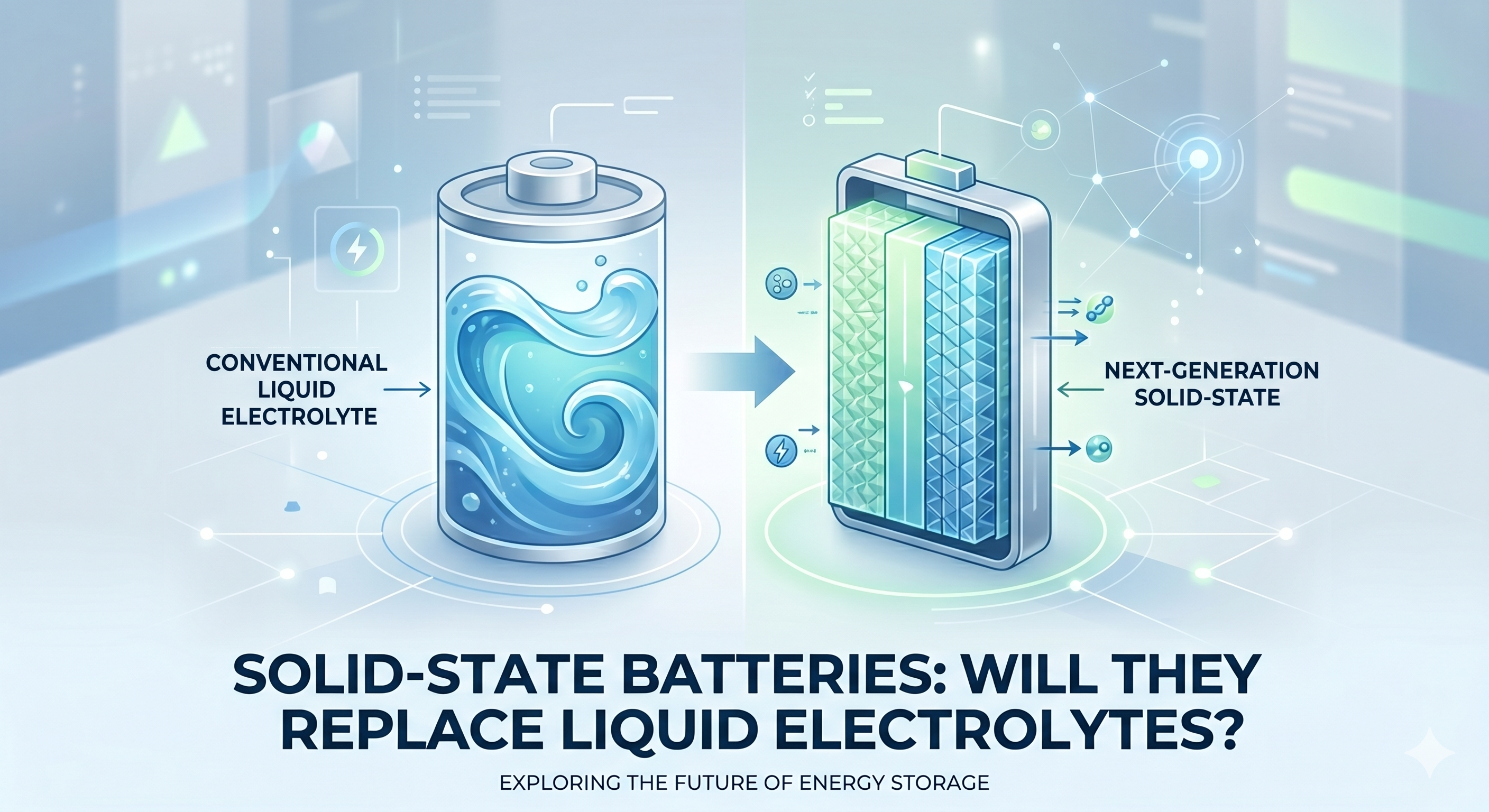
The world is currently in the midst of a massive energy transition. From the electric vehicles (EVs) parked in our driveways to the smartphones in our pockets, the demand for better, safer, and longer-lasting energy storage has never been higher. For decades, the lithium-ion (Li-ion) battery has been the undisputed king of this domain. However, as we push the limits of what liquid-based batteries can do, a new contender is emerging from the labs and entering pilot production: the Solid-State Battery (SSB).
But will solid-state technology truly replace the liquid electrolytes that have powered our digital age? To answer that, we must dive into the chemistry, the breakthroughs of 2025 and 2026, and the harsh economic realities of the manufacturing floor.
The Current King: The Era of Liquid Electrolytes
Before we can understand the “solid” future, we must understand the “liquid” present. Current lithium-ion batteries consist of two electrodes—an anode and a cathode—separated by a porous plastic sheet soaked in a liquid electrolyte. This liquid acts as the medium, allowing lithium ions to travel back and forth during charge and discharge cycles.
While this system is highly efficient and relatively cheap to produce, it has two major Achilles’ heels: safety and energy density.
-
Flammability: The liquid electrolyte is typically an organic solvent, which is highly flammable. If the battery is punctured or overheats (a phenomenon known as thermal runaway), the liquid can ignite, leading to fires that are notoriously difficult to extinguish.
-
Energy Ceiling: We are reaching the theoretical limit of how much energy a liquid-electrolyte battery can hold. To get more range out of an EV, you currently need a bigger, heavier battery pack, which eventually yields diminishing returns.
What Exactly is a Solid-State Battery?
In a solid-state battery, the liquid electrolyte and the plastic separator are replaced by a solid electrolyte. This material can be made of ceramics, polymers, or sulfides. By removing the liquid, the entire architecture of the battery changes.
This shift allows for the use of a lithium-metal anode instead of the traditional graphite anode. Lithium-metal anodes have a much higher energy density, but they are incompatible with liquid electrolytes because they tend to form “dendrites”—tiny, needle-like structures that can pierce the separator and cause a short circuit. In a solid-state system, the solid electrolyte acts as a physical barrier, potentially stopping these dendrites in their tracks.
The Three Main Types of Solid Electrolytes
-
Oxide-Based (Ceramics): These are stable and safe but can be brittle and difficult to manufacture at scale.
-
Sulfide-Based: These offer the highest ionic conductivity (meaning ions move through them very fast), making them great for fast charging. However, they are sensitive to moisture and can produce toxic gases if damaged.
-
Polymer-Based: These are the easiest to manufacture using existing equipment but often require heat to function efficiently, making them less ideal for cold-weather climates.
The Advantages: Why the Hype is Real
The transition to solid-state is often called the “Holy Grail” of battery science for several compelling reasons:
1. Unparalleled Safety
By eliminating the flammable liquid, solid-state batteries are inherently safer. They can operate at much higher temperatures without the risk of explosion or fire. This also means that EVs would require less complex (and heavy) cooling systems, further increasing efficiency.
2. Radical Energy Density
Current high-end Li-ion batteries hover around 250–300 Wh/kg. Solid-state prototypes have already demonstrated the potential to exceed 500 Wh/kg. For the consumer, this translates to electric cars that can travel 800–1,000 kilometers on a single charge—nearly double the current average.
3. Ultra-Fast Charging
Because solid electrolytes can handle higher current densities without overheating, charging times could be slashed. Imagine charging your car from 10% to 80% in just 10 minutes—the same amount of time it takes to grab a coffee at a gas station.
4. Longevity
Liquid electrolytes degrade over time due to side reactions with the electrodes. Solid-state materials are generally more stable, potentially leading to batteries that can last for hundreds of thousands of miles with minimal capacity loss.
The Challenges: Why Aren’t They Here Yet?
If solid-state batteries are so superior, why are we still using liquid ones? The road from the lab to the “Gigafactory” is paved with technical and economic hurdles.
The Problem of “Dendrites”
Contrary to early hopes, solid electrolytes aren’t a magic shield against dendrites. In some cases, lithium “whiskers” can still grow through microscopic cracks in the ceramic or sulfide layers. Researchers are currently testing “self-healing” polymers and ultra-dense ceramics to solve this.
The Interface Issue
In a liquid battery, the liquid flows into every nook and cranny of the electrodes, ensuring perfect contact. In a solid system, keeping the solid electrolyte in constant, “flush” contact with the solid electrodes as they expand and contract during use is incredibly difficult. If the contact is lost, the battery stops working.
Scalability and Cost
Building a solid-state battery requires entirely new manufacturing processes. You can’t just pour “solid” electrolyte into a cell like you do with liquid. Sulfide electrolytes, for instance, must be produced in “dry rooms” with near-zero humidity, which adds massive costs. Currently, a solid-state cell is significantly more expensive to produce than a standard Li-ion cell.
Recent Research and Industrial “Clinical” Trials (2024–2026)
The last 24 months have seen a shift from theoretical research to rigorous pilot testing. Large-scale trials—the industrial equivalent of clinical trials—are now underway.
Toyota’s Breakthrough
Toyota remains the leader in solid-state patents. In 2025, they announced a breakthrough in sulfide electrolyte durability. Their latest pilot vehicles are reportedly achieving 1,200 km of range with a 10-minute charge. Toyota plans to integrate these into high-end Lexus models by 2027.
QuantumScape and the “Anode-Free” Approach
U.S.-based QuantumScape has been sending its “Alpha-2” prototype cells to automotive partners (like Volkswagen) for testing. Their unique design uses a ceramic separator and is “anode-free” in its manufactured state; the lithium anode only forms when the battery is first charged. Recent testing data shows these cells maintaining 95% capacity after 1,000 full charge cycles.
Samsung SDI’s Pilot Line
Samsung SDI recently completed a fully automated pilot production line for solid-state batteries. Their focus is on “all-solid-state” (ASSB) technology using a proprietary solid electrolyte that maximizes ionic flow. They are currently shipping samples to premium smartphone manufacturers and EV companies for real-world stress testing.
Risk vs. Reward: A Scientific Evaluation
| Feature | Liquid Electrolyte (Current) | Solid-State (Future) | Risk Level (Solid-State) |
| Safety | High fire risk in accidents | Low-to-zero fire risk | Low |
| Energy Density | ~250 Wh/kg | 500+ Wh/kg | Low |
| Charging Speed | 30-60 mins (fast charge) | <15 mins (ultra-fast) | Medium (Heat management) |
| Cycle Life | 1,000 – 2,000 cycles | 5,000+ potential | High (Interface stability) |
| Cost | $100 – $130 per kWh | $400 – $800 per kWh (Est.) | Very High |
The Environmental and Ethical Perspective
We must also consider the “cradle-to-grave” impact. Solid-state batteries still require lithium, and often in higher concentrations if using lithium-metal anodes. However, the potential for better recycling is higher. Since solid-state batteries don’t contain toxic liquid solvents, the mechanical recycling process is theoretically cleaner.
Furthermore, if solid-state batteries can double the lifespan of an EV, we would need to produce fewer batteries overall, significantly reducing the carbon footprint of the transportation sector over the long term.
The Verdict: Replacement or Coexistence?
Will solid-state batteries replace liquid electrolytes? The answer is yes, but not overnight.
We are looking at a “tiered” energy market. For the next 5 to 10 years, liquid electrolytes (and their cousins, the semi-solid state batteries) will continue to power budget-friendly EVs and consumer electronics because they are cheap and proven.
Solid-state technology will first emerge in:
-
Aviation: Where weight (energy density) is the most critical factor.
-
Luxury EVs: Where consumers are willing to pay a premium for range and safety.
-
Specialized Medical Devices: Where safety and longevity are non-negotiable.
By the mid-2030s, as manufacturing scales and costs drop, we will likely see the “tipping point” where liquid electrolytes become the legacy technology, much like the lead-acid batteries of the past.
Conclusion
The journey from liquid to solid is not just an incremental upgrade; it is a fundamental shift in how we store power. While significant hurdles in manufacturing and interface stability remain, the progress made by companies like Toyota, QuantumScape, and Samsung suggests that the era of “limitless” mobile energy is within our grasp. Solid-state batteries represent more than just a better car battery—they are the key to a truly electrified and sustainable future.