
Recently added item(s)
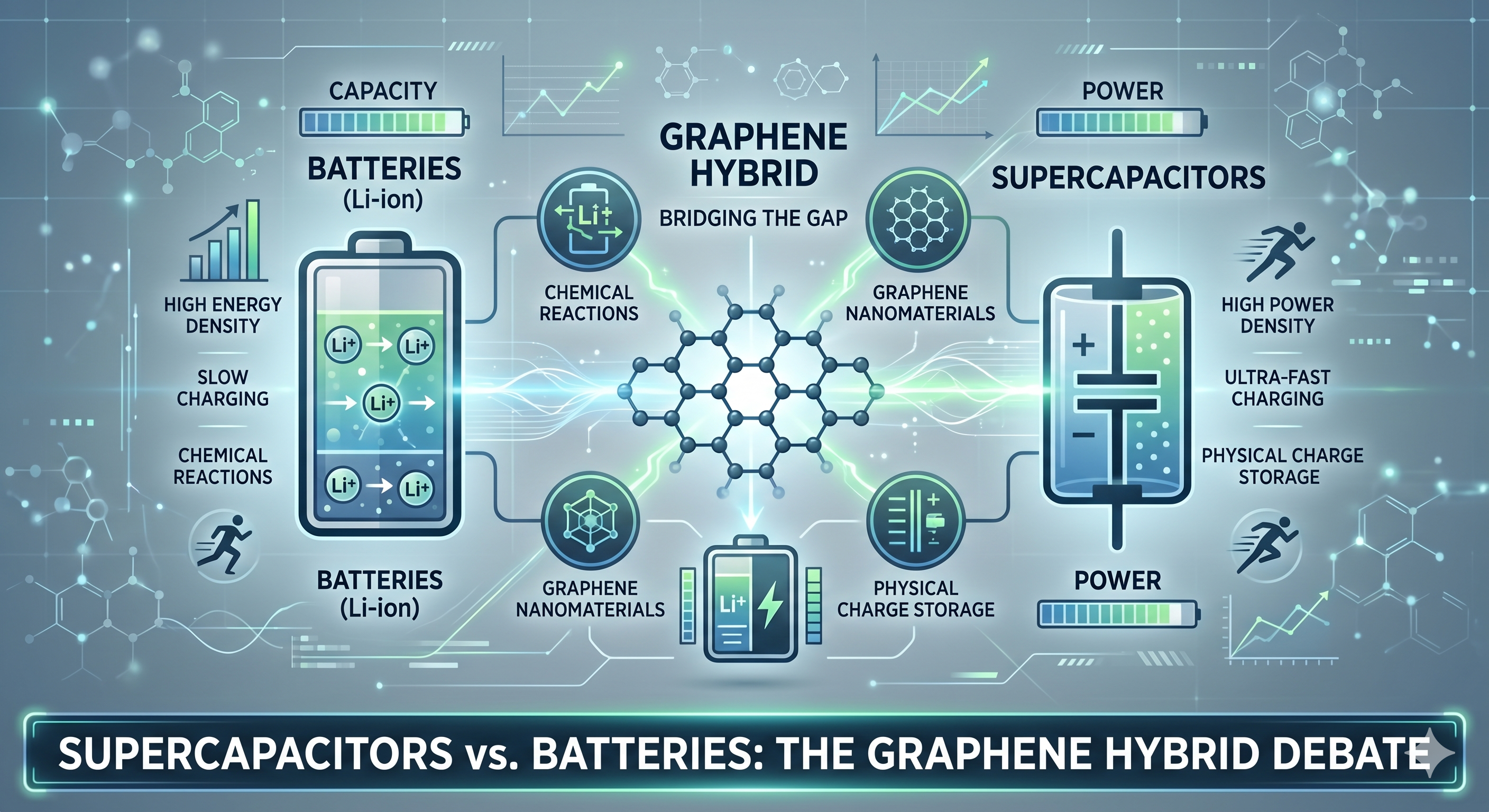
The global transition toward renewable energy and electric mobility has sparked a high-stakes technological arms race. At the heart of this revolution lies a fundamental question: How do we store energy more efficiently, charge it faster, and ensure it lasts for decades? For years, the answer was simple—Lithium-ion (Li-ion) batteries. However, as we push the limits of chemistry and physics, a new contender has emerged from the world of nanotechnology: Graphene-enhanced Supercapacitors.
The debate is no longer just “Batteries vs. Supercapacitors.” Instead, it has shifted toward the Graphene Hybrid, a “best-of-both-worlds” solution that promises to bridge the gap between the slow-and-steady endurance of batteries and the lightning-fast bursts of capacitors.
The Fundamental Divide: Energy vs. Power
To understand the debate, we must first distinguish between Energy Density and Power Density.
Batteries: The Marathon Runners
Batteries store energy through chemical reactions. This allows them to hold a vast amount of energy in a small space (high energy density). However, these chemical reactions take time to occur and physically wear down the internal components of the battery.
-
Pros: High capacity, long-term discharge.
-
Cons: Slow charging, limited cycle life (usually 1,000–3,000 charges), and heat generation risks.
Supercapacitors: The Sprinters
Supercapacitors store energy physically (electrostatically) on the surface of electrodes. Because no chemical reaction is involved, they can charge and discharge almost instantly.
-
Pros: Ultra-fast charging, millions of cycles, high safety profile.
-
Cons: Low energy density (they “leak” energy quickly and can’t hold much of it).
Why Graphene Changes Everything
Graphene is a single layer of carbon atoms arranged in a hexagonal lattice. It is the thinnest, strongest, and most conductive material known to man. In the context of energy storage, graphene is a “wonder material” because of its staggering surface area.
A single gram of graphene has a surface area of over 2,600 square meters—roughly half a football field. Since supercapacitors store energy on their surface, replacing traditional activated carbon with graphene allows them to hold significantly more charge while maintaining their incredible speed.
The Hybrid Innovation
The “Graphene Hybrid” or Lithium-ion Capacitor (LIC) aims to merge the two technologies. By using a battery-like anode (for energy) and a graphene-based supercapacitor cathode (for speed), researchers have created a device that can charge in minutes but last for hours.
Current Research and Breakthroughs (2024–2026)
The laboratory is where the graphene debate is being won. Recent studies have moved beyond theoretical models into high-performance prototypes.
1. The “Vertical Graphene” Breakthrough
Researchers at institutions like MIT and various European nanotechnology hubs have moved toward vertically aligned graphene nanosheets. Traditional graphene can “clump” together, reducing its effective surface area. Vertical alignment ensures that ions can move freely and quickly into the storage sites, potentially increasing power density by 300% compared to standard Li-ion batteries.
2. Solid-State Graphene Hybrids
One of the most exciting areas of current research is the move away from liquid electrolytes. Liquid electrolytes in Li-ion batteries are flammable. New graphene-based solid-state hybrids use a solid polymer or ceramic electrolyte. This not only makes the device “un-explodable” but also allows for thinner, flexible energy storage units that can be integrated into the fabric of clothing or the chassis of a car.
3. Graphene-Silicon Anodes
While not a pure supercapacitor, many hybrid debates focus on the use of graphene to stabilize silicon anodes in batteries. Silicon can hold 10 times more energy than graphite, but it expands and breaks during charging. Graphene acts as a “flexible cage,” holding the silicon together. This hybrid approach is currently being piloted by several EV manufacturers to extend range by 20-40%.
Pilot Programs and Field Trials
While we often use the term “clinical studies” for medicine, in the energy sector, we look at Real-World Pilot Programs and Safety Reliability Trials.
-
Public Transit in Estonia and China: Several cities have begun trialing “Flash-Charging” buses. These buses use graphene-hybrid supercapacitors. Instead of charging overnight, the bus receives a high-voltage “burst” of energy at every bus stop (taking about 20-30 seconds). This keeps the bus running indefinitely without a massive, heavy battery pack.
-
Grid Stabilization in Australia: Large-scale graphene-capacitor arrays are being tested to manage “spikes” in renewable energy. When a cloud passes over a solar farm, the power drops instantly. Graphene hybrids can react in milliseconds to fill that gap, a task that would wear out a traditional Li-ion battery bank in months.
-
Space Exploration (NASA/ESA): Graphene hybrids are being “stress-tested” for extreme environments. Unlike batteries, which fail in extreme cold, graphene supercapacitors operate effectively at -40°C, making them ideal for lunar and Martian rovers.
Advantages: The Case for Graphene Hybrids
The push for graphene-integrated systems is driven by several undeniable advantages:
-
Extreme Longevity: While your smartphone battery might degrade after two years, a graphene hybrid system can easily last 20 years or 100,000 charge cycles without significant loss of capacity.
-
Thermal Management: Because graphene is an incredible heat conductor, these systems stay cool. This eliminates the need for heavy, complex cooling systems in electric vehicles.
-
Environmental Impact: Lithium mining is water-intensive and ecologically damaging. Graphene is derived from carbon (graphite), which is abundant. Furthermore, the longevity of these devices means less electronic waste in landfills.
-
Charge Speed: Imagine charging an electric car in the time it takes to buy a cup of coffee. That is the ultimate promise of the graphene hybrid.
Risks and Challenges: The Reality Check
Despite the hype, there are significant hurdles that the “Graphene Hybrid Debate” must address before mass adoption.
1. The Cost of Quality
While carbon is cheap, high-quality, defect-free graphene is not. Producing graphene via Chemical Vapor Deposition (CVD) is expensive and difficult to scale to the “tonnage” required for the global automotive industry.
2. Volumetric Energy Density
While graphene hybrids are getting better, they still struggle to match the pure “energy-per-liter” of a high-end Lithium-ion battery. For a long-range Tesla or Lucid, a pure graphene supercapacitor would currently need to be twice the size of the battery to achieve the same range.
3. Manufacturing Standardization
The battery industry has had 30 years to perfect its supply chains. Graphene is still in the “Wild West” phase. There are no standardized grades of graphene for energy storage, leading to inconsistent results in independent testing.
The Verdict: Who Wins the Debate?
The debate shouldn’t be about one technology “killing” the other. Instead, the future belongs to Integrated Energy Systems.
In the next five to ten years, we are likely to see Dual-Storage Architectures in high-performance vehicles. A large Li-ion battery will handle the long-distance cruising (the marathon), while a smaller Graphene Hybrid unit will handle the rapid acceleration and regenerative braking (the sprint).
This hybrid approach solves the “Range Anxiety” of EVs while also solving the “Battery Wear” problem. By offloading the high-stress tasks to the graphene component, the main battery lasts longer and stays safer.
Conclusion: A Greener, Faster Future
The Graphene Hybrid Debate has moved from the pages of science fiction into the real-world manufacturing plants of the 2020s. As we refine the methods of graphene production and lower the cost of nanotechnology, the limitations of the traditional battery will become a memory.
Whether it is a smartphone that charges in seconds or a power grid that never wavers, the marriage of graphene and energy storage is the key to a sustainable, high-speed future. We are no longer waiting for a “breakthrough”—we are currently living through the implementation.