
Recently added item(s)
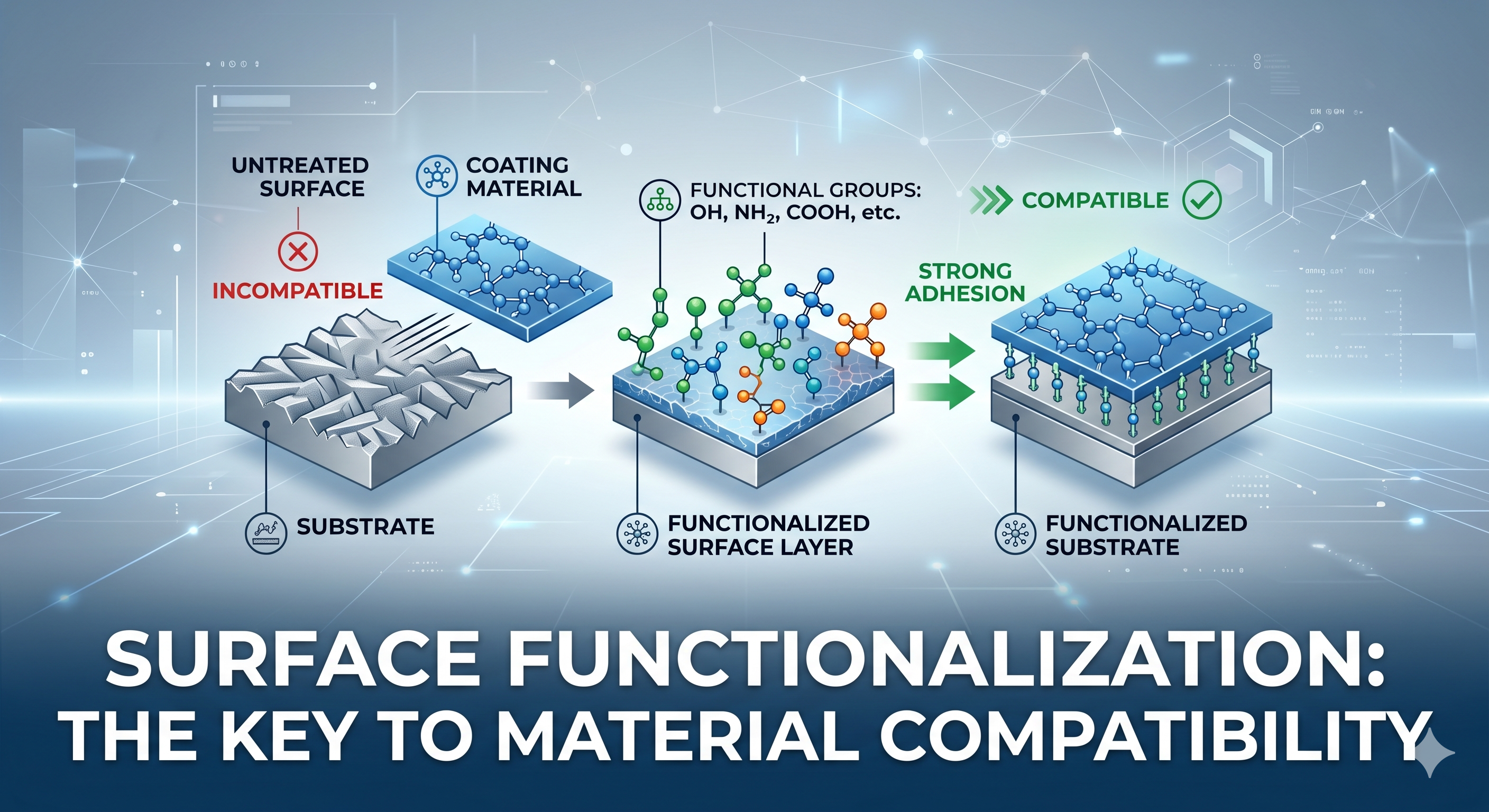
In the world of materials science, what you see on the surface is rarely the whole story. While the internal structure of a material—its “bulk”—determines properties like strength, weight, and conductivity, it is the surface that dictates how that material interacts with the rest of the world. This is the realm of Surface Functionalization. It is the process of intentionally modifying the surface of a material to give it new, specific properties without altering its core characteristics.
Whether we are talking about a carbon nanotube being integrated into a polymer resin or a titanium hip replacement being inserted into a human body, the success of the application depends entirely on the “handshake” between the material and its environment. If the handshake fails, the material fails. Surface functionalization is the invisible bridge that makes this handshake possible.
Beyond the Bulk: Why the Surface is the Key
Imagine trying to glue two pieces of ice together; no matter how strong the ice is, the surface is too slick for the bond to hold. In industrial and medical applications, we often face similar problems. Many advanced materials, such as graphene or certain high-strength ceramics, are “inert.” This means they don’t naturally want to bond with other substances.
Surface functionalization changes the “identity” of the surface. By adding specific chemical groups—like hydroxyl, carboxyl, or amino groups—we can transform a hydrophobic (water-repelling) surface into a hydrophilic (water-loving) one, or an inert powder into a highly reactive catalyst.
The Problem of Phase Separation
In composites, if the filler (like carbon fiber or nanoparticles) isn’t compatible with the matrix (the resin), they will separate. This is known as phase separation. It creates structural weaknesses and voids. Functionalization acts as a chemical “anchor,” ensuring that the filler and the matrix are chemically welded together at the molecular level.
The Mechanics of Modification: How We Change Surfaces
There are three primary ways to achieve functionalization, each suited for different materials and end-goals.
1. Covalent Functionalization (Chemical Welding)
This is the most stable form of modification. It involves creating a direct chemical bond between the surface and the functional group. For example, treating carbon nanotubes with strong acids can create carboxylic acid groups on their walls. These groups then act as docking stations for other molecules.
-
Pros: Highly stable and durable.
-
Cons: Can sometimes damage the structural integrity of the material (e.g., breaking the “honeycomb” lattice of graphene).
2. Non-Covalent Functionalization (The Wrap-Around)
Instead of a permanent bond, this method uses physical forces like Van der Waals interactions or Pi-stacking. Imagine wrapping a string tightly around a pole. The string (the functional molecule) stays in place because of the physical interaction, not a chemical bond.
-
Pros: Preserves the original properties of the material perfectly.
-
Cons: The modification can be “washed off” or displaced over time.
3. Plasma and Radiation Treatment
By bombarding a surface with plasma or high-energy radiation, we can create “radical” sites—tiny, highly reactive spots that naturally grab onto molecules in the surrounding atmosphere. This is widely used in the automotive and aerospace industries to prepare plastics for painting or bonding.
The Nano-Bridge: Functionalizing Advanced Materials
In the current industrial landscape of 2026, the demand for “smart” materials has made functionalization a non-negotiable step in manufacturing.
Graphene and Carbon Nanotubes
Graphene is the strongest material known to man, but in its raw state, it is notoriously difficult to disperse in liquids. It tends to “re-stack” into graphite. Surface functionalization allows us to attach “spacer” molecules that keep the graphene sheets apart, allowing them to be seamlessly integrated into everything from conductive inks to high-performance concrete.
Industrial Powders: Tungsten and Boron Carbides
Specialized powders used in high-wear environments often require functionalization to improve their “wettability.” If a powder is perfectly wetted by a molten metal or a resin, the resulting composite is significantly harder and more resistant to thermal shock. Recent research shows that even a single molecular layer of a functional agent can increase the fracture toughness of these materials by up to 30%.
Current Research Frontiers (2025–2026)
The last two years have seen a surge in “Dynamic Surface Functionalization.” This involves surfaces that can change their properties in response to external stimuli.
-
Stimuli-Responsive Surfaces: Researchers have developed polymer coatings that are hydrophobic at room temperature but become hydrophilic when heated. This has massive implications for self-cleaning windows and “smart” fluid filters that can open or close based on temperature.
-
Click Chemistry in Material Science: The Nobel-winning concept of “Click Chemistry”—creating complex molecules as easily as snapping Lego bricks together—is now being used to functionalize surfaces. This allows for incredibly precise “tailoring” of a surface, where scientists can choose exactly which molecules to attach with nearly 100% efficiency.
-
Molecular Layer Deposition (MLD): Similar to its predecessor (Atomic Layer Deposition), MLD allows for the growth of organic thin films one layer at a time. This is being used to create ultra-thin, flexible barriers for the next generation of wearable electronics and foldable smartphones.
Clinical Impact: From Implants to Targeted Therapy
In the medical field, surface functionalization is quite literally a matter of life and death. When a foreign object enters the body, the immune system’s first reaction is to attack it.
Biocompatible Implants
Titanium is the standard for implants, but it doesn’t always bond perfectly with bone. Clinical studies in 2025 have demonstrated that functionalizing titanium with BMP-2 (Bone Morphogenetic Protein) significantly accelerates bone growth. The protein “tricks” the body into seeing the metal as actual bone, leading to faster recovery times for dental and orthopedic patients.
Targeted Drug Delivery
This is perhaps the most exciting application. Nanoparticles are functionalized with “ligands”—molecules that act like keys. These keys only fit into the “locks” (receptors) found on the surface of cancer cells.
-
Clinical Success: Recent trials for “functionalized lipid nanoparticles” have shown that chemotherapy can be delivered directly to a tumor, sparing healthy cells and virtually eliminating the devastating side effects of traditional treatment.
The Advantage-Risk Assessment
As with any powerful technology, surface functionalization requires a careful balance.
| The Advantages | The Risks & Challenges |
| Compatibility: Allows for the mixing of “un-mixable” materials. | Leaching: Over time, functional groups can detach and enter the environment or the body. |
| Performance: Dramatic increases in strength, conductivity, and durability. | Cost: Specialized chemical treatments and plasma systems are expensive to scale. |
| Precision: Control over materials at the atomic and molecular level. | Complexity: One small error in the functionalization process can lead to total material failure. |
| Longevity: Protects surfaces from corrosion, UV damage, and wear. | Regulatory Hurdles: Functionalized medical devices face much stricter FDA/EMA scrutiny. |
Strategic Implementation in Manufacturing
For business owners and industry professionals, functionalization is a strategic tool for product differentiation. A standard industrial chemical becomes a premium “high-performance” solution once it has been functionalized for a specific niche.
However, the “Stability vs. Functionality” trade-off must be managed. A highly reactive surface is great for bonding but might be unstable during long-term storage. Developing stabilized functionalized intermediates—materials that remain “dormant” until they are activated during the final manufacturing step—is currently a major trend in global supply chains.
Conclusion: The Future of “Smart” Interfaces
We are moving away from a world of “static” materials and toward a world of “responsive” ones. Surface functionalization is the primary driver of this shift. As we continue to refine our ability to manipulate the first few layers of atoms on a material’s surface, we will see the emergence of surfaces that can heal themselves, repel all known bacteria, or generate electricity from the friction of the air.
The invisible bridge is becoming more sophisticated every day. For those working in nanotechnology and advanced materials, mastering the surface is no longer just an option—it is the only way to stay competitive in an increasingly complex material world.