Recently added item(s)
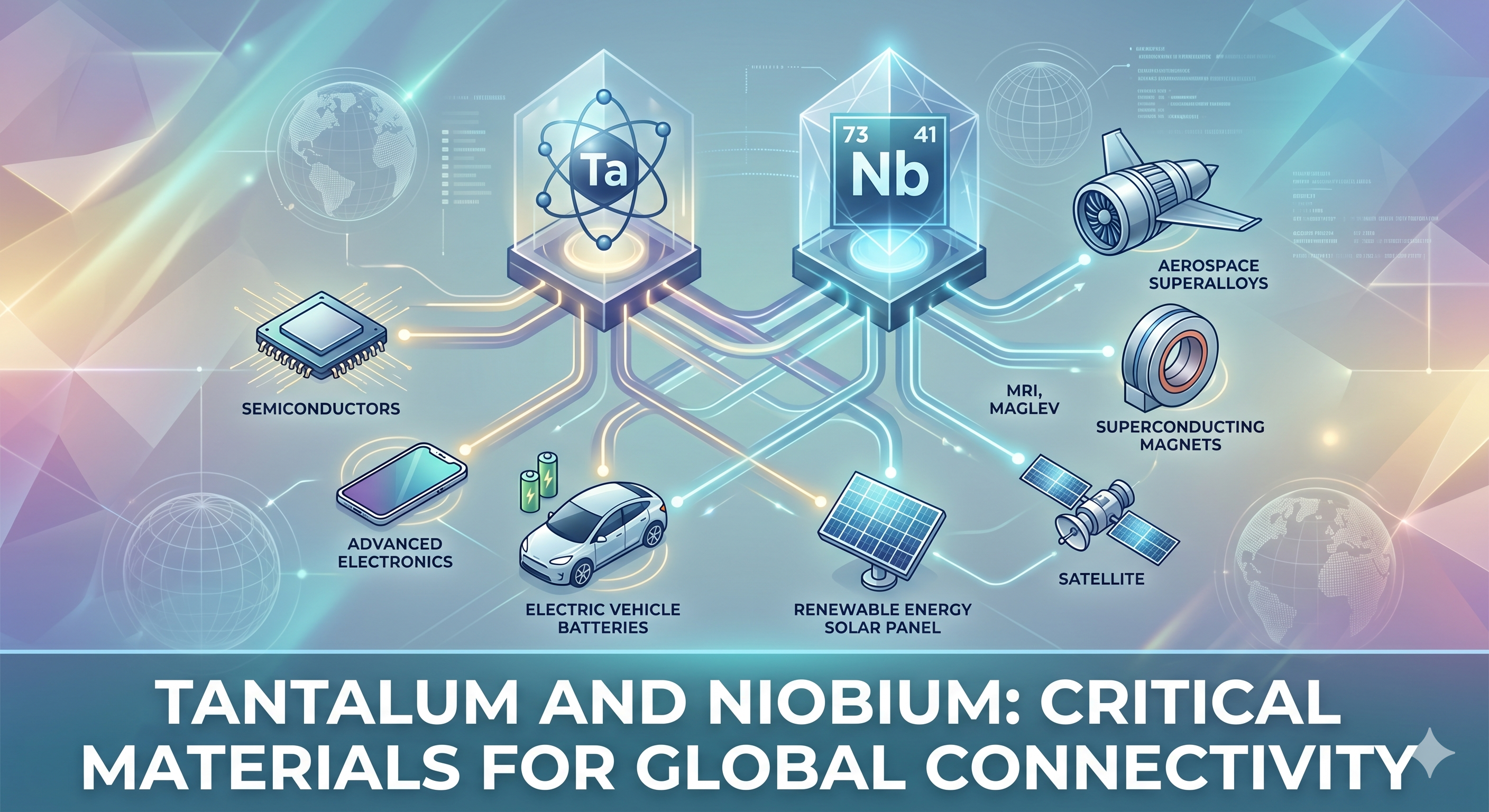
In the high-speed race toward a fully connected global society, the heroes are often invisible. While we marvel at the sleek designs of our smartphones, the speed of 5G networks, and the burgeoning power of quantum computers, the foundation of this progress rests on two “chemical twins” from the periodic table: Tantalum (Ta) and Niobium (Nb).
As we move through 2026, these materials have transcended their status as mere “industrial additives” to become strategic assets of national security and technological sovereignty. For specialists in advanced materials and nanotechnology, understanding these elements is no longer optional—it is the key to unlocking the next decade of innovation.
The Molecular “Twins”: Why Tantalum and Niobium?
Tantalum and Niobium are transition metals that sit adjacent to each other in the periodic table. They share almost identical atomic radii and similar chemical behaviors, which often makes them difficult to separate in nature—most notably in the ore known as coltan (columbite-tantalite).
However, their differences are what make them indispensable:
-
Tantalum is characterized by its extraordinary corrosion resistance (comparable to glass) and its ability to form an extremely thin, stable oxide layer. This makes it the world champion of capacitance.
-
Niobium is lighter, more abundant, and becomes a superconductor at temperatures near absolute zero. It is also a critical alloying agent that creates “super-steels” capable of withstanding the searing heat of jet turbines.
Tantalum: The Heart of Miniaturized Electronics
The primary driver for the Tantalum market, which is projected to reach nearly $9 billion by 2036, is the electronics industry. Specifically, the demand for tantalum capacitors is skyrocketing due to three main factors: 5G expansion, the AI hardware boom, and automotive electrification.
1. The 5G and 6G Revolution
In the world of telecommunications, signal clarity is everything. Tantalum capacitors are used in 5G base stations and smartphones because they offer high reliability and high volumetric efficiency. They can store a massive amount of charge in a tiny footprint, which is essential for the miniaturization of mobile devices. As research into 6G begins to gain momentum in 2026, the need for even higher frequency stability and lower ESR (Equivalent Series Resistance) is pushing Tantalum to its physical limits.
2. AI and Data Centers
The “AI Room” of the future requires massive computing power. High-end servers used for training Large Language Models (LLMs) generate significant heat and require stable power delivery. Tantalum capacitors, known for their thermal stability and long-term durability, are the preferred choice for these mission-critical environments where a single hardware failure could lead to hours of downtime.
3. Electric Vehicles (EVs)
Modern EVs are essentially computers on wheels. From the Battery Management System (BMS) to the Advanced Driver Assistance Systems (ADAS), the electrical architecture requires components that can withstand vibrations and temperature fluctuations. Tantalum’s chemical inertness ensures that these capacitors do not degrade over the 15-to-20-year lifespan of a vehicle.
Niobium: Powering the Quantum and Infrastructure Leap
While Tantalum dominates the “tiny” world of capacitors, Niobium is the king of “big” tech and “cold” tech.
1. Superconductivity and Quantum Computing
Perhaps the most exciting research update in 2025 and 2026 involves Niobium’s role in Quantum Computing. Recent studies from institutions like the University of Glasgow have highlighted Niobium-based superconducting circuits as a superior alternative to aluminum.
Niobium circuits can operate more reliably at faster clock rates and are less sensitive to external noise. In 2025, researchers successfully developed niobium-based 3D interconnects, which allow for higher qubit density on quantum chips. This is a “holy grail” for scaling quantum computers from experimental toys to industrial-grade problem solvers.
2. Aerospace and Hypersonic Flight
Niobium is a key component in nickel-based superalloys. In the aerospace sector, these alloys are used in the hot sections of jet engines. With the recent global focus on hypersonic technology (flight exceeding Mach 5), Niobium is being researched for its ability to maintain structural integrity at temperatures that would melt standard aerospace grade titanium.
Clinical Breakthroughs: The Bio-Compatible Frontier
One of the most profound shifts in recent years is the move of Tantalum and Niobium from the “gadget” world into the human body. Both metals are highly biocompatible, meaning the body does not recognize them as foreign threats.
Tantalum in Orthopedics (2026 Research)
A landmark study published in early 2026 explored Titanium-Tantalum (Ti-Ta) lattice implants. Using 3D printing (additive manufacturing), researchers created porous scaffolds that mimic the mechanical properties of human bone. Unlike traditional stainless steel or pure titanium implants, these Ti-Ta alloys prevent “stress shielding”—a phenomenon where the implant is too strong, causing the surrounding natural bone to weaken. The Tantalum component promotes rapid osteointegration, allowing bone cells to grow directly into the metal structure.
Niobium in Bioactive Ceramics
Research published in 2025 on Potassium Tantalum Niobate (KTN) ceramics has shown promise in “bioelectrets”—materials that can maintain a permanent electric charge. These scaffolds can be used to stimulate bone healing via tiny electrical signals, mimicking the natural piezoelectric effect of bone. This represents a fusion of electronics and biology that could revolutionize recovery times for complex fractures.
Advantage vs. Risk Assessment
Every critical material comes with a double-edged sword. To understand the role of Ta and Nb, we must evaluate the trade-offs between their technological brilliance and their socio-economic costs.
The Advantages
-
Efficiency: No other materials provide the same capacitance-to-volume ratio as Tantalum or the same accessible superconductivity as Niobium.
-
Durability: Their resistance to corrosion and heat ensures that modern infrastructure—from satellites to subsea cables—lasts for decades.
-
Biocompatibility: They are the gold standard for long-term medical implants, reducing the need for revision surgeries.
The Risks
-
Supply Chain Concentration: Nearly 70% of the world’s Niobium comes from a single country (Brazil), and a large portion of Tantalum is sourced from the Democratic Republic of Congo (DRC). In 2026, geopolitical tensions and regional conflicts (such as M23 control over key mining regions) have made the supply chain highly volatile.
-
Conflict Minerals (Coltan): Tantalum mining has historically been linked to human rights abuses and environmental degradation. While “Conflict-Free” certification programs exist, the “gray market” remains a significant challenge for ethical sourcing.
-
Environmental Impact: Mining these minerals is energy-intensive and can lead to habitat destruction. However, the development of phytomining (using plants to extract metals from soil) and improved recycling techniques for electronics are current research priorities to mitigate this risk.
The Strategic Outlook: Recycling and Reserves
As of early 2026, global powers have begun treating these materials with the same urgency as oil or grain. The United States recently announced a $12 billion critical mineral reserve to buffer against supply shocks.
For the industry, the “Holy Grail” is Circular Economy Integration. Currently, less than 1% of Tantalum in end-of-life electronics is recycled due to the difficulty of extracting tiny capacitors from complex circuit boards. However, new hydrometallurgical techniques and AI-driven robotic sorting are showing promise in making “urban mining” more profitable than traditional mining by 2030.
Conclusion
Tantalum and Niobium are the silent conductors of our digital symphony. They allow us to communicate instantly across continents, they enable surgeons to rebuild human frames, and they provide the “cold” pathways for the quantum computers that will solve the climate and energy crises of tomorrow.
For entrepreneurs and scientists like those at Nanokar and Başoğlu Kimya, the challenge lies in the sustainability of innovation. By advancing the science of 2D materials, nano-powders, and ethical sourcing, we ensure that global connectivity remains a bridge to the future, rather than a drain on our planet’s resources.