
Recently added item(s)
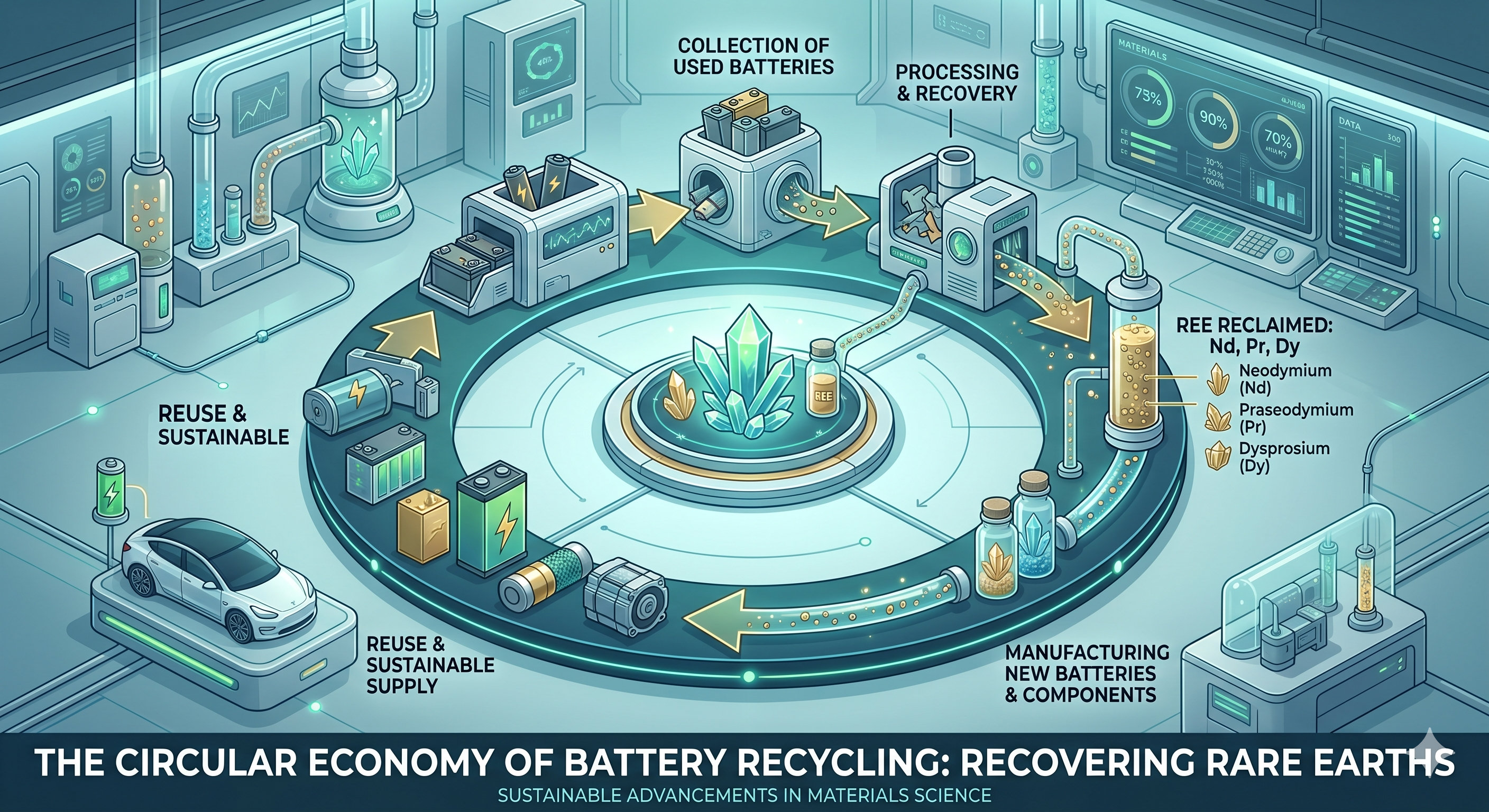
The 21st century is defined by a colossal shift in how humanity consumes energy. As we race to decarbonize the global economy, internal combustion engines are being replaced by Electric Vehicles (EVs), and fossil fuel power plants are giving way to intermittent renewable sources like solar and wind, which require massive stationary storage solutions. At the heart of this transition lies the battery—specifically, high-performance Lithium-ion (Li-ion) batteries and, to a lesser extent, Nickel-Metal Hydride (NiMH) batteries.
This green revolution, however, has a hidden appetite. To build these powerful energy storage devices, we require vast amounts of critical minerals. While Lithium, Cobalt, and Nickel dominate headlines, another group of elements is equally vital yet often overlooked in the recycling conversation: Rare Earth Elements (REEs).
To ensure that the green transition does not result in a new environmental crisis, we must shift from a linear “take-make-dispose” economy to a Circular Economy. This approach focuses on closing the loop, ensuring that materials from end-of-life batteries are recovered and reintroduced into the production cycle, reducing the need for virgin mining.
The ‘Rare’ in Rare Earths: Why They Matter
Rare Earth Elements are a group of 17 chemical elements in the periodic table, specifically the 15 lanthanides plus scandium and yttrium. Despite their name, they are relatively abundant in the Earth’s crust. However, they are rarely found in concentrated, economically exploitable ore deposits, and extracting them is a technologically complex and environmentally demanding process.
In the context of batteries and the broader EV ecosystem, REEs are indispensable:
-
NiMH Batteries: While Li-ion is king for pure EVs, NiMH batteries are still used in many hybrid vehicles. The anode of a NiMH battery consists of a metal hydride alloy that contains substantial amounts of REEs, such as Lanthanum (La), Cerium (Ce), Neodymium (Nd), and Praseodymium (Pr). In fact, REEs can make up nearly 30% of the anode material in these batteries.
-
Electric Motors: Crucially, while not inside the battery itself, REEs are essential for the application of battery power in EVs. High-performance permanent magnets used in EV traction motors rely heavily on Neodymium (Nd), Praseodymium (Pr), Dysprosium (Dy), and Terbium (Tb) to achieve high torque and efficiency in a compact size. A circular economy for batteries must look at the whole system, including the motors they power.
The Environmental and Geopolitical Imperative for Recycling
Currently, the primary supply chain for REEs is fraught with risk. Mining and processing these elements involve crushing immense amounts of rock, followed by complex chemical separation processes using acids and solvents. This generates significant volumes of toxic chemical waste and, frequently, radioactive byproducts (such as thorium and uranium) found in the same ore.
Furthermore, REE supply is geographically concentrated, posing significant geopolitical risks. Securing a local, sustainable supply of these materials through recycling is not just an environmental preference; it is becoming a matter of national and economic security for many regions.
Techniques for Recovery: The Science Behind Closings the Loop
Recovering REEs from batteries, particularly NiMH types, is a scientifically complex endeavor. The materials are often intricately bonded at the microscopic level within the battery structure. Current research and industrial practices focus on several primary methods:
1. Pyrometallurgy (Smelting)
This is a traditional technique where batteries are fed into high-temperature furnaces. The metals are melted down, and different elements separate based on density and chemical properties.
-
The REE Problem: While effective for recovering Cobalt and Nickel from Li-ion batteries, pyrometallurgy is highly inefficient for REEs. In the intense heat, REEs hold a strong affinity for oxygen and usually end up trapped in the slag (waste byproduct) in an oxidized form that is difficult and costly to process further.
2. Hydrometallurgy (Chemical Leaching)
This process utilizes aqueous chemistry to dissolve the battery components and selectively precipitate out specific metals. It is generally considered more energy-efficient and precise than smelting for complex materials.
-
Process: After mechanically shredding the batteries to create “black mass,” strong acids (like sulfuric or hydrochloric acid) are used to dissolve the metals. Researchers then use solvent extraction or ion exchange methods to separate the specific REEs (Nd, Pr, La, Ce) from the resulting “pregnant leach solution.”
-
Innovations: Current scientific focus is on developing less harsh, more selective solvents, such as ionic liquids, to improve efficiency and reduce secondary pollution.
3. Direct Recycling (Non-Destructive)
The theoretical “holy grail” of recycling involves separating components without breaking down their chemical structure, allowing materials to be refurbished and reused directly in new batteries. While this shows promise for cathode materials in Li-ion batteries, it is still in the early, mostly lab-based stages for NiMH REE components due to the degradation mechanisms within the battery over time.
Industrial “Clinical” Trials and Real-World Field Studies
While the term “clinical trials” belongs to medicine, the engineering equivalent involves pilot plants and industrial-scale demonstration projects to prove laboratory concepts in the harsh reality of the supply chain. Today, numerous companies and research institutions are conducting these critical “field studies.”
-
Europe’s Push: Large-scale projects, such as those by Umicore or the EU-funded SUSMAGPRO project, are actively testing hydrometallurgical routes to extract Neodymium and Dysprosium not only from battery scrap but also from end-of-life permanent magnets found in electronics and automotive motors. They are testing the purity of the recycled material to ensure it meets the rigorous standards required for new manufacturing.
-
North American Initiatives: Companies like Redwood Materials and Li-Cycle, while primarily focused on the Lithium and Cobalt in Li-ion batteries, are expanding their research into holistic recycling profiles. They are conducting feasibility studies on recovering REEs from the motors of the EVs they process, recognizing that a truly circular automotive economy requires capturing both battery metals and magnet metals.
-
Efficiency and Purity Studies: Current industrial pilots are reporting recovery rates for REEs from NiMH scrap exceeding 85%, with some methods achieving magnet-grade purity of over 99%. These trials are essential for proving that recycled REEs can perform identically to virgin mined materials.
Advantage–Risk Assessment: A Balanced View
Implementing a circular economy for battery and REE recycling presents a classic technological and economic balancing act.
Advantages
-
Environmental Protection: Effective recycling dramatically reduces the demand for virgin mining, sparing ecosystems from the landscape destruction and toxic/radioactive waste associated with primary REE extraction.
-
Reduced Carbon Footprint: Generally, hydrometallurgical recovery of REEs from concentrated scrap requires significantly less energy than extracting the same amount from low-grade ores, leading to lower overall carbon emissions for the green transition.
-
Supply Chain Security: Developing a robust domestic recycling industry creates a secondary, stable source of critical minerals, insulating economies from geopolitical tensions and trade restrictions.
-
Economic Opportunity: The creation of a recycling infrastructure spawns a new industrial sector focused on material collection, logistics, and advanced chemical processing, creating “green” jobs.
Risks and Challenges
-
Economic Viability: Currently, recycling REEs can be more expensive than mining them, especially when virgin material prices are low. The technology is capital-intensive, and the processes are complex.
-
Chemical Use in Recovery: While hydrometallurgy prevents mining waste, it requires large quantities of strong acids and organic solvents. If not managed within a strictly controlled closed-loop system, these chemicals pose their own risks to human health and the environment.
-
Logistical Nightmare: Batteries are hazardous to transport (risk of fire). Establishing a safe, efficient system to collect millions of degraded batteries from vehicles and devices spread across continents is a monumental logistical and regulatory challenge.
-
Technological Obsolescence: If battery chemistry shifts drastically away from metals that are currently valuable (e.g., if a new, REE-free battery type dominates the market), expensive recycling infrastructures built today could become obsolete.
Conclusion: The Road Ahead
The circular economy of battery recycling, specifically the recovery of Rare Earth Elements, is not a luxury; it is a fundamental necessity for a sustainable future. Our current reliance on linear consumption is incompatible with a planet of finite resources.
Science has proven that we can recover these vital elements with high efficiency and purity. The challenge now is to bridge the gap from pilot plants to full-scale industrial integration. This requires a concerted effort from scientists to innovate cleaner recovery methods, from policymakers to create supportive regulations and incentives for using recycled content, and from manufacturers to design products with their entire lifecycle—including disassembly and recycling—in mind.
By mastering urban mining and closing the material loop, we can ensure that the vehicles of tomorrow are truly green, powered not just by renewable electricity, but by a responsibly managed, circular resource system.