
Recently added item(s)
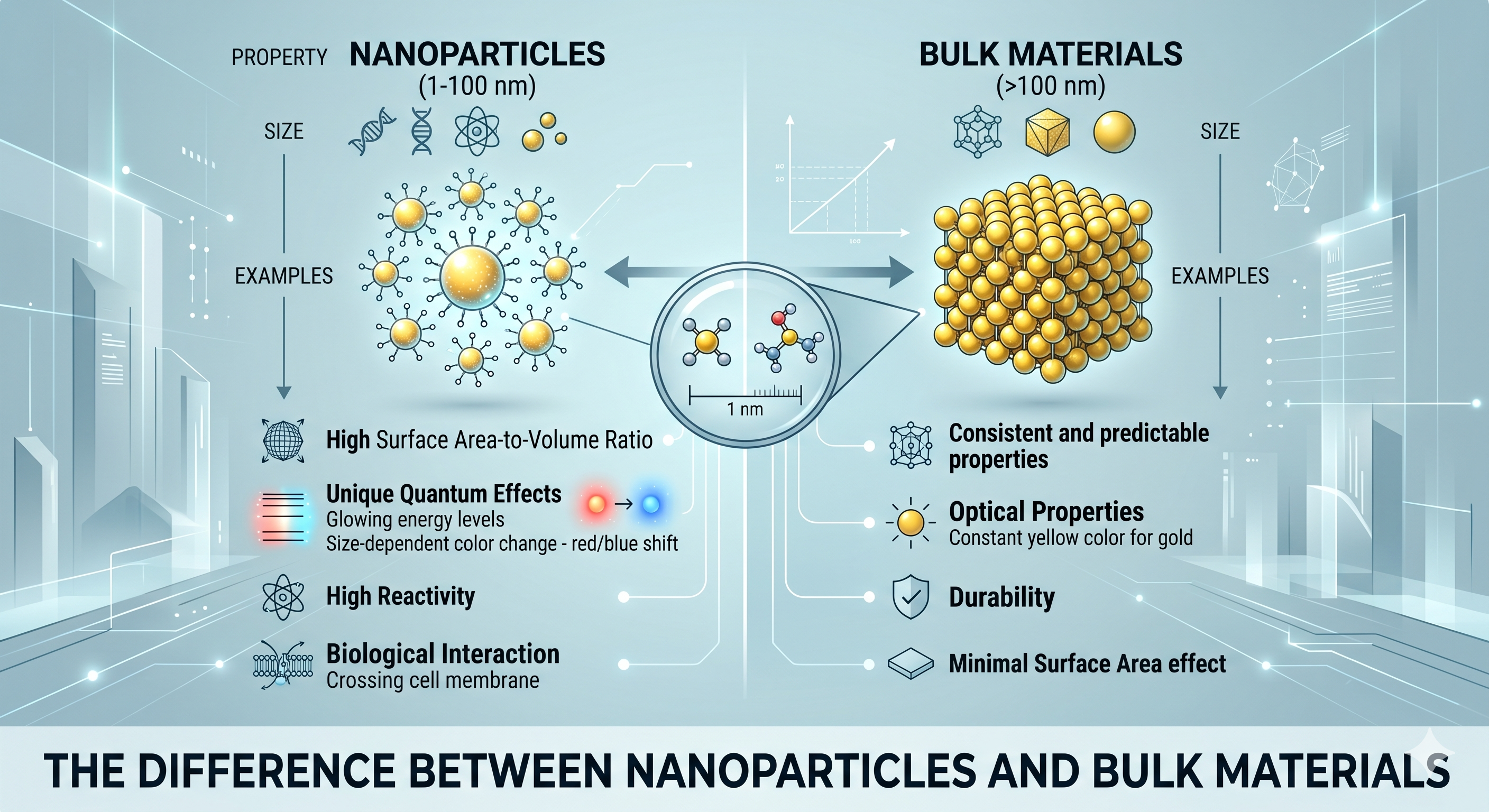
Imagine a ring made of pure gold. It shines with a familiar yellow luster, it doesn’t rust, and it conducts electricity well. This is bulk gold. Now, imagine taking that same gold and chopping it down until the particles are so small that thousands of them could fit across the width of a single human hair. This is nanogold.
Surprisingly, if you were to look at a solution containing these tiny gold particles, they wouldn’t look yellow. Depending on their exact size, they might appear ruby red, purple, or even blue.
This dramatic shift in color highlights the central theme of nanotechnology: when materials are reduced to the nanoscale, their properties change fundamentally. They are no longer governed solely by the classic laws of physics we experience daily; instead, they begin to dance to the tune of quantum mechanics.
This blog post will explore the fascinating scientific distinctions between nanoparticles and bulk materials, delve into cutting-edge research and clinical applications, and provide a balanced assessment of the advantages and risks this “small” revolution brings to our world.
Defining the Scale: How Small is “Nano”?
To appreciate the difference, we must first understand the scale. A nanometer (nm) is one-billionth of a meter ($10^{-9}$ meters).
To put this in perspective:
-
A sheet of paper is about 100,000 nm thick.
-
A strand of human DNA is about 2.5 nm wide.
-
A single gold atom is roughly 0.3 nm in diameter.
Nanoparticles are generally defined as materials where at least one dimension falls within the range of 1 to 100 nanometers.
Bulk materials, on the other hand, are macroscopic materials. Their dimensions are large enough—typically micrometers ($10^{-6}$ m) or millimeters ($10^{-3}$ m) and above—that their properties are consistent throughout the sample and are independent of their size.
The boundary between “nano” and “bulk” isn’t always sharp, but within this 1–100 nm range, properties begin to deviate significantly from the material’s bulk counterpart.
The Root Causes: Why Properties Change at the Nanoscale
The dramatic shift in behavior at the nanoscale isn’t magic; it’s rooted in two primary physical phenomena.
1. Exponential Increase in Surface Area-to-Volume Ratio
This is the most straightforward factor. As you break a bulk material into smaller pieces, the total surface area increases, while the total volume remains the same.
Think of cutting a cube. Every cut exposes new surfaces. When you reach the nanoscale, the surface area becomes enormous compared to the volume of the material.
Why does this matter? Atoms at the surface of a material are different from atoms in the interior. Interior atoms are surrounded by neighbors, forming stable bonds in all directions. Surface atoms, however, have “dangling bonds”—they are missing neighbors on one side. This makes them highly reactive, eager to bond with other molecules.
In bulk materials, surface atoms are a negligible fraction of the total. In nanoparticles, surface atoms can make up a significant percentage (sometimes over 50%) of the entire particle. Consequently, nanoparticles are far more chemically reactive and catalytic than bulk materials.
2. Quantum Confinement Effects
This is where the classic laws of physics break down. In bulk materials, electrons are relatively free to move within energy bands, allowing the material to conduct electricity or absorb light in predictable ways.
As the size of the material shrinks to the nanoscale, the space available for these electrons becomes constrained. They are “confined” within the tiny dimensions of the nanoparticle. This confinement alters their energy levels, much like a guitar string produces a higher pitch when shortened.
Why does this matter? Changing electron energy levels directly dictates a material’s optical, electrical, and magnetic properties.
-
Optical: The changing color of gold nanoparticles is a quantum confinement effect (specifically, Surface Plasmon Resonance). It also explains why bulk Titanium Dioxide is the white pigment in paint, while nano-Titanium Dioxide is transparent and used in clear sunscreens—it absorbs UV light but allows visible light to pass through.
-
Electrical: Materials that are insulators in bulk form can become conductors at the nanoscale, and vice versa.
A Comparison Table: Bulk vs. Nanoparticles
| Property | Bulk Materials (>100 nm) | Nanoparticles (1–100 nm) | Scientific Cause |
| Surface Area:Volume | Low | Extremely High | Geometric scaling. |
| Chemical Reactivity | Low to Moderate (Inert for some) | Very High (Highly reactive/catalytic) | Large fraction of surface atoms with dangling bonds. |
| Optical Properties | Consistent luster/color (e.g., gold is yellow) | Size-dependent color/transparency (e.g., gold is red/blue) | Quantum confinement; Surface Plasmon Resonance. |
| Melting Point | Consistent (e.g., gold melts at 1064°C) | Lowered melting point (e.g., 2nm gold melts at ~300°C) | Surface atoms are less tightly bound and melt easier. |
| Electrical Conductivity | Follows classical laws (conductors or insulators) | Size-dependent; can shift (insulators become conductors) | Quantum confinement alters electron energy bands. |
| Interaction with Biology | Generally treated as a foreign body at the macroscopic level | Can penetrate cells, cross barriers (like Blood-Brain Barrier) | Size compatibility with biological molecules/structures. |
Current Research Breakthroughs (2024–2026)
Nanotechnology isn’t a speculative field; it’s driving active, transformative research across multiple disciplines. Recent studies have highlighted novel applications that would be impossible with bulk materials.
1. Medicine: Smart Drug Delivery and Theranostics
Traditional chemotherapy involves flooding the body with toxic drugs, hoping enough reaches the tumor to kill it before the patient is severely harmed.
Nanoparticles offer a surgical strike approach. “Smart” nanoparticles can be loaded with drugs and engineered to:
-
Circulate longer: Avoiding detection by the immune system.
-
Target tumor cells: By attaching “homing molecules” that only bind to receptors unique to cancer cells.
-
Release on command: Dumping their payload only when they encounter the acidic environment of a tumor or when triggered by external light or heat.
A burgeoning field is theranostics, where a single nanoparticle acts as both a diagnostic tool (imaging agent) and a therapeutic agent (drug carrier). Recent trials have used iron oxide nanoparticles for enhanced MRI contrast while simultaneously delivering targeted cancer drugs.
2. Energy: Next-Generation Batteries and Solar Cells
The demand for faster-charging, higher-capacity batteries is insatiable. The challenge with traditional electrodes (like bulk graphite) is that they expand and contract significantly during charging, eventually cracking and failing.
Researchers are replacing bulk materials with nanostructured materials (like carbon nanotubes or silicon nanowires). These nanomaterials have:
-
Higher surface area: Allowing for faster electrochemical reactions (faster charging).
-
Mechanical flexibility: They can withstand expansion and contraction without cracking.
In solar energy, quantum dots (tiny semiconductor nanoparticles) are being used to create flexible, highly efficient solar cells. Because their absorption spectrum is size-dependent, scientists can tune them to absorb different parts of the solar spectrum, capturing more energy than traditional silicon panels.
Clinical Trials and Real-World Examples in Medicine
The most rigorous validation of any technology lies in human clinical trials. Nanomedicine has successfully transitioned from the lab bench to clinic in several key areas.
1. Approved Nanomedicines (Real-World Examples)
-
Abraxane (Protein-bound Paclitaxel): Paclitaxel is a powerful but poorly soluble chemotherapy drug. Traditional formulations require toxic solvents that cause severe side effects. Abraxane bonds the drug to nano-sized albumin proteins (natural carriers). This improves solubility, allowing for higher, safer doses, and takes advantage of a tumor’s natural tendency to absorb albumin, leading to targeted accumulation.
-
Doxil (Liposomal Doxorubicin): This is one of the earliest successful nanomedicines. It encapsulates the chemotherapy drug doxorubicin within a liposome—a nano-sized fatty bubble. This bubble protects the heart and kidneys from the drug’s severe toxicity. Because tumors often have leaky blood vessels, the tiny liposomes can seep through and accumulate specifically in the tumor, leading to better outcomes.
2. Recent Clinical Focus (2025–2026)
Current trials are pushing the boundaries toward active targeting and combinatorial therapies.
-
mRNA Vaccines (Lipid Nanoparticles): The most famous global example of nanotech is the COVID-19 mRNA vaccines (Pfizer/BioNTech, Moderna). These vaccines use lipid nanoparticles (LNPs) to protect the fragile mRNA molecule and deliver it into cells. Without this nanotech carrier, the mRNA would be destroyed instantly in the body.
-
Targeted Immunotherapy Trials: Ongoing phase I/II trials are testing nanoparticles engineered to deliver immunostimulatory drugs directly to the tumor microenvironment, actively “re-awakening” the patient’s immune system to fight the cancer.
Advantages–Risks Assessment: Balancing the Scale
The unique properties of nanoparticles provide unprecedented advantages, but these same properties can introduce unique risks.
Advantages: The Transformative Potential
-
Targeted Precision: In medicine, agriculture, and manufacturing, nanotech allows for intervention at the molecular level, maximizing efficacy while minimizing waste and side effects.
-
Enhanced Performance: Materials become stronger, lighter, more reactive, or more efficient, revolutionizing energy storage, computing, and aerospace.
-
Novel Functionality: Nanotech enables the creation of “smart” materials that can respond to light, heat, or pH, such as self-healing coatings or adaptive drug release systems.
Risks: The Challenge of Toxicology and Environment
-
Novel Toxicity (Nanotoxicology): A chemical that is harmless in bulk form may become toxic at the nanoscale. Their small size allows them to enter cells, cross the blood-brain barrier, or interact with DNA in ways that we are still trying to understand.
-
Environmental Persistence and Bioaccumulation: Because nanoparticles are so stable and reactive, if released into the environment, they could accumulate in organisms or enter the food chain, with unknown long-term consequences. Standard filtration systems may not capture them.
-
Regulatory Lag: Traditional environmental and safety regulations are often based on the chemistry of bulk materials. Applying these same regulations to nanoparticles—which act differently—may not be sufficient to protect public health and the environment.
Conclusion: A World Re-engineered from the Bottom Up
The world of bulk materials is consistent and predictable. The world of nanoparticles is dynamic, customizable, and governed by a different set of physical laws. The key difference isn’t just about size; it’s about the fundamental shift in physical, chemical, and biological properties that occurs within the 1–100 nm range.
This shift allows us to re-engineer medicine, energy, and electronics from the bottom up, atom by atom. But this incredible potential is matched by a need for caution. We must proceed with rigorous scientific investigation into the toxicology and environmental impact of nanomaterials to ensure that this small revolution brings only large benefits to humanity.