
Recently added item(s)
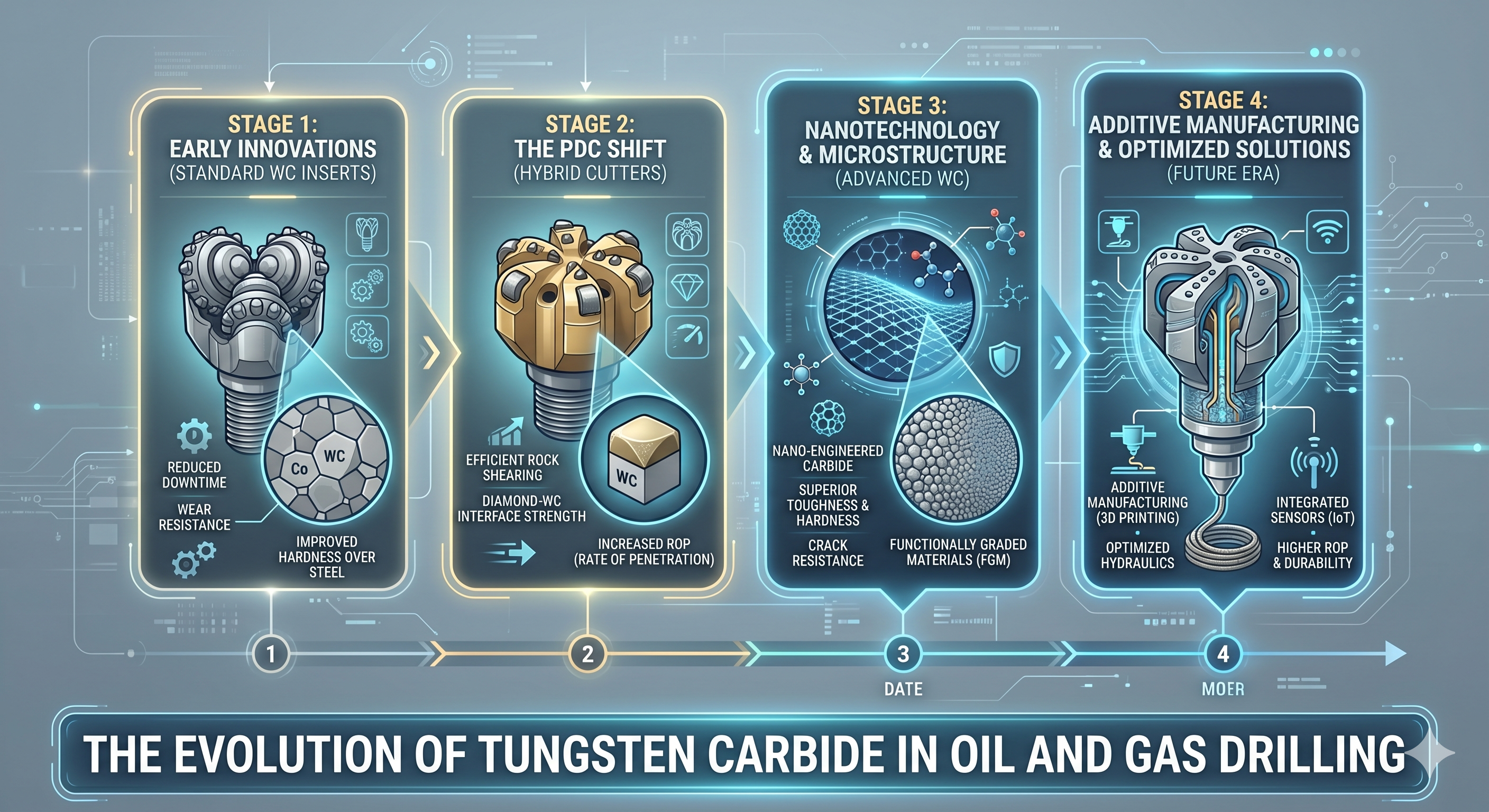
In the high-stakes world of energy exploration, the earth’s crust is often described as a “brick wall” thousands of feet thick. To pierce through miles of granite, sandstone, and abrasive salt domes, the oil and gas industry requires materials that defy the standard laws of wear and tear. For nearly a century, one material has stood as the undisputed heavyweight champion of the drill bit: Tungsten Carbide (WC).
As we navigate the energy landscape of 2026, Tungsten Carbide is undergoing a radical transformation. No longer just a “dumb” heavy metal, it has evolved into a nano-engineered “cermet” (ceramic-metallic composite) that allows us to reach deeper, hotter, and more pressurized reserves than ever before. This article explores the history, the molecular science, the latest field research, and the future of the material that keeps the global energy heart beating.
The Material Alchemy: Why Tungsten Carbide?
To the casual observer, a drill bit looks like a massive piece of steel. However, the “teeth” that do the actual work are almost always made of Tungsten Carbide. But what exactly is it?
Tungsten Carbide is a composite material, often referred to as a cermet. It consists of hard particles of tungsten carbide “cemented” together by a metallic binder, usually Cobalt (Co).
Think of it like a brick wall:
-
The Tungsten Carbide grains are the bricks. They are incredibly hard (nearly as hard as diamond) and provide the resistance to scratching and grinding.
-
The Cobalt binder is the mortar. It is “tough” and flexible, allowing the bricks to absorb the massive impacts of a vibrating drill string without shattering.
By adjusting the ratio of “bricks” to “mortar”—or the size of the bricks themselves—engineers can “tune” the material. More cobalt makes it tougher; less cobalt (and smaller grains) makes it harder. In the oil and gas sector, where a single broken bit can cost hundreds of thousands of dollars in “down-time,” this tuning is an exact science.
Evolutionary Milestones: From Steel to the Carbide Revolution
The journey of the drill bit is a story of overcoming limits.
-
The Steel Era (Pre-1930s): Early drill bits were made of hardened steel. While they worked for shallow wells, they dulled quickly in hard rock, requiring frequent and expensive “trips” (pulling the entire drill string out of the hole to change the bit).
-
The Introduction of WC (1930s – 1970s): When Tungsten Carbide was first introduced, it was a game-changer. It allowed for “roller cone” bits that could grind through rock for days rather than hours.
-
The PDC Hybrid (1980s – 2010s): The industry saw the rise of Polycrystalline Diamond Compact (PDC) cutters. These use a Tungsten Carbide base with a thin layer of man-made diamond on top. The WC provides the structural support, while the diamond provides the cutting edge.
-
The Nano-Engineering Era (2020 – 2026): Today, we are no longer limited to standard grain sizes. We are manipulating WC at the atomic level to create “Functionally Graded Materials” (FGMs).
The Nano-Breakthrough: Small Grains, Big Gains
The most significant shift in recent years—and a core focus of advanced materials companies—is the transition to Nano-Structured Tungsten Carbide.
In traditional WC, grain sizes range from 1 to 5 micrometers. In nano-WC, grains are reduced to less than 100 nanometers. This creates a much higher density of “interfaces” between the carbide and the cobalt.
Why does this matter? According to the Hall-Petch relationship in materials science, reducing grain size increases hardness. Usually, when you make something harder, it becomes more brittle (like glass). However, nano-engineered WC breaks this rule. Because the nano-grains are so tightly packed, they can actually arrest the spread of microscopic cracks, resulting in a material that is both harder and tougher than its predecessors.
Field Validations and “Clinical” Industrial Trials (2025–2026)
In the energy sector, we don’t have “clinical trials” in a medical sense, but we have Field Validation Studies—rigorous, multi-month tests in high-temperature, high-pressure (HTHP) wells.
1. The “Deep Geothermal” Challenge
Recent trials in 2025 focused on using nano-WC bits in ultra-hot geothermal wells in Iceland and the Western United States. Standard bits often fail when temperatures exceed 250°C. However, new “Cobalt-Free” Tungsten Carbide—which uses nickel or high-entropy alloys as the binder—demonstrated the ability to maintain structural integrity at 400°C. These trials proved that WC is not just for oil, but for the future of renewable geothermal energy.
2. Erosion-Resistance in High-Sand Wells
A 2026 research paper published in Petroleum Science analyzed the “erosive wear” of WC-coated valves in the Middle East. High-velocity sand in the fluid stream can “sandblast” through metal in weeks. The study showed that laser-cladded nano-WC coatings increased component lifespan by 400% compared to traditional hard-facing.
3. Additive Manufacturing (3D Printing) of WC
For the first time in 2025, a major service company successfully field-tested a “Binder Jet” 3D-printed drill bit body. Because WC is so difficult to machine, 3D printing allows engineers to create internal cooling channels that were previously impossible. This keeps the bit cool, extending the life of the diamond cutters by 20% in hard-rock formations.
Advantage vs. Risk Assessment
Even a “super-material” like Tungsten Carbide has trade-offs.
The Advantages
-
Extreme Longevity: WC can drill through thousands of feet of rock without needing a replacement, saving millions in operational costs.
-
High Thermal Conductivity: It pulls heat away from the cutting face, protecting the expensive diamond layers above it.
-
Chemical Inertness: It remains stable in the presence of “sour gas” (H2S) and corrosive drilling muds.
-
Compressive Strength: It can withstand the massive “Weight-on-Bit” (WOB) required to crush rock at great depths.
The Risks and Challenges
-
Brittleness Under Impact: While tough, WC can still “chip” if it hits a sudden change in rock hardness (like moving from soft shale into hard chert) if the drill string is not managed carefully.
-
Supply Chain Vulnerability: Tungsten is classified as a “critical mineral.” Over 80% of global production is concentrated in a few regions, making it susceptible to geopolitical shocks.
-
Cobalt Leaching: In very acidic wells, the cobalt binder can “leach” out, leaving the tungsten grains unsupported and leading to a “crumbly” failure.
-
Health Hazards (Manufacturing): Inhaling WC-Cobalt dust during production is linked to “Hard Metal Lung Disease.” This has led to the 2026 push for robotic, “closed-loop” sintering and grinding facilities.
Sustainability and the Circular Economy
In 2026, the oil and gas industry is under pressure to reduce its carbon footprint. Tungsten Carbide is surprisingly “green” in one specific way: Recyclability.
Unlike liquid chemicals or polymers, WC can be recycled almost indefinitely. The “Zinc Process” allows used drill bits to be broken down into their original powders without losing quality. Current industry data suggests that nearly 40% of new Tungsten Carbide drill bits now contain recycled material, reducing the energy-intensive mining process and lowering the “embodied carbon” of the drilling operation.
Conclusion
The evolution of Tungsten Carbide is a testament to human ingenuity. We have taken a heavy, dark mineral from the earth and refined it into a nano-structured marvel that allows us to explore the earth’s deepest secrets. From the classic roller cone bits of the 20th century to the 3D-printed, nano-enhanced cutters of 2026, Tungsten Carbide remains the silent partner in global energy.
For professionals in the field, the message is clear: the future of drilling isn’t just about more power—it’s about more “material intelligence.” By leveraging the science of the small (nanotechnology), we are solving the biggest challenges in the energy sector.