
Recently added item(s)
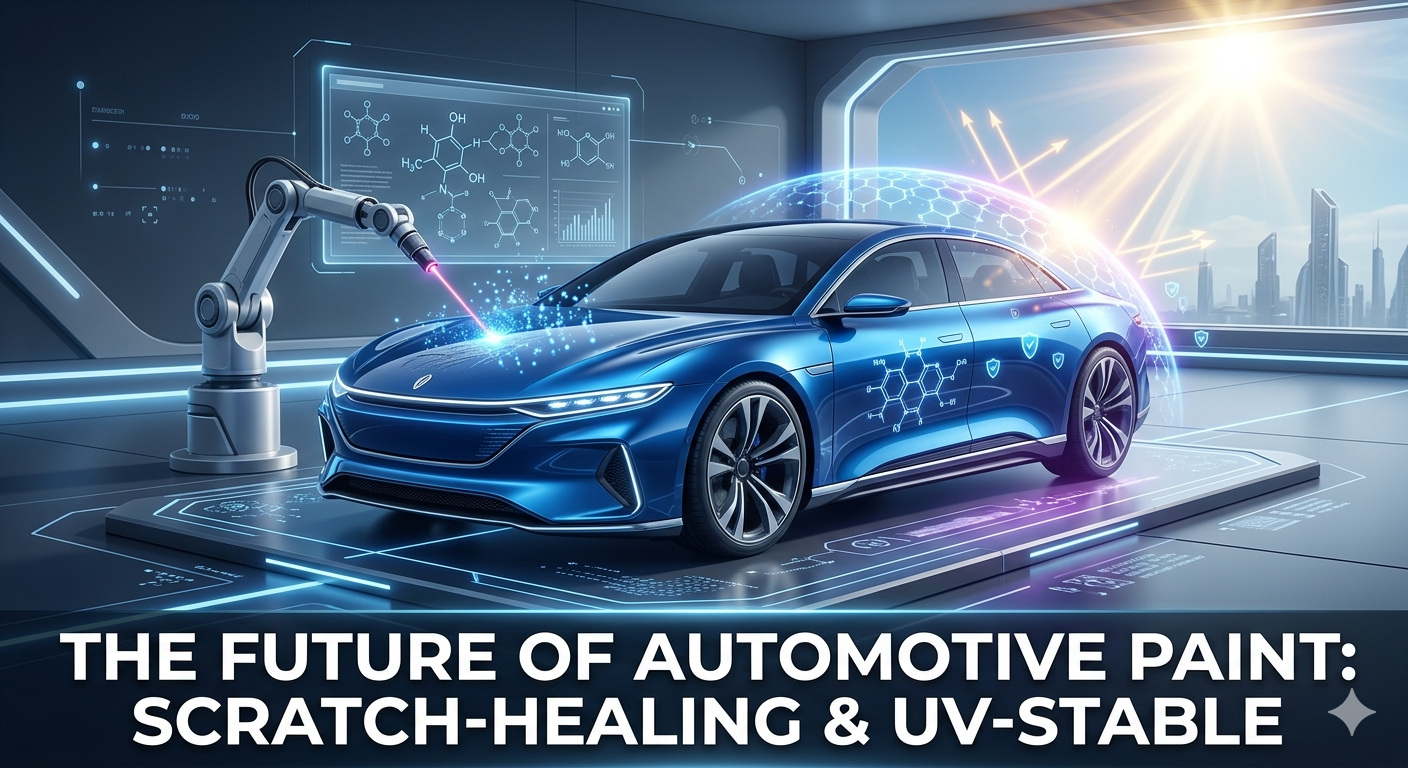
For decades, the gleam of a showroom car has been the ultimate symbol of automotive pride. Yet, that perfection is fleeting. The moment a car leaves the dealership, it enters a hostile world filled with rogue shopping carts, abrasive dust, tree sap, acid rain, and the relentless degradation caused by the sun’s Ultraviolet (UV) radiation. A car owner’s relationship with their paint often shifts from admiration to a stressful battle against wear and tear.
Traditionally, automotive protection meant passive defense—waxing, sealing, or the application of rigid Ceramic Coatings. However, the future of automotive paint is shifting from passive resistance to active resilience. We are on the cusp of widespread adoption of intelligent, “living” coatings that can heal their own injuries and resist sun damage indefinitely. This is the era of scratch-healing and UV-stable automotive paint.
Traditional Automotive Paint: A Finite Shield
To understand the revolution, we must first understand the status quo. Modern automotive paint isn’t a single layer; it is a complex stack:
-
E-Coat (Electrophoretic Primer): The corrosion barrier applied directly to the metal or composite body.
-
Primer Surfacer: Smooths the surface and protects the E-coat.
-
Base Coat (Color): Contains the pigment and metallic flakes that give the car its look.
-
Clear Coat: The crucial final layer. A clear, glossy resin that protects the layers underneath from physical and chemical damage.
The clear coat is the frontline soldier. Almost every swirl mark, key scratch, and bit of environmental etching happens within this layer. Traditional clear coats are “passive cross-linked polymers.” Imagine a dense, rigid net of molecules. It is tough, but when scratched, the molecules are severed or displaced. The damage is permanent until someone physically removes the surrounding paint (polishing) to match the scratch depth.
Furthermore, traditional clear coats degrade over time due to Photo-oxidation. UV rays penetrate the clear coat, breaking down the chemical bonds of the polymers. This causes the paint to lose its gloss (chalking), become brittle, yellow, and eventually crack or delaminate (the dreaded clear coat failure).
The Science of Scratch-Healing Paint: Resurrection of the Surface
The concept of scratch-healing is not science fiction; it is polymer chemistry combined with material science. There are two primary scientific pathways achieving this: extrinsic and intrinsic self-healing.
1. Extrinsic Self-Healing: The Microcapsule Approach
This method mimics how a body heals a cut. During the manufacturing process of the clear coat resin, millions of microscopic capsules containing a liquid “healing agent” are embedded within the paint matrix.
When a sharp object scratches the paint, it ruptures these microcapsules along its path. The healing agent is released by capillary action into the groove of the scratch. It then reacts with a catalyst present in the surrounding paint or is triggered by air, polymerizing (hardening) and filling the scratch.
While scientifically sound, this method has limitations in automotive applications. It is usually “one-and-done”; if the same spot is scratched again, there are no healing agents left. Furthermore, matching the refractive index of the healed area exactly with the rest of the clear coat to ensure perfect transparency remains a challenge.
2. Intrinsic Self-Healing: The “Living” Polymer Network
This is the most promising technology for the future of cars. Intrinsic self-healing relies on the clear coat’s fundamental molecular structure. Instead of rigid, broken-once bonds, these polymers possess Dynamic Covalent Bonds or Reversible Physical Bonds (like Hydrogen Bonding).
Imagine these molecules are not locked in a static net but are holding hands in a crowded room. When a scratch occurs, the molecules are forced apart, but the handholds (chemical bonds) aren’t necessarily broken forever; they are temporarily disconnected or shifted.
When energy is introduced—usually in the form of heat—the molecules become “mobile.” They seek out their former partners or form new bonds across the scratch groove. This process is essentially “reflow” paint on a molecular level.
The Triggers:
-
Heat-Activated: Many current self-healing paints require the owner to pour hot water on the scratch or use a heat gun (reflow temperatures around 60°C).
-
Photo-Activated: Future research is focused on paints that heal using UV light as the energy source. This creates an elegant irony: the light that destroys traditional paint heals the new generation.
Updated Research and Industrial “Clinical Studies”
The automotive industry does not perform human clinical trials, but it undertakes rigorous “clinical” style industrial testing to validate longevity and performance. Research is accelerating, moving from prestigious university labs to large-scale deployment by major chemical manufacturers like BASF, PPG, and AkzoNobel.
The South Korean Breakthrough (2022-2023):
A highly prominent recent study came from the Korea Research Institute of Chemical Technology (KRICT). Researchers developed a self-healing clear coat that can repair scratches in just 30 minutes under normal sunlight.
The KRICT team used a reversible polymer network based on hindrances urea bonds. Crucially, they added an inexpensive “photothermal dye” that absorbs infrared light (part of sunlight) and converts it efficiently into localized heat within the scratched area. This dye accelerates the molecular reflow process without overheating the entire car panel.
Industrial Testing Methodologies:
To replace traditional clear coats, these new materials must pass brutal standardized aging tests, often referred to as “clinical weathering”:
-
Xenon Arc Weatherometer (Accelerated Aging): Exposes paint panels to extreme intensity UV light, heat, and moisture cycles, simulating 10 years of Florida sun in a few months.
-
Taber Abrasion: Measures resistance to scratching and car wash swirls.
-
Field Trials: Leading car manufacturers have quiet “in-fleet” testing programs where employee cars or test mules with experimental coatings are tracked over years to observe real-world performance against bird droppings, salt, and sand.
Manufacturers like Nissan (with “Scratch Shield”) have deployed early versions of reflow paint. However, the newest research is focused on faster healing times at lower temperatures and increased toughness.
Fighting the Fade: Advancements in UV Stability
A scratch-healing paint that turns yellow in three years is useless. The future of automotive paint requires simultaneous breakthroughs in UV stability. Modern science is addressing photo-oxidation with multi-pronged strategies:
-
Advanced UV Absorbers (UVA): Traditional coatings use UVAs that sacrifice themselves. They absorb UV light and convert it to heat, but they degrade over time. New research focuses on “non-migratory” or polymeric UVAs that are chemically grafted onto the clear coat’s molecular backbone, preventing them from evaporating or washing away.
-
Hindered Amine Light Stabilizers (HALS): These don’t absorb UV; they act as “radical scavengers.” When UV light breaks polymer bonds, it creates highly reactive “free radicals.” HALS react with these radicals, neutralizing them before they can cause a chain reaction of decomposition. New generation HALS are being designed to be infinitely regenerative.
-
Nanotechnology Integration: Incorporating nanoparticles of Zinc Oxide ($ZnO$) or Titanium Dioxide ($TiO_2$) into the clear coat. These materials are well-known physically based sunscreens. However, at the nanoscale, they can be made perfectly transparent, reflecting UV rays away from the coating without affecting the car’s color.
Advantage-Risk Evaluation
While the future is bright, the adoption of these advanced coatings is a balance of significant benefits and complex challenges.
Advantages
-
Longevity and Aesthetics: A car can maintain its “new” appearance indefinitely, free from swirl marks and minor scratches. Fading and clear coat failure are virtually eliminated.
-
Resale Value: A pristine exterior is one of the single biggest factors in a used car’s valuation.
-
Decreased Maintenance: The need for professional polishing (paint correction) is reduced to near zero. New coatings often integrate hydrophobicity (dirt repelling), making them easier to clean.
-
Environmental Impact: While the synthesis of new polymers is energy-intensive, reducing the frequency of repainting, detailing chemical waste, and car washing provides a long-term net environmental benefit.
Risks and Challenges
-
High Initial Cost: These intelligent polymers are exceptionally expensive to research and synthesize. This cost will be passed on to consumers, initially appearing only on luxury vehicles or as high-end options.
-
Repair Dilemma (Collision Repair): What happens if a car with scratch-healing paint gets into a serious accident? Standard body shops cannot simply repaint a panel with traditional materials; it will not match the healing property or the aging characteristics of the rest of the car. Specialized repair networks and materials are required.
-
Application Complexity: Applying these advanced clear coats is a sensitive industrial process requiring precise temperature, humidity, and curing control. They are difficult to apply outside of highly controlled factory environments.
-
Deep Scratches Still Lose: Scratch-healing paint is designed for micro-abrasions (swirls, wash marks, light key scratches). If a scratch penetrates the color base coat or reaches the metal, there is no molecular structure left to “handhold” across the gap. The car still requires traditional repair.
Looking Over the Horizon: Omniphobic and Multi-functional Coatings
The future of automotive paint is not static. Scratch-healing and UV-stability are just the foundational technologies. Research is already moving toward “multi-functional” coatings:
-
Omniphobic Paint: Paints that repel not just water (hydrophobic) but oils, grease, and fingerprint stains (oleophobic). This creates a genuinely self-cleaning car.
-
Integrated Sensing: Clear coats embedded with graphene or conductive nanoparticles that can detect damage and alert the owner, or even measure environmental pollutants.
-
Color-Changing (“Chameleon”) Paint: While existing, nanotechnology is being used to make electrically controllable color shifts safer, more UV stable, and accessible.
Conclusion
The automotive industry is moving beyond passive defense. The clear coat of the future will be an active, responsive shield. It will integrate complex polymer networks that can resurrect their surface after minor injuries and regenerative stabilizers that defy the aging effects of the sun. This shift from simple protection to resilient self-repair represents a fundamental change in the relationship between owners and their vehicles. While economic and repairability challenges remain, the science of scratch-healing and UV-stable coatings has already proven that the future of automotive paint is no longer a passive coat of shine, but an active technology of preservation.